
Your Records
Your Records, Organized & Secure
We help you find, organize, and safeguard the documents behind a strong claim, from your DD-214 to your service treatment records and medical evidence. Missing paperwork is one of the most common reasons good claims stall or get denied, and it is almost always fixable. We will show you exactly what to request, who to request it from, and how to keep it all in one place. None of this costs anything, and you can do every step yourself with our help.

How to Get Your Military & Medical Records
A benefits claim is only as strong as the paperwork behind it, and records are where most claims quietly stall. Below is a plain, step-by-step guide, written out in full, for requesting your DD-214 and the records the VA needs. Take your time, because you can do all of this yourself for free and at your own pace. And if the process ever feels like too much, that is exactly the kind of thing we are here to help with.
Straight talk from an accredited agent
Your paperwork is the claim.
After 20 years doing this, here is what I want every veteran to understand about the four documents below - because the right one, at the right time, can decide which benefit you win and how much you are paid. The VA does not rate the man in front of them; it rates the file. A strong, complete, well-organized file is what wins - and it is something you can build yourself, starting today. Get these documents right and you are already ahead of most claims that cross my desk.
- Albert L. Thombs Jr., VA-accredited claims agent (#45147)

Your DD-214 is the master key
In 20 years I have never opened a claim without it. This one page proves your branch, your dates, and your character of discharge. Get it first - almost nothing moves until it is in your file.
Matters most for: Eligibility for health care, compensation, pension, home loans & burial

Medical evidence sets the size of your check
The VA rates what is written down, not what you say at the exam. A clear diagnosis, a link back to service, and proof of how bad it is today can be the difference between 10% and 70% - hundreds of dollars a month, for life.
Matters most for: Your rating on disability compensation, TDIU & SMC

Keep it together - the VA gives you days, not weeks
When a development letter lands with a deadline, you will not have time to hunt for one missing paper. Keep every document in a single folder so you can answer fast and never miss a cut-off.
Matters most for: Faster decisions and fewer denials on every claim

Hand your rep the full file - copies only
Give your accredited representative the complete record so we are not fighting your case with one hand tied. Send copies, never the originals, and keep the originals safe at home.
Matters most for: A stronger, faster case when someone represents you
Evidence discipline
Target it, don’t dump it.
Here is the honest part, from my side of the desk. Don’t drop a giant stack of paper on your advocate - or file everything you have ever had with the VA - and expect someone to read all of it and find the gold. Nobody can read a mountain of unrelated records, and when you bury the proof under years of paperwork that has nothing to do with your claim, the evidence that actually wins gets lost. The veterans who win are the ones who hand over targeted evidence.
Target the condition you are claiming
Every document should answer one question: how does this prove THIS condition is connected to service and this severe? A record that does not move that needle - an old unrelated visit, a note about a different body part - only buries the proof that does. If it does not help prove the claim in front of you, leave it out.
Buddy statements with a purpose
A short, dated note from someone who witnessed the event or sees your symptoms - tied to one specific issue, not a life story. One focused page beats ten rambling ones.
Point to the exact records
Specifically identify the medical records that support your claim - the visit, the diagnosis, the page. Flag it so the reviewer cannot miss the evidence that matters.
The bottom line: a clean, focused packet gets read, understood, and decided faster. A shoebox of everything just slows your claim down - and slow is how good claims stall.
What is a DD-214, and why does it matter?
Your DD-214 is your official discharge document - the single most important piece of paper when you file a claim. It lays out the basics of your service:
- When you served
- Your branch of service
- Your military job or occupation
- The type of discharge you received
The VA uses it to confirm you are eligible for almost every benefit - health care, disability compensation, pension, home loans, and burial benefits. If you cannot find yours, do not worry: you have the right to request a free replacement, and the steps are below.
Two different requests - don’t mix them up
This trips up more veterans than anything else: asking for your DD-214 and asking for your medical records are two separate requests, and they often go to two different places. Getting your discharge papers back does not get you your medical evidence, and getting your medical records does not get you your DD-214. Know which one you actually need before you start.
1. Your DD-214 / service record
Proves who you are and that you served. Comes from the National Personnel Records Center (or milConnect for recent separations). This is the document that makes you eligible.
2. Your medical records
Proves your condition and how severe it is. Comes from the VA, from private doctors (using VA Form 21-4142, shown further down), or from your service treatment records. This is what sets your rating.
Step by step: request your DD-214 and service records
There are three ways to ask for your records. Pick the one that is most comfortable for you. All three are free.
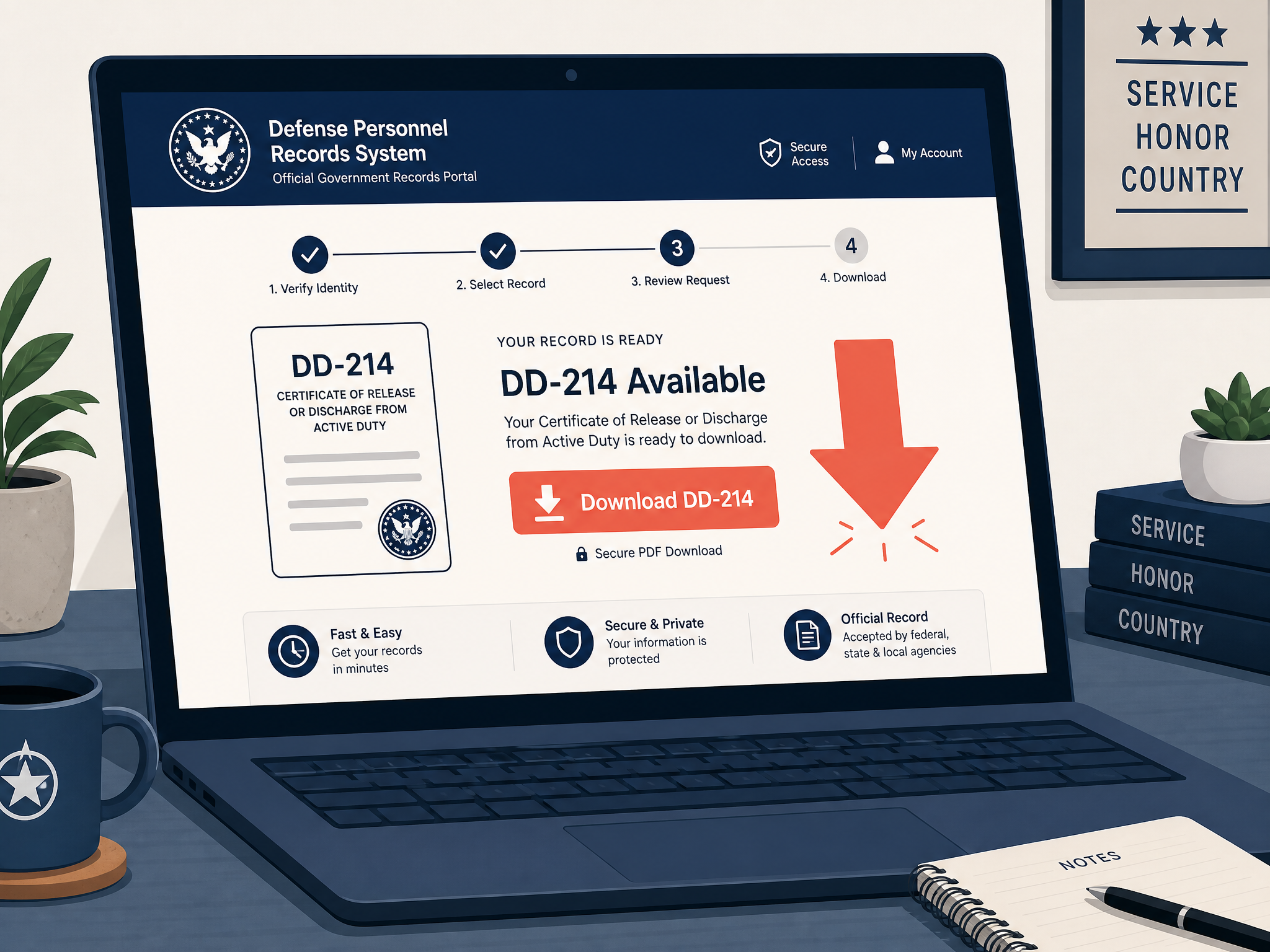
FIG. 01 - REQUEST ONLINE
Option 1 - Online (usually the fastest)
- 1If you separated recently, go to milConnect at milconnect.dmdc.osd.mil and sign in to download your DD-214 right away.
- 2For older records, use the National Archives eVetRecs system at archives.gov/veterans. Follow the on-screen questions.
- 3Create a free account, answer the questions about your service, and submit the request from your own computer.
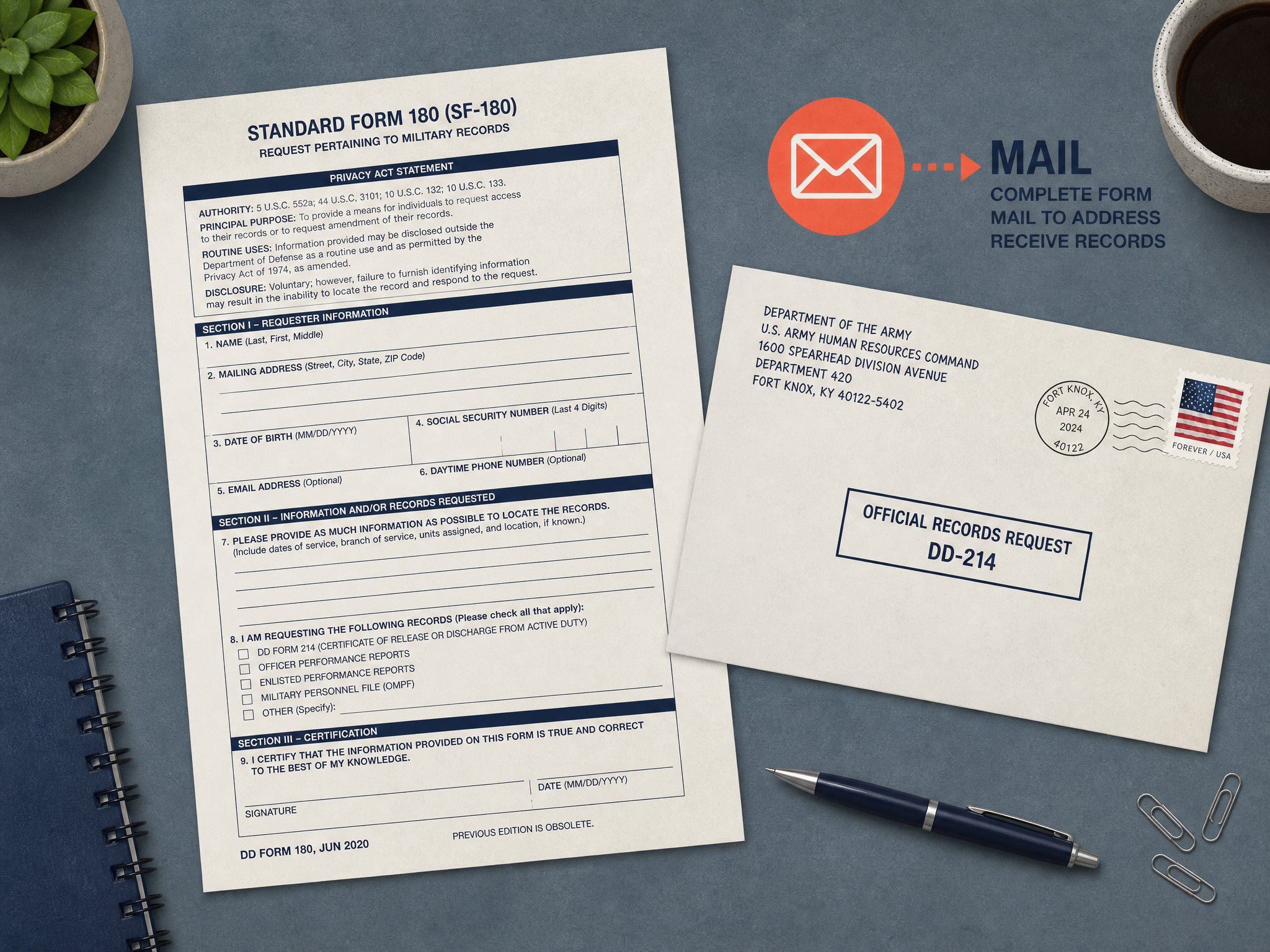
FIG. 02 - REQUEST BY MAIL
Option 2 - By mail or fax (Standard Form SF-180)
- 1Download Standard Form SF-180 (Request Pertaining to Military Records) from archives.gov. We can also mail you a paper copy.
- 2Fill it out (we show you exactly how, with a marked-up example, further down this page), then sign and date it. A signature is required.
- 3Mail or fax it to the National Personnel Records Center at the address and fax number printed on the form.
FIG. 03 - REQUEST BY PHONE
Option 3 - By phone or with our help
- 1Call the National Personnel Records Center at 314-801-0800, Monday to Friday, to ask questions or check on a request.
- 2Call the VA at 1-800-698-2411 (MyVA411) for general help finding any record.
- 3Or just start a free chat with us and we will walk you through it one step at a time.
Where to mail or fax your form
National Personnel Records Center
1 Archives DriveSt. Louis, MO 63138
Questions? Call them directly at 314-801-0800, Monday through Friday.
Planning a funeral with military honors? Tell them it is urgent - the records center offers faster, emergency service for burials.
What to have ready before you request
- The veteran full legal name used while in service
- Social Security number and date of birth
- Branch of service (Army, Navy, Air Force, Marines, Coast Guard, Space Force)
- Approximate dates of service (start and end)
- Service number, if it is different from the Social Security number (older records)
- For a deceased veteran: your relationship, plus the veteran date and place of death
Gather your medical evidence
Strong medical proof is what wins a disability claim. Here is how to collect it.
- Ask your VA doctor or use My HealtheVet at myhealth.va.gov to download your VA medical records.
- Request records from any private (non-VA) doctors and hospitals that treated the condition.
- Ask a doctor for a short letter (sometimes called a nexus letter) explaining how the condition is connected to your service.
- Collect "buddy statements" - short written notes from people who served with you or who see your condition day to day.
What every box on your DD-214 actually proves
Your DD-214 is the single most important document you own as a veteran, and almost every claim starts here. But the boxes are cramped and coded, and most people never learn what they mean. Here is a plain-language map of the ones that matter most, so you can find what the VA is actually looking for. If you cannot lay hands on your DD-214, do not worry, because we will show you exactly how to request a copy for free.
DD Form 214 - Certificate of Release or Discharge from Active Duty
1. Name (Last, First, Middle)
DOE, JOHN A.
2. Dept / Component & Branch
ARMY / RA
3. Social Security No.
xxx-xx-xxxx
4a. Grade / Rank
SGT / E-5
12. Record of Service
12a Entered AD
2004-06-14
12b Separated
2012-06-13
12c Net Active
08 00 00
12f Foreign Svc
02 04 00
13. Decorations, Medals, Badges, Citations & Campaign Ribbons
ARMY COMMENDATION MEDAL; COMBAT INFANTRYMAN BADGE; IRAQ CAMPAIGN MEDAL W/ CAMPAIGN STAR; ...
14. Military Education
WARRIOR LEADER COURSE (4 WKS, 2008); ...
18. Remarks
SERVED IN A DESIGNATED IMMINENT DANGER PAY AREA; DEPLOYED IRAQ 2007-2008; ...
24. Character of Service
HONORABLE
27. Reentry Code
RE-1
28. Narrative Reason for Separation
COMPLETION OF REQUIRED ACTIVE SERVICE
Illustration of a sample DD-214 (the "Member 4" copy - the one the VA wants, because it shows Block 24). Your form's box numbers match these; the values above are examples, not real data.
Branch & component
Block 2Shows which service you were in and whether it was active duty, Guard, or Reserve. That controls which benefits you qualify for and which agency holds your official file.
Your service dates & time
Block 12Proves exactly when and how long you served, plus any foreign service. This sets your wartime era - Vietnam, Gulf War, Post-9/11 - which drives pension eligibility and many presumptive claims.
Medals, badges & campaigns
Block 13The combat and location proof. A Combat Action Ribbon, Combat Infantryman Badge, Purple Heart, or a campaign medal (Vietnam Service, Iraq Campaign) shows where you were and whether you saw combat - central to PACT Act, Agent Orange, and burn-pit presumptions and to combat-related pay (CRSC).
Remarks - the fine print that wins claims
Block 18Read this box carefully. Lines like "SERVED IN A DESIGNATED IMMINENT DANGER PAY AREA" or listed deployment locations can establish toxic exposure and combat service the rest of the form never spells out.
Character of service - your eligibility key
Block 24"Honorable" or "General (Under Honorable Conditions)" opens the door to VA benefits. "Other Than Honorable" or worse may need a discharge upgrade or a Character of Discharge review first - do not assume you are shut out; ask.
Narrative reason for separation
Block 28Explains why you left. A medical or disability separation here points to conditions already documented in service - a real head start on proving a service-connected claim.
One honest word about exposure claims
Your exposure was never limited to your job title. It was driven by your unit, every place you were stationed or deployed, and every job you actually did. Blocks 13 and 18 are where those clues live - campaign medals and remarks that show where you really were. If your DD-214 hints at a location or a mission the VA has not connected yet, that is exactly the kind of thing worth having an accredited agent look at.
Do not keep the only copy in a drawer
A lost DD-214 can take weeks to replace. Scan it once and keep a copy in your free Document Vault, where a spouse or trusted person can reach it the day they need it.
Get your records released — the right way
Three short forms do almost all the record-gathering in a VA claim. The SF-180 pulls your military file, and VA Forms 21-4142 and 21-4142a let the VA request your private medical records for you. Below is each one, marked up so you can see exactly what goes where, with links to fill them out online or print them. None of this costs a dime, and once these are in, the VA does the legwork of chasing down your records.
Honest advice
Don’t just wait on the VA to gather your records
The 21-4142 lets the VA request your private medical records for you — and it is worth filing. But a VA record-pull can be slow, and slow records are the number-one reason a good claim stalls. Whenever you can, get your own copies too. Ask your VA doctor or use My HealtheVet for your VA records, and ask every private doctor and hospital for the records that show your condition.
Once you have them in hand, you have choices: give them to your accredited representative, drop them off at your local VA regional office, or take them to the Release of Information (medical records) desk at your VA medical center. Having these forms right here means you know exactly what information the VA needs — so you get a clean, complete record pull no matter where your records live.
Standard Form SF-180
Request Pertaining to Military Records — pulls your DD-214 and service file
Section I — Information needed to locate records
1. Name used during service (Last, First, Middle)
DOE, JOHN A.
2. Social Security No.
xxx-xx-xxxx
3. Date of Birth
1954-03-02
5. Branch of Service
ARMY
6. Service dates (from / to)
1972 - 1976
Section II — What you are requesting
1. Documents requested (check the boxes)
[x] DD FORM 214 [x] MEDICAL / HEALTH RECORDS
Section III — Requester
. Signature (required)
John A. Doe
. Date (within last year)
2026-07-14
Sample only — the box numbers match your real SF-180; the values are examples, not real data.
How to fill it out
- 1Section I — who the record belongs to. Enter the veteran’s full name used in service, Social Security number, and date of birth.
- 2Service details. Add the branch and the approximate dates of service. Close is fine if you are not certain.
- 3Section II — what you need. Check “DD Form 214,” and check “Medical / Health Records” if you want your service treatment records too.
- 4Section III — sign it. Sign in cursive and date it within the last year. For a deceased veteran, note your relationship and attach proof of death.
Where it goes: National Personnel Records Center, 1 Archives Drive, St. Louis, MO 63138 — or fax 314-801-9195. Planning a funeral with honors? Ask for emergency service (fax 314-801-0764).
VA Form 21-4142
Authorization to Disclose Information to the VA — lets the VA request your private medical records
Veteran’s identifying information
1. Veteran’s name (Last, First, Middle)
DOE, JOHN A.
2. Social Security No.
xxx-xx-xxxx
3. VA file / claim number
xxxxxxxxx
4. Date of birth
1954-03-02
. Authorization
I AUTHORIZE THE VA TO REQUEST MY RECORDS FROM THE PRIVATE PROVIDER(S) LISTED ON FORM 21-4142a
. Signature
John A. Doe
. Date signed
2026-07-14
Sample only — values are examples, not real data. Good for 12 months from the date you sign.
How to fill it out
- 1Match your VA identity. Enter your name, Social Security number, VA file/claim number, and date of birth exactly as the VA has them.
- 2Read the authorization. You are giving the VA permission to request your private (non-VA) records — physical and mental-health treatment (psychotherapy notes are not included).
- 3Sign and date it. Your signature makes it valid for 12 months. You can cancel it in writing to the VA at any time.
- 4Attach Form 21-4142a. This form must travel with the provider list below, or the VA cannot act on it.
Good to know: the VA cannot pay any fee a provider charges for copies. If a doctor’s office asks for money, gather those records yourself instead — or call us and we’ll help.
VA Form 21-4142a
General Release for Medical Provider Information — the list of who treated you
List every private provider (add a row for each)
1. Provider / hospital name & full address
VALLEY HEART CLINIC, 210 MAIN ST, LAS VEGAS, NV 89101
. Condition treated
HYPERTENSION
. Treatment dates (approx.)
2015 - PRESENT
2. Provider / hospital name & full address
DESERT VA COMMUNITY CARE, ...
. Condition treated
KNEE, LOWER BACK
. Treatment dates (approx.)
2019 - 2022
Sample only — values are examples, not real data.
How to fill it out
- 1Name each provider. Write the full name and address of every private doctor, clinic, or hospital that treated the condition.
- 2Say what and when. List the condition they treated and the approximate dates. Month and year are enough — you don’t need the exact day.
- 3One row per provider. Add a line for each place you were seen. If you run out of room, attach a second sheet.
- 4Send it with the 21-4142. The two forms work as a pair — submit them together.
Albert’s tip
Be surgical - don’t sign away access to everything
When you fill out the 21-4142 and 21-4142a, the real question is exactly what records you are giving the VA access to. Don’t take the lazy route and authorize a blanket “release everything about me.” List only the providers and the conditions tied to the benefit you are actually claiming.
A focused, targeted release gets you a clean record pull that points straight at the evidence you need. A scattershot “give them all of it” just buries the records that matter under years of unrelated visits - and slows your whole claim down. Think like a marksman, not a fire hose.
- List the providers who treated the condition you are claiming - not every doctor you have ever seen.
- Name the specific conditions, so the release points at the evidence that supports your claim.
- Remember it lasts 12 months and you can cancel it in writing anytime - you stay in control.
Four ways to turn in your 21-4142
Pick whichever is easiest for you. Online is the fastest way to get it on file.
Online (fastest)
Fill it out and submit right on VA.gov — no printing, no stamp. This is the quickest way to get it on file.
Upload a scan (QuickSubmit)
Already printed and signed it? Scan it and upload the PDF through the QuickSubmit tool at access.va.gov.
By mail
Mail the signed form to the VA Claims Intake Center, PO Box 4444, Janesville, WI 53547-4444.
In person
Hand it to a clerk at any VA regional office, or give it to your accredited representative to file for you.
Your privacy
Your privacy is protected by law
We know handing over medical records feels personal. It should. Two federal laws — the Privacy Act of 1974 and HIPAA — control how the VA collects, stores, and shares your information. The VA must give you a Notice of Privacy Practices, keeps your records in protected systems, and needs your written permission (this is what the 21-4142 is) before it requests records from outside doctors or shares your information with anyone else.
See and copy your records
You can look at and get copies of the records the VA keeps about you, including your medical file.
Fix what is wrong
If something in your record is incorrect or incomplete, you can ask (in writing to your facility’s Privacy Officer) to have it corrected.
See who it was shared with
You can request an accounting — a list of who the VA disclosed your information to and why.
Limit and cancel access
The authorization you sign lasts only 12 months, and you can cancel it in writing at any time.
The VA does not sell or rent your personal information, and VA.gov encrypts it in transit.
Read the VA’s privacy practicesNot sure which form you need?
You don’t have to figure this out alone. Tell us what records you’re after and we’ll point you to the right form — or fill it out with you. Call 702-992-4883.
The mock-ups above are simplified illustrations to show you what each form asks for. Always fill out the current official form from VA.gov or the National Archives using the buttons provided.
Who to call for your records
Keep these numbers handy, because you will reach for them more than once during a claim. You can tap any number on a phone to call it directly, and every call is free. These are official government and support lines, not middlemen or paid services. If you are not sure who to call first, start at the top of the list and they will point you the right way.

Two ways to move forward — both free
Can't find an important document?
Our free assistant can walk you through how to request your DD-214 and other records, step by step. Tell it what you already have and what is missing, and it will point you to the right form and office. If a request comes back denied or incomplete, we can help you figure out the next move. There is no cost to ask, and nothing you share here is ever sold or shared.
Have a question? Get free information
Ask a question, learn what you may be owed, or find out where you stand. Confidential, free, and no obligation to go any further.
Ready to hire us? Register
Decided you want us to work your claim? Registering is free — we match you with an accredited advocate and get you started. We cannot begin until you sign VA Form 21-22a, and fees, if any, are always disclosed up front.