
Veteran Benefits
How to File a VA Claim
The plain, start-to-finish sequence for filing a VA disability claim - the forms, the evidence, the C&P exam, and the timeline - so you file it once and file it right.
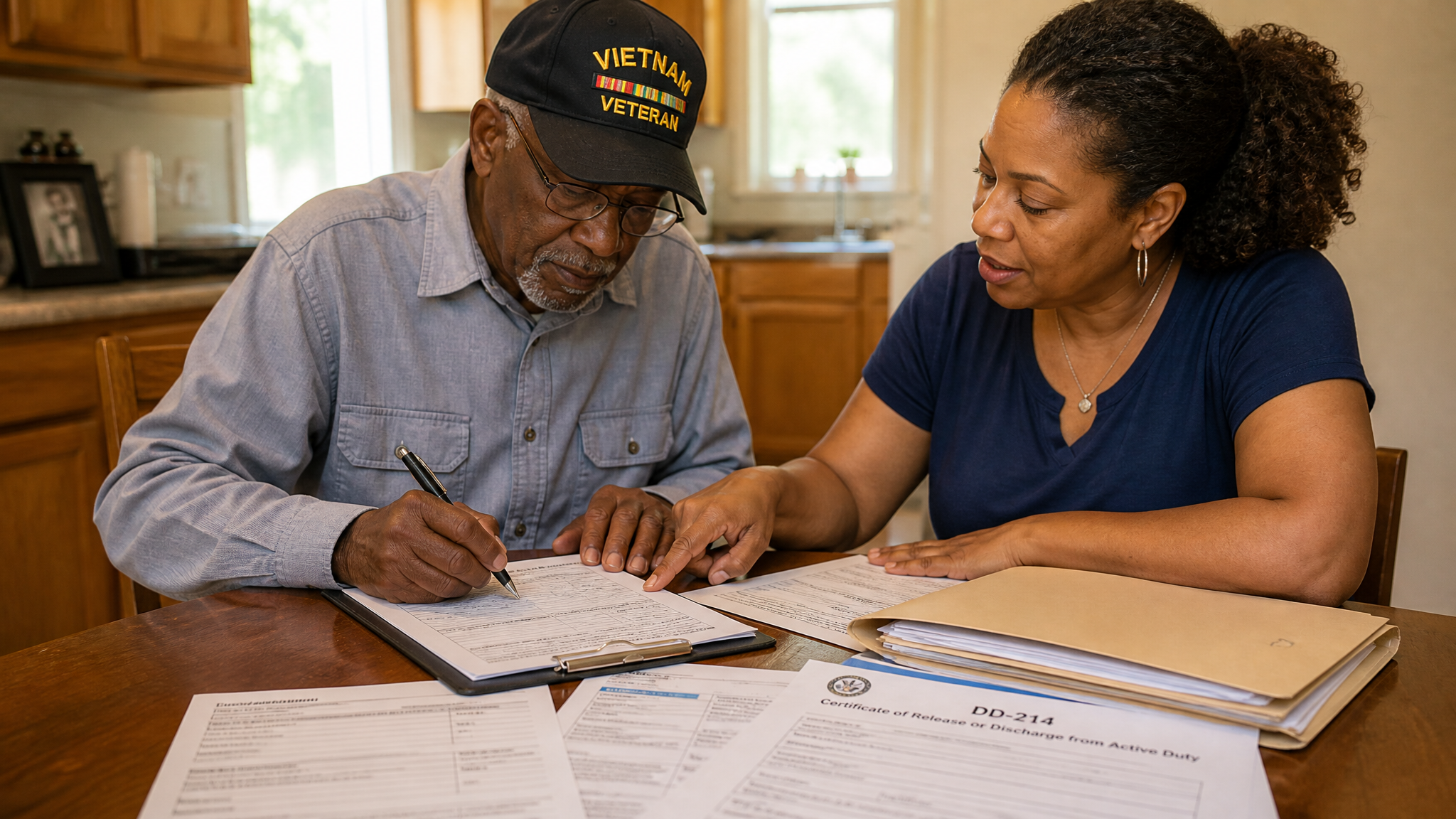
Who this is for
Filing a VA claim is not complicated once someone lays it out in order - it is just that nobody ever does. Here is the whole sequence, start to finish, in plain English: the one form that protects your back pay, the evidence that actually wins, and the exam you must not miss.
In plain language
What How to File a VA Claim covers
- The exact forms: Intent to File (21-0966) and the claim itself (21-526EZ)
- How to lock in your effective date and protect your back pay before you are even ready
- Fully Developed Claim vs. standard claim - which is faster and why
- What a C&P exam is, how to prepare, and why you must show up
- The realistic timeline, and what happens after the decision letter arrives

VA Disability Claims for Burn Pits, Agent Orange, and More (PACT Act)Official video - U.S. Department of Veterans Affairs - theSITREP
5 things most veterans aren't aware of
These apply to nearly every VA claim - and they change how much you get and when.
Your filing date sets your back pay
Benefits are generally paid back to the day you file - not the day you are approved. Filing an intent to file today can protect months, even years, of retroactive pay.
One condition can trigger others (secondary claims)
A service-connected condition that causes another - like sleep apnea from PTSD, or a bad knee from a bad hip - can be rated on its own. Each secondary condition adds to your rating.
A medical nexus is what wins the claim
The VA needs a documented link between your condition and your service. A clear nexus opinion is often the difference between an approval and a denial.
Accredited help is free to file an initial claim
By law, an accredited agent cannot charge a fee to prepare and file your original claim. If someone asks for money up front to file, that is a red flag.
A denial is not the end of the road
You have three appeal lanes - Higher-Level Review, a Supplemental Claim with new evidence, and the Board of Veterans Appeals. Many denials are overturned on review.
The full picture
Everything you need to know
Nothing hidden behind a click, and nothing you have to go looking for on another website. Here is the whole story in plain language - the facts and the figures first - so you can decide what fits your situation.
Key facts & current figures
- File an Intent to File (VA Form 21-0966) first - it locks in your effective date for up to a year, so back pay can reach all the way back to the day you filed it.
- The claim itself is VA Form 21-526EZ. Filing it costs nothing, and by law no one may charge you a fee to file an initial claim.
- A Fully Developed Claim - where you send all your evidence up front - is usually decided faster than a standard claim where the VA has to go gather records itself.
- You almost always get a C&P exam (Compensation & Pension exam). It is free, it is not a trap, and missing it is the fastest way to a denial.
- Average time to a decision runs roughly 4 to 5 months, though a clean, well-documented claim can move faster and a complex one slower.
General figures, current as of December 2025 and reviewed each year. Your exact amount depends on your situation - always confirm on va.gov.
Step 1: File an Intent to File and stop the clock
- Before you have a single document ready, file an Intent to File (VA Form 21-0966). It tells the VA you are coming, and it locks in your effective date for up to one year.
- This matters more than almost anything else, because your back pay is calculated from your effective date. File the Intent to File today, take four months to gather evidence, and your eventual award still reaches back to today.
- You can file it online, by phone at 1-800-827-1000, or on paper. It takes minutes and it is the single most valuable free move in the whole process.
Step 2: Gather the evidence that actually decides claims
- Your DD-214 (discharge papers), which proves your service and character of discharge.
- Medical evidence showing you have the condition now - VA records, private doctor records, test results, prescriptions.
- Evidence the condition is connected to service - service treatment records, the incident that caused it, or a doctor's written opinion (a "nexus" statement) linking the two.
- Buddy statements (VA Form 21-10210) from people who served with you or who see how you live now. These are powerful and badly underused - a spouse, a battle buddy, or an adult child describing what they witnessed can carry a claim.
Step 3: File the claim - and choose the faster lane
- The claim is VA Form 21-526EZ. File it online at va.gov, by mail to the Evidence Intake Center, or with a free accredited Veterans Service Officer.
- If you send all of your evidence at the same time, you are filing a Fully Developed Claim (FDC). You are telling the VA it does not need to go chase records - everything is already here.
- A standard claim, by contrast, puts the VA in charge of gathering federal records, which adds time. The FDC lane is almost always faster when your evidence is already in hand.
- List every condition you are claiming, and do not leave off the "smaller" ones. Tinnitus, sleep apnea, and mental-health conditions are among the most commonly missed.
Step 4: The C&P exam - show up, and be honest
- Most claims trigger a Compensation & Pension exam (C&P). The VA schedules it, it is completely free, and a provider evaluates the condition you claimed.
- Describe your worst days, not your best ones. Veterans instinctively downplay their symptoms out of pride - and the exam is not the place for it. Be honest about how the condition affects your work, your sleep, and your daily life.
- Do not miss it. A missed C&P exam is one of the fastest routes to a denial. If you truly cannot make the date, call and reschedule rather than simply not going.
- You never pay for a C&P exam. If a VA facility ever bills you for one, that is an error - call the billing office and have it reversed.
Step 5: The decision, the timeline, and what comes next
- Expect a decision in roughly 4 to 5 months on average. You can track it in your va.gov account, where the claim moves through stages you can watch.
- When the decision letter arrives, read it carefully. It states your rating for each condition, your effective date, and your monthly amount - and it explains exactly how to challenge it if you disagree.
- If you are denied or under-rated, that is not the end of the road - you have three separate review options, and you have one year to use them. See the VA Appeals Process page for the full breakdown.
- If you win, confirm the VA has your dependents on file (a spouse, children, or dependent parents can raise your monthly amount at 30% and above) and that your direct deposit is set up.
The evidence that actually wins the claim
Filing the form is the easy part, and most people are surprised to hear that. Claims are won or lost on the evidence behind them, not on the application itself. These three guides walk you through the pieces that decide most claims, in plain language and step by step. Get these right and you give yourself the best possible shot at the rating you deserve.



This is where most veterans lose money
When you file matters more than you think
Health care, compensation, and every dollar the VA owes you all start on a date - and that date is set by a single form filed on time, not by how strong your case is when you finish. Older veterans lose thousands every year simply because nobody told them to plant a flag in the ground first. Here is exactly how the timing works, what to gather, and how to find out whether you already have a claim in motion.
File something TODAY
The single most expensive mistake is waiting. The day the VA receives your Intent to File is the day your effective date is locked - and your back pay is counted from that date, not the day you finish gathering evidence.
You then have 12 months
An Intent to File holds your place for one full year. That gives you time to collect records and build your case while your effective date keeps counting. Miss the 12-month window and you start over at a later date - and lose every month of back pay in between.
PACT Act deadlines still matter
Toxic-exposure enrollment and many PACT Act filing windows are time-sensitive. If you served in a covered location, do not assume the door stays open forever - lock your date now and sort out the details after.
What information you need to gather
You do not need all of this before you file - file first, then collect. But this is the evidence that decides how fast your claim moves and how high it rates:
- Your DD-214 (or other separation documents) - proof of service and character of discharge.
- Your service treatment and personnel records - what happened to your body while you served.
- Current medical records and a list of your diagnoses - what you are being treated for now.
- Any private doctor notes, imaging, or test results that connect a condition to your service.
- For health care enrollment: recent household income information (this affects your priority group, not whether you qualify).
Not sure if you already have an active claim?
Many older veterans have a claim that was started years ago - by themselves, a family member, or a service organization - and never realize it is still open, denied, or waiting on evidence. We can find out for you.
To pull your file and check your claim status, the VA requires written authorization. You sign a VA Form 21-22a, appointing an accredited agent to represent you - then we look directly into your VA record, tell you exactly what is there, and what your next move should be. No guessing, no waiting on hold.
Albert L. Thombs Jr., VA Accredited Claims Agent #45147. Checking your status is free, and by law you are never charged to file an initial claim.
Your complete benefit picture
You do not have to sort this out alone
You can file an initial claim entirely yourself, for free. No accredited agent or attorney may charge you to file an initial claim - fees are only ever allowed later, after the VA has issued its first decision on the claim. Anyone asking for money to file your first claim is breaking the law.

Two ways to move forward — both free
Not sure if this applies to you?
Ask our free assistant a few plain questions and get an honest read on what you and your family may qualify for, at no cost. It takes just a few minutes, and there is no sign-up and no obligation of any kind. You will get a clear, plain-language picture of where you stand and what might be worth filing. And if you would rather talk to a real person, an accredited agent is only a message away.
Have a question? Get free information
Ask a question, learn what you may be owed, or find out where you stand. Confidential, free, and no obligation to go any further.
Ready to hire us? Register
Decided you want us to work your claim? Registering is free — we match you with an accredited advocate and get you started. We cannot begin until you sign VA Form 21-22a, and fees, if any, are always disclosed up front.
Worth knowing
Before you file, keep this in mind
You can file an initial claim entirely yourself, for free. No accredited agent or attorney may charge you to file an initial claim - fees are only ever allowed later, after the VA has issued its first decision on the claim. Anyone asking for money to file your first claim is breaking the law.
A clear path forward
Your step-by-step action plan
No rush and no pressure - but a little order helps. Applying is always free.
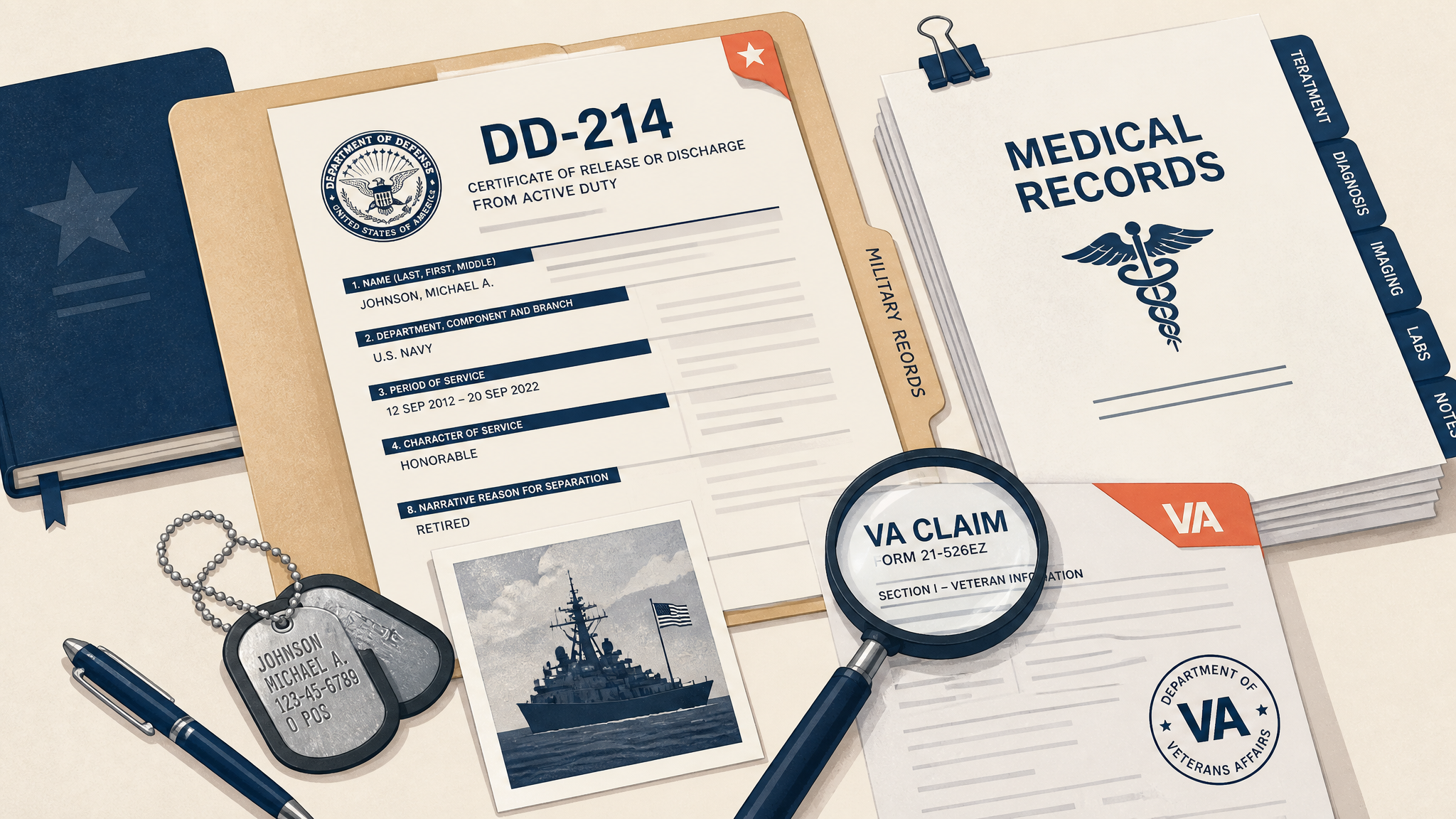
FIG. 01 - Gather your paperwork
Day 1 - file today
File your Intent to File
Submitting an Intent to File locks in your effective date and gives you a full year to complete the claim. Any back pay is figured from this date - so file it the moment you decide to move, even before you have gathered a single record.
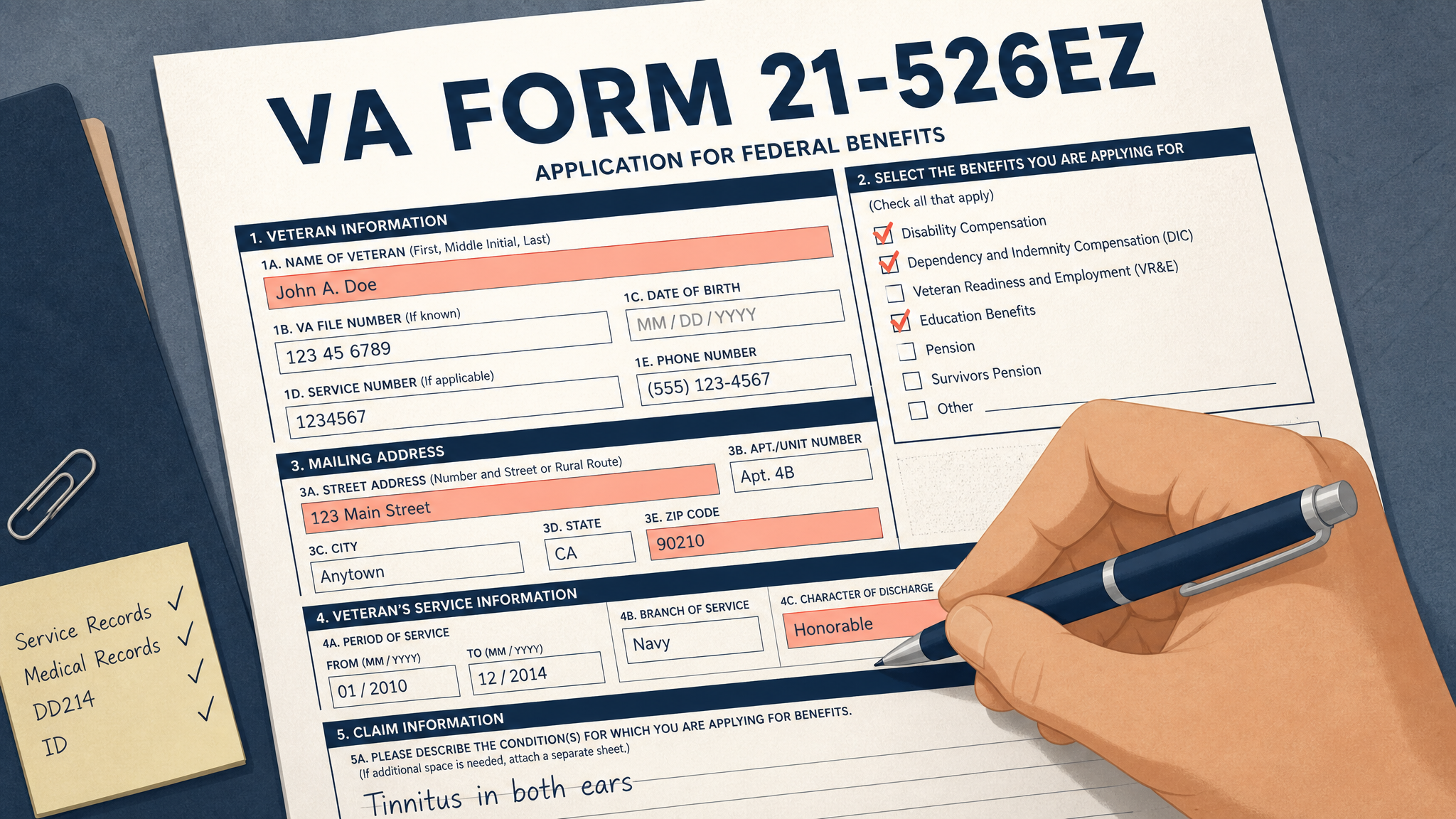
FIG. 02 - Fill out the form
Week 1-2
Request your service records
Order your Official Military Personnel File and DD-214 from the National Archives (the National Personnel Records Center) at no cost, or have an accredited agent pull them for you. These records prove where and when you served.

FIG. 03 - File the claim
Week 1-6
Start collecting your medical records
Gather your VA and private treatment records and a current diagnosis for every condition you plan to claim. Start early - private offices often take several weeks to release records.
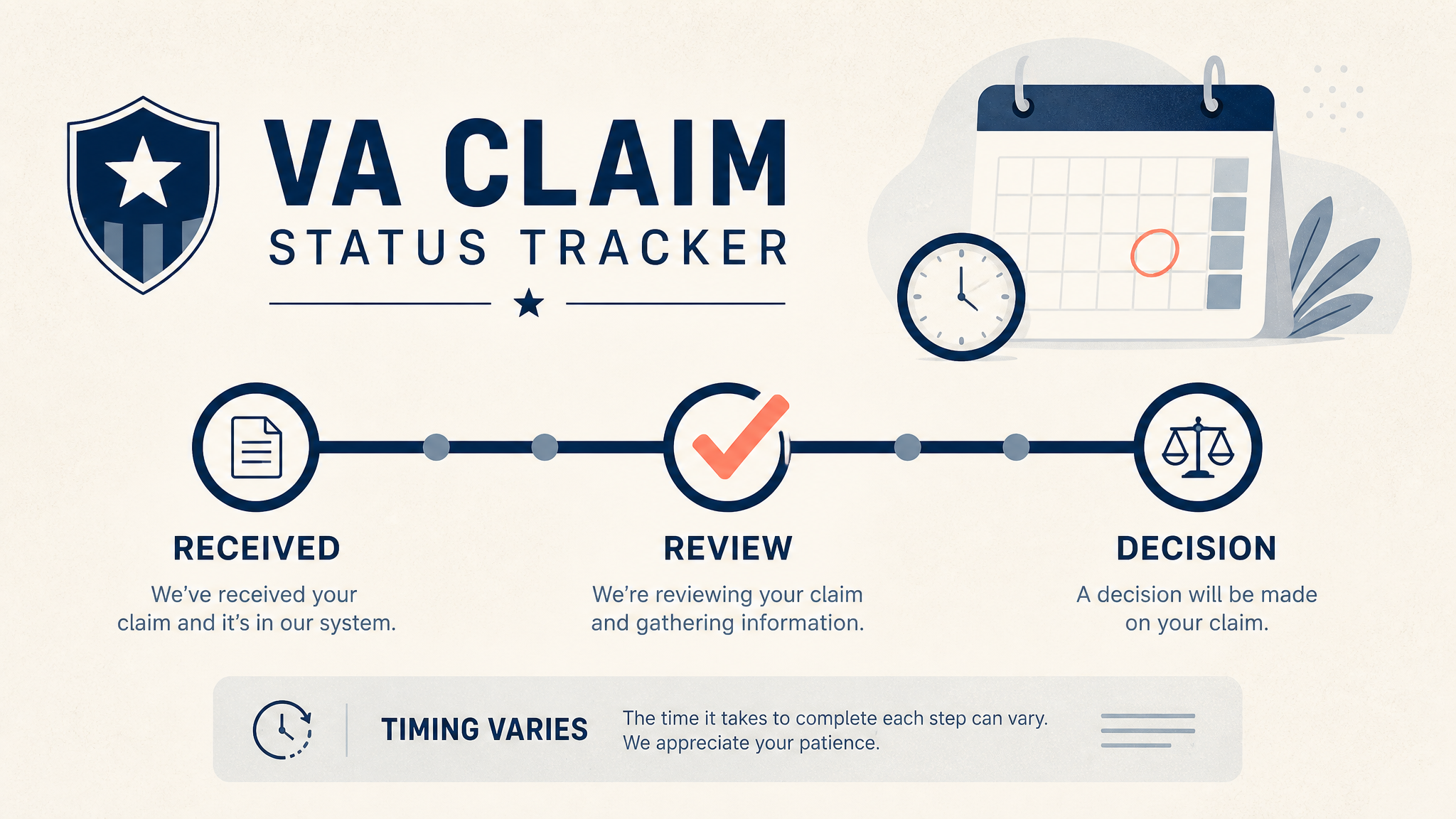
FIG. 04 - After you file
Month 2-3
Build the connection to service
Tie each condition to your service with a nexus - a supporting doctor statement, buddy statements, or your own written account. This link is what turns a diagnosis into a granted claim.
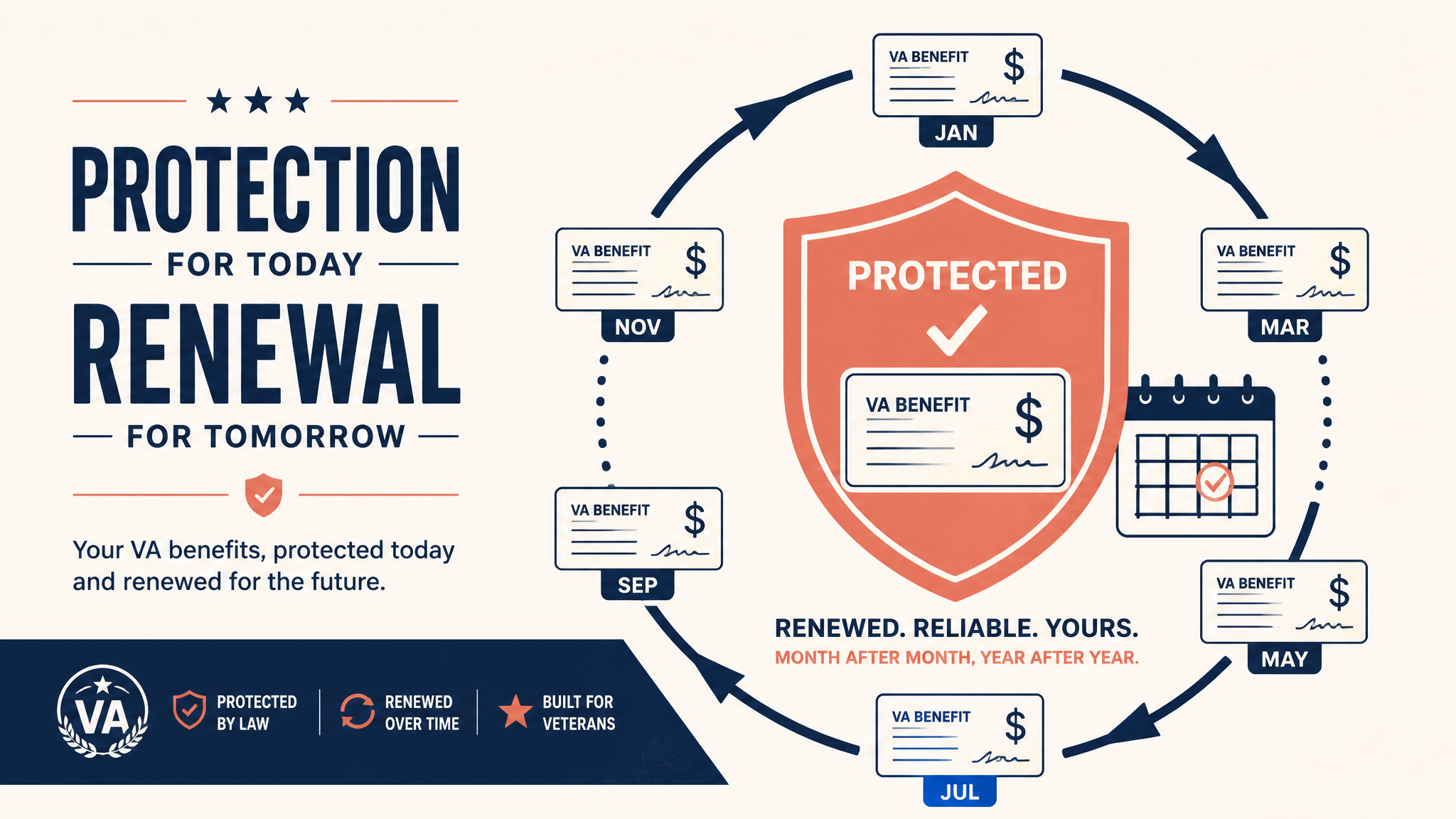
FIG. 05 - Keep it working
Within 1 year of your Intent to File
File VA Form 21-526EZ
File before your one-year Intent-to-File window closes so back pay runs all the way to Day 1. Claim every condition at once - your combined rating is built from all of them together.
FIG. 06 - Gather your paperwork
After you file
Go to your C&P exam and track the claim
Attend any Compensation & Pension exam the VA schedules - missing it can sink the claim. Then watch your status on VA.gov, and if you are denied, use a Supplemental Claim, Higher-Level Review, or Board Appeal.
Who to call & where to go
These are free, official VA lines. Have your Social Security number handy when you call.
MyVA411 - Main VA Line
Not sure who to call? Start here. One number for anything VA - they route you to the right office.
VA Benefits Hotline
Compensation, pension, and general claim questions.
Rather have us handle it?
No phone tag, no hold music. Call our office and a real, VA-accredited person walks you through it - start to finish.
702-992-4883Not sure where to start?
Start with an Intent to File, gather your DD-214 and medical evidence, then file VA Form 21-526EZ online at va.gov, by mail, or with a free accredited representative. Send your evidence with the claim if you can - that is what turns it into a faster Fully Developed Claim.
More benefits for veterans
These often go hand in hand - tap any card to learn more.


































Free information — get a free benefit review
Tell us how to reach you and an accredited team member will help you understand this benefit and claim everything you have earned. No cost, no obligation.
Ready to hire us? Register with us
For veterans who’ve decided they want us on their claim — registering is free too, and it does not make you our client or obligate you to anything. Here is exactly how it works:
- You register. This simply starts the conversation — you are not our client yet, and you owe us nothing.
- You sign and return VA Form 21-22a. It appoints us as your accredited representative and gives us access to your VA file.
- Once we have your signed 21-22a and access to your case, we verify everything is in order.
It involves the registration form and signing VA Form 21-22a — by law we can’t accept your claim, work on it, or contact the VA for you until that power of attorney is signed. You decide whether to move forward.
Official VA links
Answers, in plain language
Common questions about How to File a VA Claim
What is How to File a VA Claim?
The plain, start-to-finish sequence for filing a VA disability claim - the forms, the evidence, the C&P exam, and the timeline - so you file it once and file it right.
Who qualifies for How to File a VA Claim?
This benefit is generally for: Veteran. The exact forms: Intent to File (21-0966) and the claim itself (21-526EZ) How to lock in your effective date and protect your back pay before you are even ready
How do I apply for How to File a VA Claim?
Start with an Intent to File, gather your DD-214 and medical evidence, then file VA Form 21-526EZ online at va.gov, by mail, or with a free accredited representative. Send your evidence with the claim if you can - that is what turns it into a faster Fully Developed Claim.
What does it cost to get help with How to File a VA Claim, and are you VA-accredited?
You can file an initial claim entirely yourself, for free. No accredited agent or attorney may charge you to file an initial claim - fees are only ever allowed later, after the VA has issued its first decision on the claim. Anyone asking for money to file your first claim is breaking the law. It is free to talk with us, and no one may charge you to file a first-time VA claim. The Aging Veteran is led by Albert L. Thombs Jr., a VA-accredited claims agent (accreditation #45147) and disabled veteran; any appeal work is handled on a no-fee-unless-you-win basis. We are an independent accredited practice and are not affiliated with, or endorsed by, the U.S. Department of Veterans Affairs.