
Veteran Benefits
VA Disability & Social Security (SSDI/SSI) Together
Two of the largest benefits an older or disabled veteran can hold are VA disability compensation and Social Security - and you are allowed to receive both. But they follow completely different rulebooks: one looks at your service-connected conditions, the other at your work history and your ability to work at all. Knowing how they fit together - and where SSI is different - can protect thousands of dollars a year.
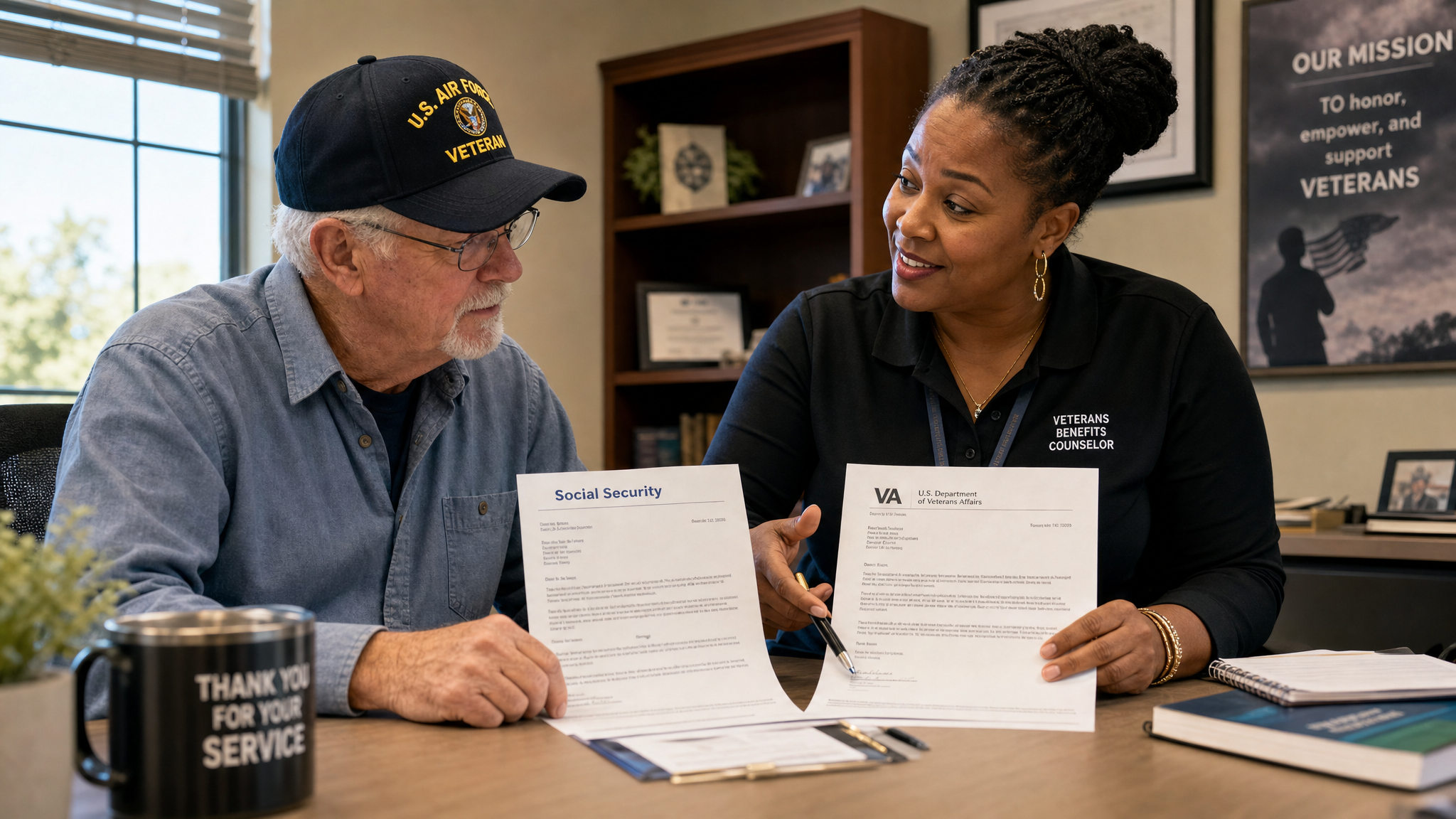
Who this is for
VA compensation and Social Security are two of the biggest checks an older or disabled veteran can receive - and you are entitled to both. The trap is assuming a 100% VA rating automatically means Social Security says yes. It does not, but it does move you to the front of the line.
In plain language
What VA Disability & Social Security (SSDI/SSI) Together covers
- Getting VA compensation and Social Security at the same time
- How SSDI differs from needs-based SSI
- Expedited Social Security processing for 100% P&T veterans
- Why a VA rating does not automatically mean SSA approval

VA & Social Security CoordinationOfficial video - U.S. Dept of Veterans Affairs
5 things most veterans aren't aware of
These apply to nearly every VA claim - and they change how much you get and when.
Your filing date sets your back pay
Benefits are generally paid back to the day you file - not the day you are approved. Filing an intent to file today can protect months, even years, of retroactive pay.
One condition can trigger others (secondary claims)
A service-connected condition that causes another - like sleep apnea from PTSD, or a bad knee from a bad hip - can be rated on its own. Each secondary condition adds to your rating.
A medical nexus is what wins the claim
The VA needs a documented link between your condition and your service. A clear nexus opinion is often the difference between an approval and a denial.
Accredited help is free to file an initial claim
By law, an accredited agent cannot charge a fee to prepare and file your original claim. If someone asks for money up front to file, that is a red flag.
A denial is not the end of the road
You have three appeal lanes - Higher-Level Review, a Supplemental Claim with new evidence, and the Board of Veterans Appeals. Many denials are overturned on review.
Both at once
You can draw VA compensation and Social Security together
No SSDI offset
VA pay does not reduce your Social Security Disability benefit
100% P&T = fast
A permanent and total rating triggers expedited SSA processing
The full picture
Everything you need to know
Nothing hidden behind a click, and nothing you have to go looking for on another website. Here is the whole story in plain language - the facts and the figures first - so you can decide what fits your situation.
Key facts & current figures
- You can receive VA disability compensation and Social Security at the same time - they are separate programs with different rules, and neither one bars the other.
- VA compensation does not reduce Social Security Disability Insurance (SSDI), which is based on your work history, not your income.
- Supplemental Security Income (SSI) is needs-based, so VA compensation counts as income and can lower or end an SSI payment - but not SSDI.
- A 100% Permanent & Total VA rating qualifies you for expedited SSDI/SSI processing - write "Veteran 100% P&T" in the Remarks and send your VA award letter.
- Social Security uses its own definition of disability (you cannot do substantial work for 12+ months), so a 100% VA rating helps but does not guarantee SSA approval.
General figures, current as of December 2025 and reviewed each year. Your exact amount depends on your situation - always confirm on va.gov.
You can hold both at once
- VA disability compensation pays for service-connected conditions; Social Security disability pays because you cannot work. They are independent, and receiving one does not disqualify you from the other.
- SSDI (Social Security Disability Insurance) is based on the work credits you earned paying into Social Security. VA compensation does not offset SSDI - you keep both in full.
- When you reach full retirement age, SSDI simply converts to Social Security retirement at the same amount; your VA compensation continues unchanged.
SSDI vs. SSI - an important difference
- SSDI is an earned, insurance-type benefit tied to your work history and is not reduced by VA compensation.
- SSI (Supplemental Security Income) is a needs-based program with strict income and asset limits. A VA payment counts as unearned income and can lower or eliminate an SSI check.
- Some veterans qualify for SSDI, some for SSI, and a few for a small amount of both - which one applies depends entirely on your work record and finances.
Expedited processing for severe disabilities
- Veterans with a 100% Permanent & Total VA rating get priority, expedited handling of an SSDI or SSI claim - decisions can come in weeks rather than many months.
- To trigger it, identify yourself as "Veteran 100% P&T" in the application's Remarks (or tell the representative) and provide your VA notification letter.
- A separate Wounded Warrior expedite covers veterans who became disabled on active duty on or after October 1, 2001, regardless of their rating percentage.
Why the two decisions can differ
- SSA has its own definition of disability: a severe, medically documented impairment that keeps you from substantial gainful work and is expected to last at least 12 months or result in death.
- A high VA rating is helpful evidence but not automatic approval - it is possible to be 100% from the VA yet denied by SSA, or the reverse.
- If you hire someone to help with a Social Security appeal, the fee is limited by law (a percentage of back pay up to a federal cap), and accredited VSOs can help line the two claims up.
The fear I hear most
Will taking VA disability shrink your Social Security?
I hear it constantly. A veteran is sure that if he claims his VA disability, Social Security will quietly cut his check to make up for it. It does not work that way. These are two separate systems with two separate rulebooks, and one does not reach into the other. You are entitled to both - in full.
There may be money you never claimed. Your years in uniform can add special earnings to your Social Security record and raise your monthly check - but only if the service is on your record. More on that below.

“If I take my VA disability, they will dock my Social Security.”
No. VA disability compensation and Social Security are separate programs. SSDI and Social Security retirement are based on your work record, not your income - your VA check does not reduce either one.
“I have to pick one or the other - I cannot draw both.”
You can hold both in full at the same time. Millions of veterans collect VA compensation and Social Security together, month after month, with no offset.
“My 100% rating means Social Security will automatically approve me.”
Not automatic - Social Security uses its own test. But a 100% Permanent & Total rating moves you to the front of the line for expedited processing, so a decision comes far faster.
Three different checks - and only one is affected by your VA pay
“Social Security” is really three programs. Knowing which one you are asking about is the whole ballgame, because two of them ignore your VA money completely.
Earned by working
SSDI - Disability Insurance
- Based on the work credits you paid into Social Security
- You keep your full VA check and your full SSDI check
- A 100% P&T rating gets you expedited handling
Based on need
SSI - Supplemental Security Income
- A needs-based program with strict income and asset limits
- Your VA payment counts as income and can reduce the SSI check
- Some veterans get a small SSI amount on top of SSDI
At retirement age
Social Security Retirement
- When you reach full retirement age, SSDI simply converts to retirement
- The amount stays the same - just a different name for the check
- Your VA compensation continues in full, unchanged
The extra credits most veterans never claim
For decades, the government added special earnings to the Social Security records of people who served. Those extra credits can raise your monthly benefit for the rest of your life - but for service before 1968, they are only added when you speak up and prove your service.
Tell Social Security you served and show your DD-214. It costs nothing to ask, and it can mean a bigger check every single month.
1957 - 1977
An extra $300 in earnings is added for each quarter (3 months) you were on active duty.
1978 - 2001
An extra $100 is added for every $300 of active-duty basic pay, up to $1,200 more per year.
After January 2002
The extra credits were discontinued - service after this date does not add special credits.
For your spouse and family
A survivor can receive Social Security AND VA benefits
When a veteran passes, a surviving spouse is often told to choose. That is wrong. Social Security survivor benefits and VA survivor benefits (called DIC) are separate - your family can qualify for both at the same time. Do not leave one on the table because someone assumed they cancel each other out.
Social Security survivor
Based on the veteran's work record - paid by Social Security.
VA DIC
A tax-free monthly VA payment - paid on top of Social Security.
How to find out what you are owed
You do not need a lawyer to check. Three simple steps tell you what your Social Security is worth and whether your military service is properly counted.

FIG. 01 - Open your account
Open your my Social Security account
A free online account shows your estimated monthly benefit and lets you apply. Set it up at ssa.gov/myaccount - a family member can sit with you and help.
Online: ssa.gov/myaccount
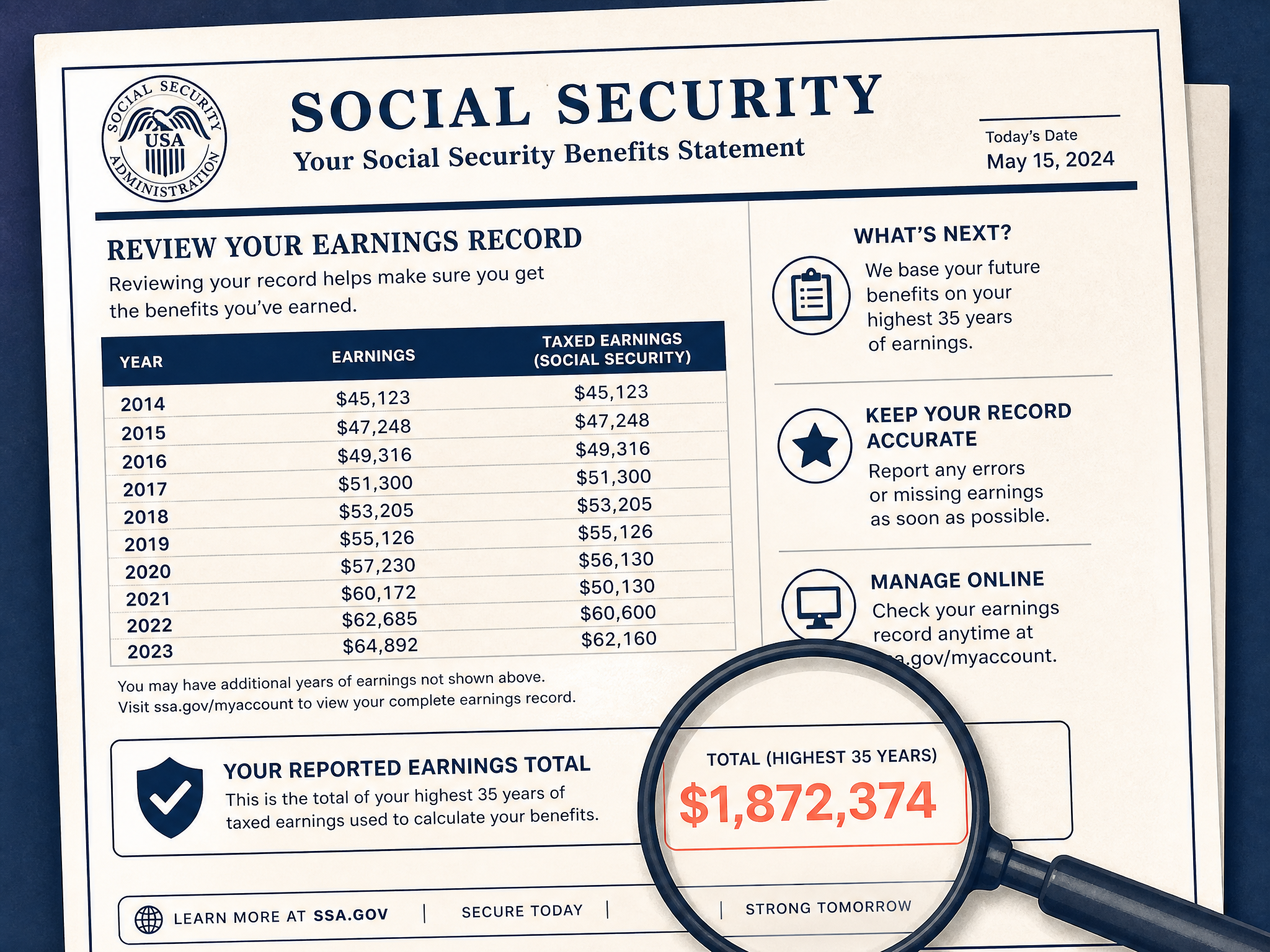
FIG. 02 - Check your record
Check your earnings record
Look at the year-by-year earnings on your statement. If your active-duty years look low or blank, your military service may not be credited - and that lowers your check.
Bring your DD-214 as proof of service
FIG. 03 - Call and ask
Call Social Security directly
The VA cannot file this for you. Call Social Security, and if you are rated 100% Permanent & Total, ask for expedited processing and say “Veteran 100% P&T.”
Social Security: 1-800-772-1213
Not sure how your VA benefits and Social Security fit together?
Tell me what you are receiving now and where you are worried. I will walk you through exactly what you can hold at the same time, what a survivor can claim, and how to make sure your service is counted. No charge to ask.
Your complete benefit picture
Two systems, two checks
VA disability compensation and Social Security are separate programs, and you can receive both at the same time. VA pay never reduces SSDI, which is based on your work history. Only needs-based SSI counts your VA income. Confirm the current rules with SSA before you file.

Two ways to move forward — both free
Not sure if this applies to you?
Ask our free assistant a few plain questions and get an honest read on what you and your family may qualify for, at no cost. It takes just a few minutes, and there is no sign-up and no obligation of any kind. You will get a clear, plain-language picture of where you stand and what might be worth filing. And if you would rather talk to a real person, an accredited agent is only a message away.
Have a question? Get free information
Ask a question, learn what you may be owed, or find out where you stand. Confidential, free, and no obligation to go any further.
Ready to hire us? Register
Decided you want us to work your claim? Registering is free — we match you with an accredited advocate and get you started. We cannot begin until you sign VA Form 21-22a, and fees, if any, are always disclosed up front.
Use the expedited lane
A 100 percent P&T rating puts your SSA claim on the fast track
Social Security expedites disability claims for veterans rated 100 percent permanent and total. Write "Veteran 100% P&T" in the remarks and attach your VA award letter when you apply.
A separate Wounded Warrior process expedites claims for service members who became disabled while on active duty on or after October 1, 2001.
Different definitions
SSA uses its own all-or-nothing definition of disability, so a VA rating does not guarantee approval - but the VA evidence strongly supports your case.
SSDI versus SSI
VA compensation has no effect on work-based SSDI, but it does count as income against needs-based SSI.
A clear path forward
Your step-by-step action plan
No rush and no pressure - but a little order helps. Applying is always free.
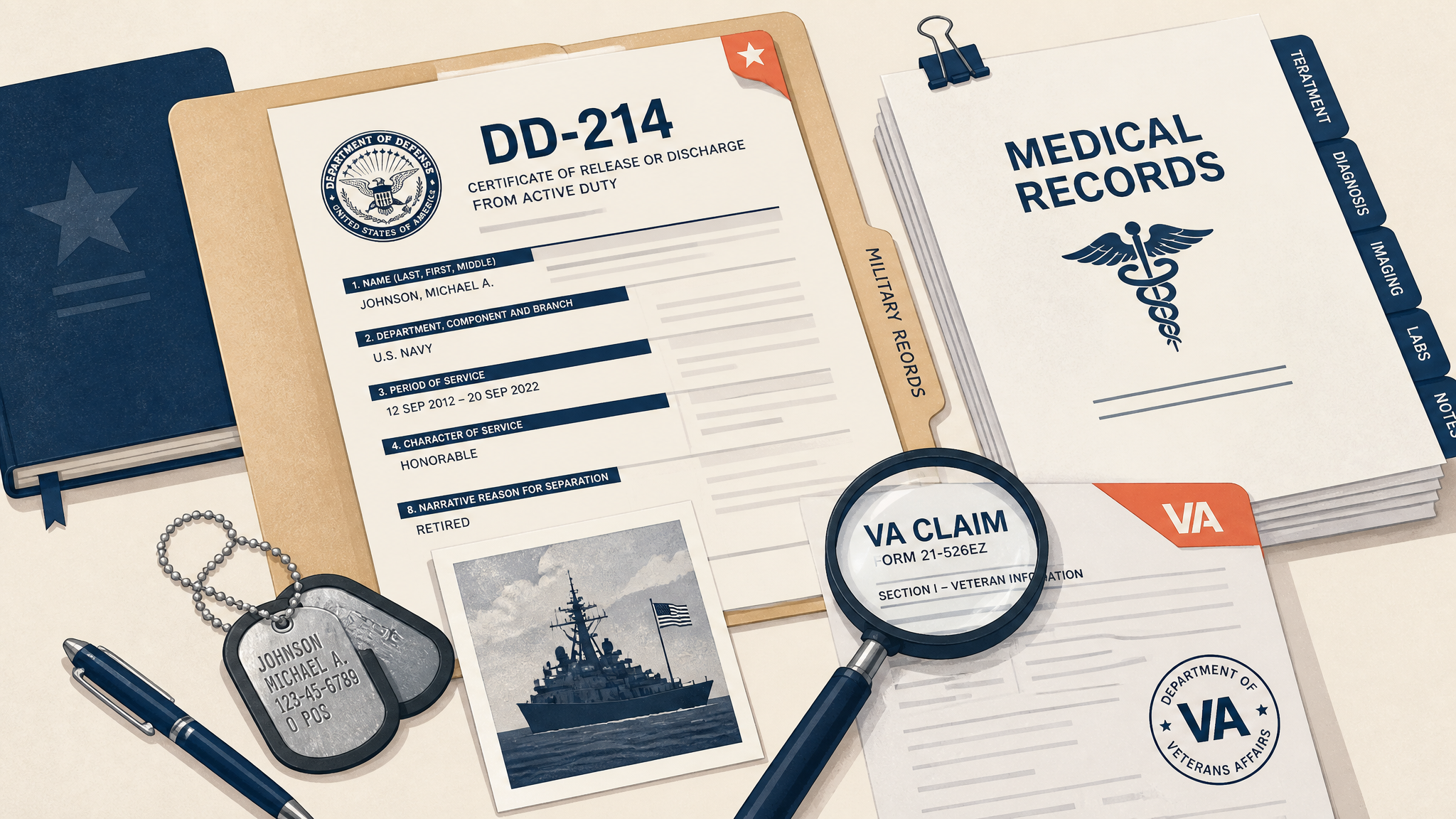
FIG. 01 - Gather your paperwork
First
Know which program fits
Decide whether you are seeking work-based SSDI or needs-based SSI, since VA income only affects SSI.
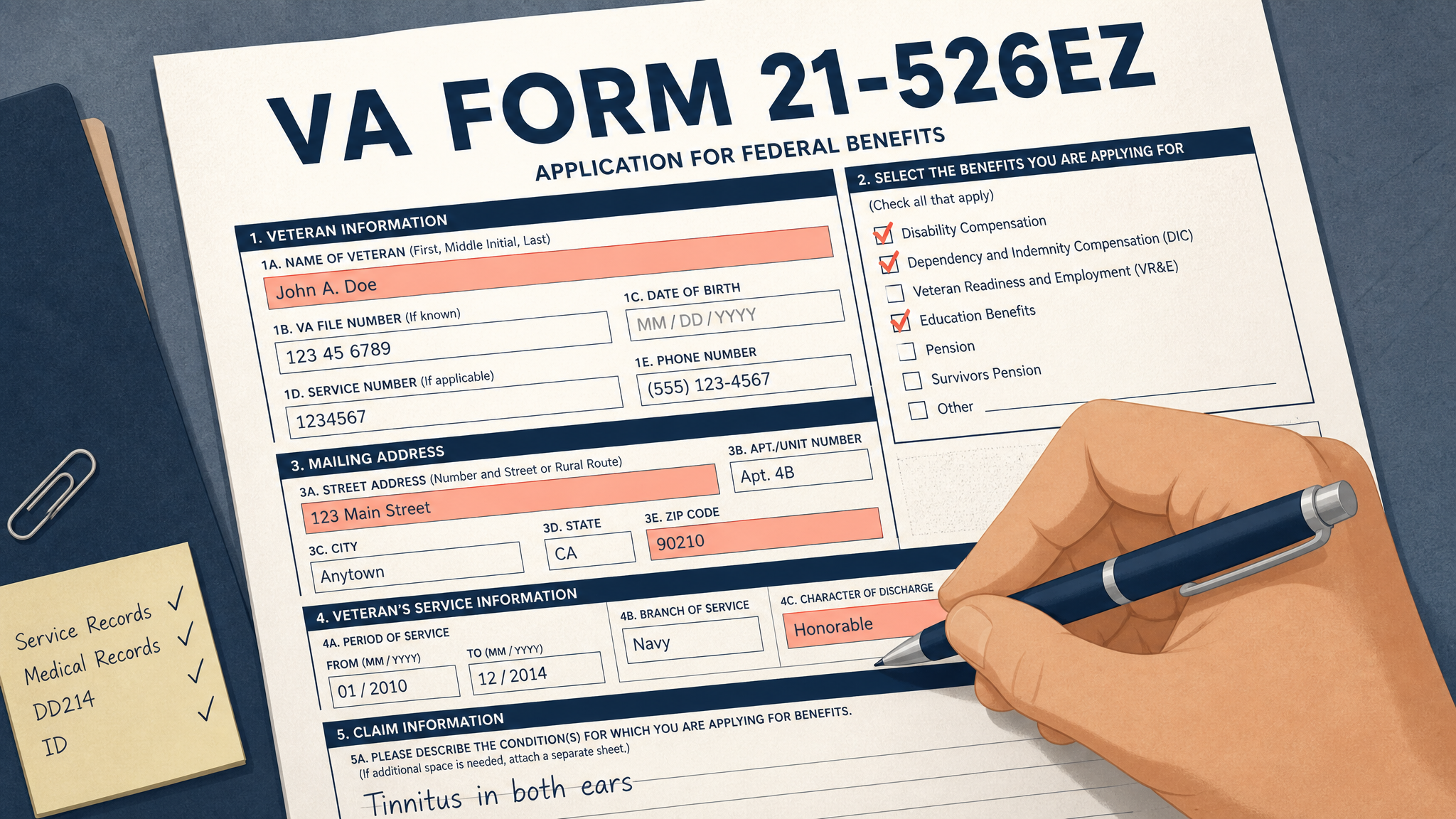
FIG. 02 - Fill out the form
Flag it
Claim the expedite
If you are rated 100 percent permanent and total, mark it clearly and attach your VA award letter to trigger faster handling.
FIG. 03 - File the claim
Apply
File with SSA
Apply online or call Social Security at 1-800-772-1213, and include your VA medical evidence to support the claim.
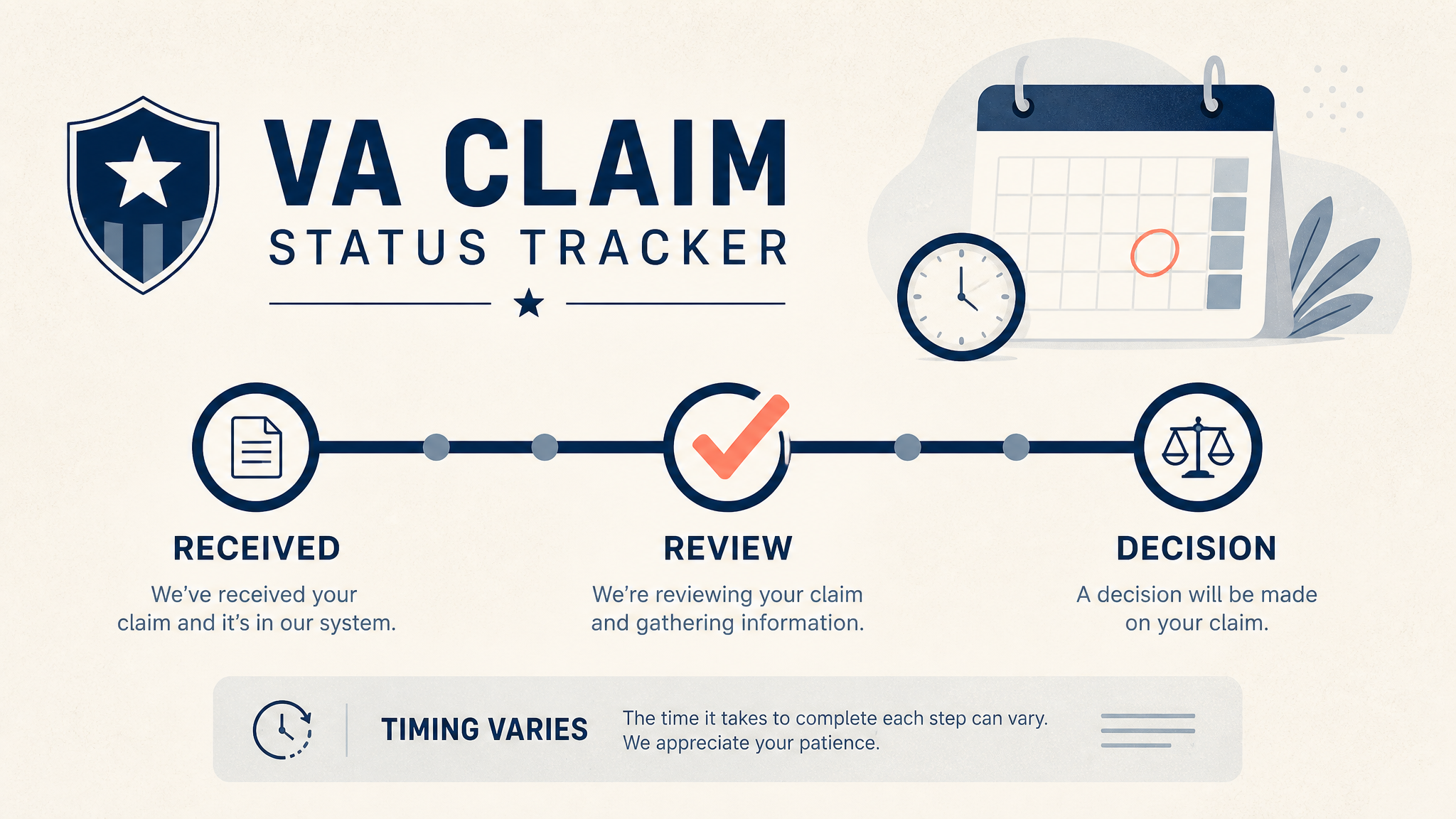
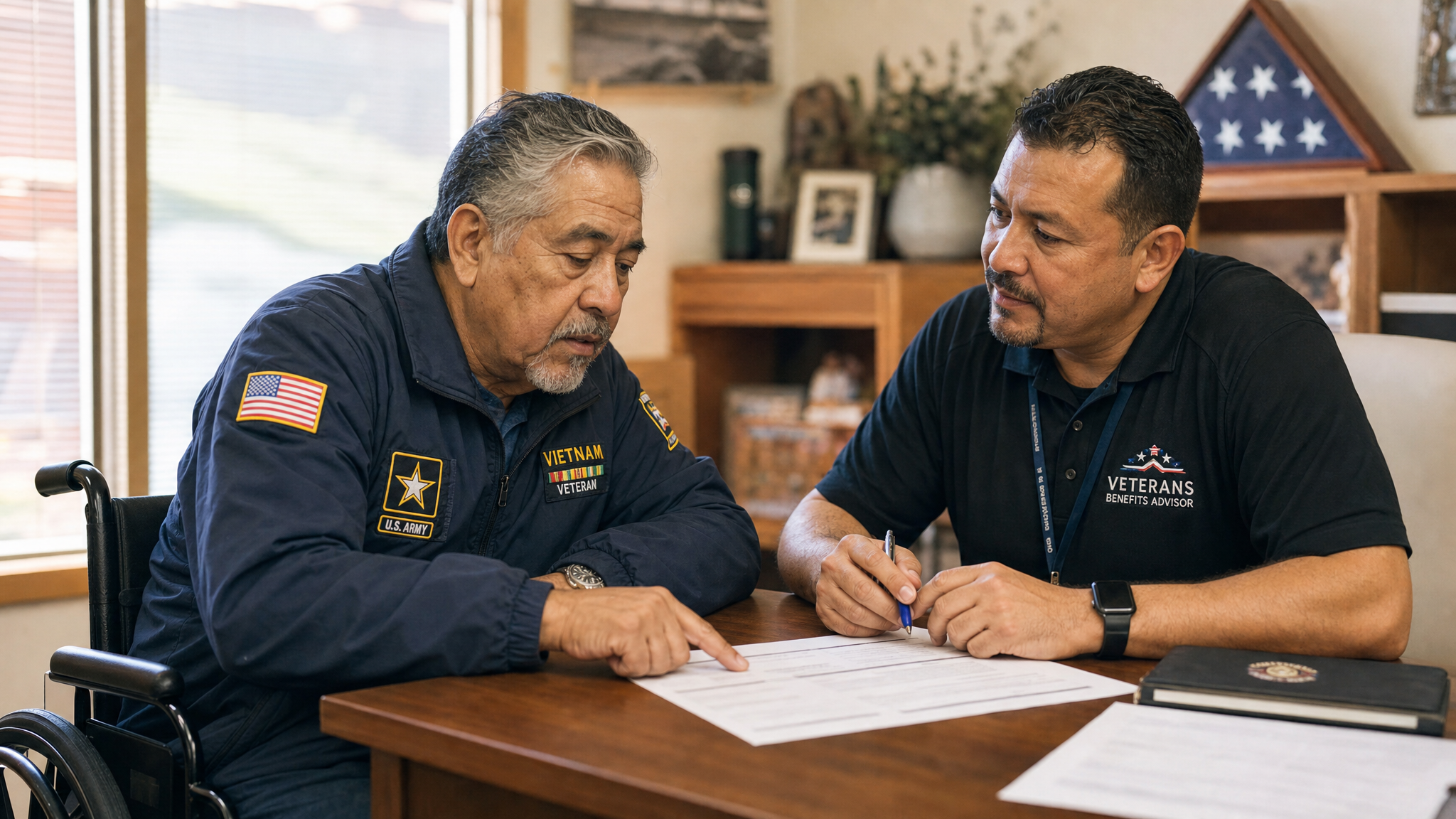
FIG. 04 - After you file
Coordinate
Track both awards
Keep both award letters together, because each program reviews eligibility on its own schedule.
Who to call & where to go
These are free, official VA lines. Have your Social Security number handy when you call.
Social Security Administration
Social Security retirement and disability (SSDI/SSI) questions.
VA Benefits Hotline
Compensation, pension, and general claim questions.
Rather have us handle it?
No phone tag, no hold music. Call our office and a real, VA-accredited person walks you through it - start to finish.
702-992-4883Not sure where to start?
Apply for Social Security directly with the Social Security Administration - online, by phone at 1-800-772-1213, or at a local office. The VA cannot file it for you. If you have a 100% Permanent & Total rating, ask for expedited processing: enter "Veteran 100% P&T" in the Remarks section and submit your VA rating award letter as proof. Veterans disabled while on active duty on or after October 1, 2001 can request the Wounded Warrior expedite regardless of rating. Keep your VA and SSA matters separate, since each agency decides on its own.
More benefits for veterans
These often go hand in hand - tap any card to learn more.

































Free information — get a free benefit review
Tell us how to reach you and an accredited team member will help you understand this benefit and claim everything you have earned. No cost, no obligation.
Ready to hire us? Register with us
For veterans who’ve decided they want us on their claim — registering is free too, and it does not make you our client or obligate you to anything. Here is exactly how it works:
- You register. This simply starts the conversation — you are not our client yet, and you owe us nothing.
- You sign and return VA Form 21-22a. It appoints us as your accredited representative and gives us access to your VA file.
- Once we have your signed 21-22a and access to your case, we verify everything is in order.
It involves the registration form and signing VA Form 21-22a — by law we can’t accept your claim, work on it, or contact the VA for you until that power of attorney is signed. You decide whether to move forward.
Official VA links
Answers, in plain language
Common questions about VA Disability & Social Security (SSDI/SSI) Together
What is VA Disability & Social Security (SSDI/SSI) Together?
Two of the largest benefits an older or disabled veteran can hold are VA disability compensation and Social Security - and you are allowed to receive both. But they follow completely different rulebooks: one looks at your service-connected conditions, the other at your work history and your ability to work at all. Knowing how they fit together - and where SSI is different - can protect thousands of dollars a year.
Who qualifies for VA Disability & Social Security (SSDI/SSI) Together?
This benefit is generally for: Veteran who cannot work, Veteran rated 100% Permanent & Total, Older veteran nearing retirement age, Veteran with limited income and assets. Getting VA compensation and Social Security at the same time How SSDI differs from needs-based SSI
How do I apply for VA Disability & Social Security (SSDI/SSI) Together?
Apply for Social Security directly with the Social Security Administration - online, by phone at 1-800-772-1213, or at a local office. The VA cannot file it for you. If you have a 100% Permanent & Total rating, ask for expedited processing: enter "Veteran 100% P&T" in the Remarks section and submit your VA rating award letter as proof. Veterans disabled while on active duty on or after October 1, 2001 can request the Wounded Warrior expedite regardless of rating. Keep your VA and SSA matters separate, since each agency decides on its own.
What does it cost to get help with VA Disability & Social Security (SSDI/SSI) Together, and are you VA-accredited?
The mistake I see most is a veteran assuming a 100% VA rating automatically means Social Security disability - it does not. SSA does not use the VA's percentages; it asks a different question: can you do any substantial gainful work? A 100% P&T rating is strong evidence and moves you to the front of the line, but you still have to meet SSA's test. The flip side: your VA check will not cut your SSDI, so never let anyone tell you that you have to choose. Only SSI, the needs-based program, is reduced by VA income. It is free to talk with us, and no one may charge you to file a first-time VA claim. The Aging Veteran is led by Albert L.