
Veteran Benefits
VA Disability Compensation
Disability compensation is a tax-free monthly payment for injuries or illnesses connected to your service, or that your service made worse. It is not welfare and it is not based on income, it is money you earned by wearing the uniform. The amount depends on your combined rating and the dependents you support, and it can change as your conditions change. Build your combined rating and estimate your payment below, with no sign-up required.

It is never too late to file
There is no age limit for filing
There is no age limit for filing a VA disability claim. Many veterans - older veterans especially - assume they are too old, or that they waited too long, and quietly give up on benefits they earned. Nothing could be further from the truth. The VA does not look at your age. If a condition is connected to your service, you can file at 50, 70, or 90 - and you can still be owed a tax-free monthly payment and back pay.
The full compensation picture
Everything you need to know about disability compensation
Nothing hidden behind a click, and nothing you have to go looking for on another website. The rating rules, the add-ons, the effective-date traps, and the doors most veterans are never told about - all of it in plain language, right here.
Key facts & current figures
- 2026 rates (effective Dec 1, 2025): about $180.42/mo at 10% and $356.66/mo at 20% (no dependent add-ons below 30%).
- At 30% and up you get extra for dependents: roughly $617/mo at 30% with a spouse, rising to about $4,158/mo at 100% with a spouse.
- Rates rise each year with the Social Security cost-of-living adjustment (2.8% for 2026).
- File an 'Intent to File' first to lock in your effective date, and possible back pay, while you gather evidence.
- If you are denied, you have three review paths: a Supplemental Claim (new evidence), a Higher-Level Review, or a Board Appeal.
General figures, current as of December 2025 and reviewed each year. Your exact amount depends on your situation - always confirm on va.gov.
What disability compensation is
- It is a tax-free monthly payment for veterans who were injured or became ill because of their military service, or whose condition was made worse by service.
- Both physical conditions (like a back injury or hearing loss) and mental health conditions (like PTSD) can qualify.
- You can apply at any age. Many senior veterans qualify years later for conditions that slowly got worse over time.
How the rating works
- The VA rates your disability from 0% to 100%, in steps of 10. The higher the rating, the higher your monthly payment.
- If you have more than one condition, the VA combines them using a special table (not simple addition), so two 50% conditions do not add up to 100%.
- A rating of 10% or higher also makes you exempt from most VA health care copays.
2026 monthly rates (effective December 1, 2025)
- About $180.42 per month at 10%, and about $356.66 per month at 20% (there are no dependent add-ons below 30%).
- At 30% and higher, you get extra money for a spouse, children, or dependent parents.
- At 100% with a spouse, the payment is roughly $4,158 per month. Rates rise each year with the cost-of-living adjustment (2.8% for 2026). Always confirm the current figure on va.gov.
Extra payments you might qualify for
- Individual Unemployability (TDIU) can pay you at the 100% rate if service-connected conditions keep you from holding steady work, even when your rating is lower.
- Special Monthly Compensation (SMC) adds money for serious losses, such as loss of use of a limb or the need for daily aid and attendance.
- Aid and Attendance can also be added if you need help with daily activities.
Step by step: how to file (this is always free)
- Step 1: File an Intent to File (VA Form 21-0966) first. This locks in your effective date so back pay can reach back to that day.
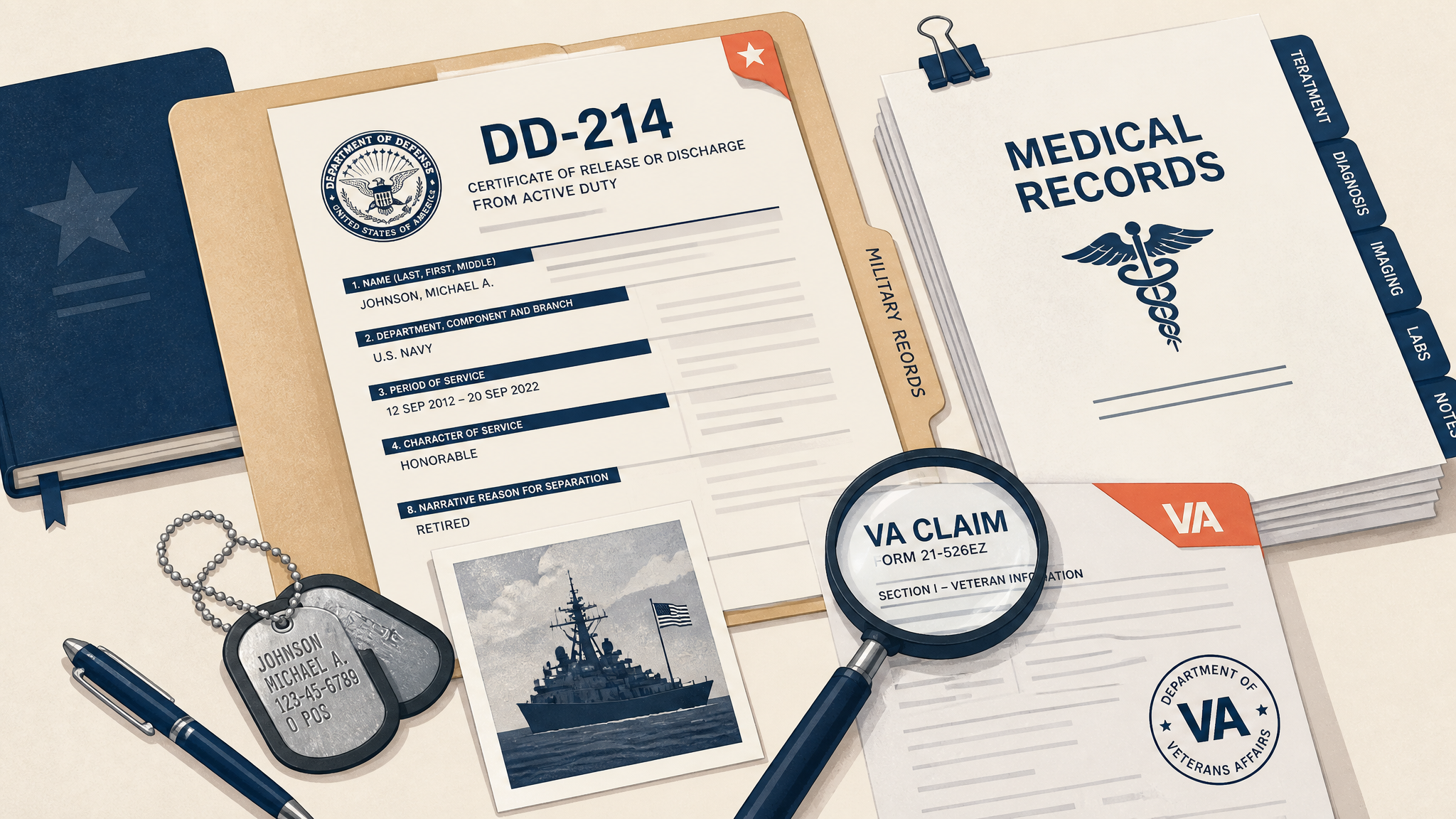
- Step 2: Gather your DD-214, your medical records, and a written list of your conditions.
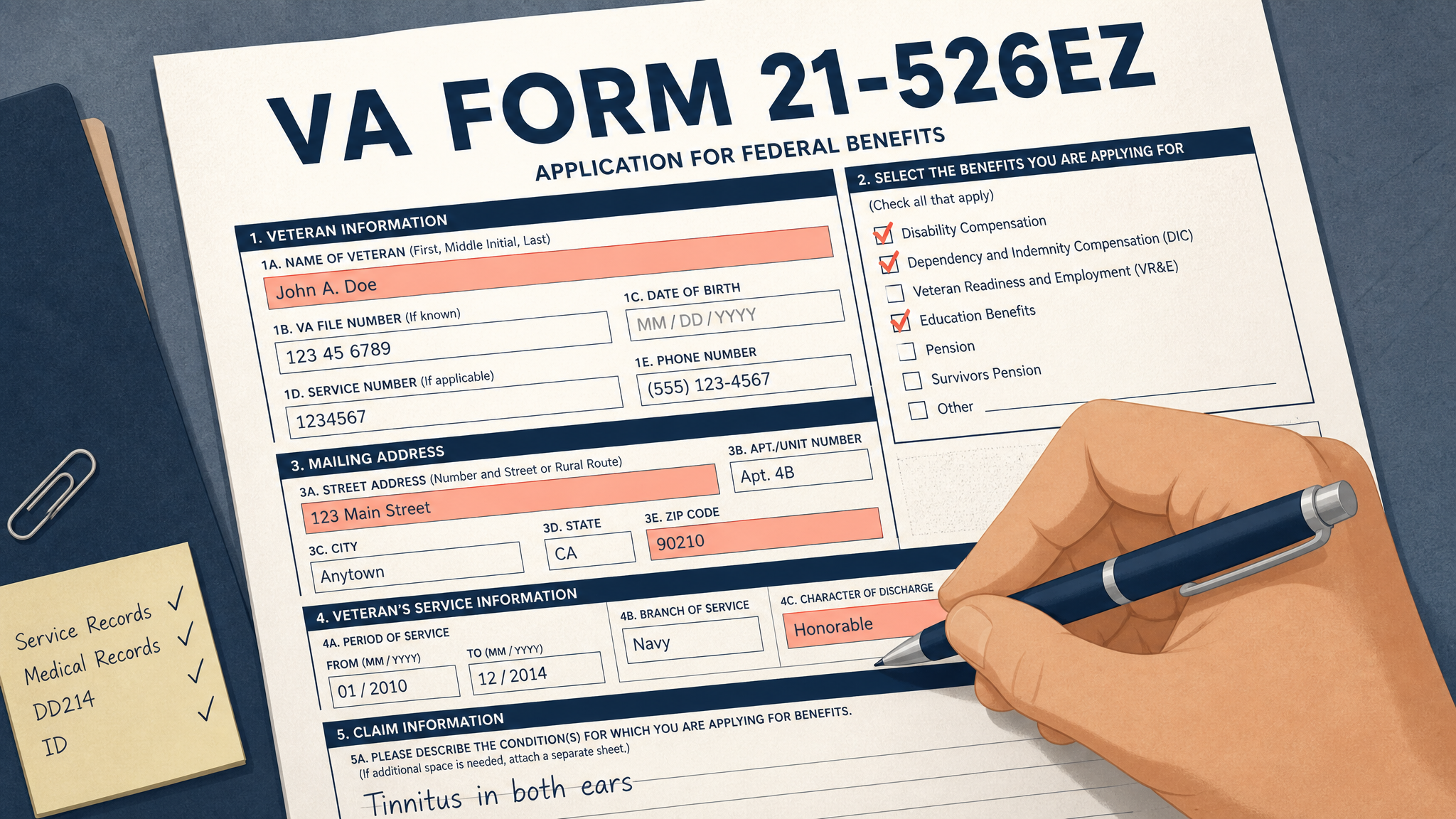
- Step 3: File your claim using VA Form 21-526EZ, online at va.gov, by mail, or with a free accredited Veterans Service Officer.
- Step 4: Go to any exam the VA schedules (called a C and P exam) and bring your evidence.
VA disability does NOT cancel your Social Security
- This is one of the most damaging myths we see: a veteran believes that having a VA disability rating somehow disqualifies them from Social Security retirement or Social Security Disability Insurance (SSDI). That is completely wrong. They are two separate federal programs with separate rules, and you can collect both at the same time with no offset.
- VA disability compensation is tax-free. Social Security is a different entitlement based on your work credits. Neither one reduces the other. A veteran rated at 100% can also draw full Social Security retirement - every dollar of both.
- The same applies to SSDI. If your service-connected conditions - or any condition - prevent you from doing substantial gainful activity as Social Security defines it, you can qualify for SSDI on top of your VA compensation. The definitions of "disabled" are different for each program, so being rated 100% by the VA does not automatically give you SSDI, but it is strong supporting evidence.
- Many veterans we work with are leaving thousands of dollars a year on the table because they assumed one benefit cancels the other. It does not. Apply for both. You earned both.
If you disagree with the decision
- You have three ways to challenge a decision within one year: a Supplemental Claim (new evidence), a Higher-Level Review (a senior reviewer takes a fresh look), or a Board Appeal (a Veterans Law Judge).
- You can switch to another option if one does not work out. Free help is available from accredited Veterans Service Officers.
A clear path forward
How to get your benefits: your first-year filing plan
Whether this is a first claim or a push for a higher rating, the path is the same - and the dates matter. File your Intent to File on Day 1 to lock your effective date, then use the next twelve months to gather records and build your case. Here is the order that works.
Day 1 - file today
File an Intent to File
This one step locks in your effective date and gives you a full year to finish the claim. Any back pay is calculated from the day you file this - even while you gather everything else. It is free and takes minutes.
Week 1-2
Request your service records
Order your Official Military Personnel File and DD-214 from the National Archives (the National Personnel Records Center) at no cost, or let an accredited agent pull them for you. These prove where and when you served - the foundation of every claim.
Week 1-6
Start collecting your medical records
Gather your VA and private treatment records and a current diagnosis for every condition. These show the condition exists today. Start now - private offices can take weeks to send records.
Month 2-3
Build the connection to service
Tie each condition to your service with a nexus - a doctor statement, buddy statements, or your own account of what happened. This link is what turns a diagnosis into a granted claim.
Within 1 year of your Intent to File
File VA Form 21-526EZ
File before your one-year Intent-to-File window closes so back pay runs all the way to Day 1. Claim every condition - physical and mental - because your combined rating is built from all of them together.
If denied
Use your review options
A denial is not the end. You have three paths: a Supplemental Claim with new evidence, a Higher-Level Review, or a Board Appeal.
What you have earned
Your rating is the key to everything
Disability compensation is a tax-free monthly payment based on a combined rating from 10% to 100%. That single number drives your monthly check - and it opens doors to health care, housing help, and special monthly compensation.
The catch: the VA does not simply add your ratings together. It combines them on a sliding scale, which trips up a lot of veterans. The estimator below does that math for you, then layers on dependents so you can see the real number.

$180.42/mo
Starting rate at 10%, tax-free (2026)
$4,158/mo
Roughly the 100% rate with a spouse (2026)
100% tax-free
Disability compensation is never taxed
Your rating & payment estimator
Add each condition and its rating, then add your family. The estimate updates as you go - no personal details required.
Build your combined rating
Add each service-connected condition and its rating. The VA does not simply add your ratings - it combines them, so two 50% conditions do not equal 100%.
Your combined VA rating
Exact math: 0% -> VA rounds to the nearest 10%
Add your family
Once your combined rating is 30% or higher, the VA pays more for eligible dependents.
Marital status
Dependent children
Children under 18
Children 18-23 in an approved school
Dependent parents
Parents who relied on you financially.
Estimated monthly payment
$0.00
About $0 per year, tax-free
Add at least one condition above to see your estimated payment.
Estimate only. Excludes the bilateral factor and other special rates. The VA rounds combined ratings to the nearest 10%. Rates adjust yearly with the COLA - confirm on va.gov.
Why the math matters
Two 50% ratings do not equal 100%
The VA combines ratings on a descending scale, then rounds to the nearest 10%. Getting one more condition rated correctly can be the difference between 80% and 90% - and hundreds of dollars a month. That is why an accurate review pays off.
Benefits that build on your rating
Your disability rating is the foundation. These benefits often stack on top - tap any card to learn more.




Get a free rating review
Tell us how to reach you and an accredited team member will review your rating and help you claim every dollar you have earned. No cost, no obligation.

Ready to hire us? Register with us
For veterans who’ve decided they want us on their claim — registering is free too, and it does not make you our client or obligate you to anything. Here is exactly how it works:
- You register. This simply starts the conversation — you are not our client yet, and you owe us nothing.
- You sign and return VA Form 21-22a. It appoints us as your accredited representative and gives us access to your VA file.
- Once we have your signed 21-22a and access to your case, we verify everything is in order.
It involves the registration form and signing VA Form 21-22a — by law we can’t accept your claim, work on it, or contact the VA for you until that power of attorney is signed. You decide whether to move forward.

Two ways to move forward — both free
Not sure your rating is right?
Talk with our free assistant any time, or have an accredited specialist review your combined rating and find the increases and back pay you may be owed.
Have a question? Get free information
Ask a question, learn what you may be owed, or find out where you stand. Confidential, free, and no obligation to go any further.
Ready to hire us? Register
Decided you want us to work your claim? Registering is free — we match you with an accredited advocate and get you started. We cannot begin until you sign VA Form 21-22a, and fees, if any, are always disclosed up front.