
Veteran Benefits
VA Health Care
Enrolled VA health care is the largest integrated health system in the country - primary care, hospital care, surgery, specialists, mental health, and a pharmacy - and for most older veterans it costs far less than they assume. Service-connected care is free, a 10% rating ends inpatient and outpatient care copays while a 50% rating (Priority Group 1) ends medication copays too, and even the veterans who do pay are capped at real, published dollar amounts rather than the open-ended bills that come with private insurance.

There’s a free calculator on this page - find your health-care priority group. No sign-up, no cost.
Who this is for
You earned the right to real health care for your service - a doctor who knows your name, prescriptions you can afford, mental health support, hearing aids, and the long-term care nobody else covers well. Most older veterans who are not enrolled believe one of two things: that they do not qualify, or that it costs too much. Almost always, both are wrong. There is no income limit that locks you out of VA health care - and if you carry even a 10% rating, your inpatient and outpatient care copays are already zero (a 50% rating clears prescription copays too).
In plain language
What VA Health Care covers
- Primary care, hospital care, surgery, emergency care at a VA facility, and the full range of specialists
- Prescriptions through the VA pharmacy and the mail-order pharmacy that fills roughly 80% of VA scripts
- Mental health care, PTSD treatment, substance-use treatment, and readjustment counseling at Vet Centers
- Preventive care - vaccines, cancer screenings, bloodwork, and the free toxic-exposure screening
- Audiology and hearing aids, eye care and glasses, prosthetics, home health, respite, and long-term care
- Online tools to refill prescriptions, message your care team, view labs, and file for travel reimbursement

Enrolling in VA Health Care with Form 10-10EZOfficial video - U.S. Department of Veterans Affairs - theSITREP
5 things most veterans aren't aware of
These apply to nearly every VA claim - and they change how much you get and when.
Your filing date sets your back pay
Benefits are generally paid back to the day you file - not the day you are approved. Filing an intent to file today can protect months, even years, of retroactive pay.
One condition can trigger others (secondary claims)
A service-connected condition that causes another - like sleep apnea from PTSD, or a bad knee from a bad hip - can be rated on its own. Each secondary condition adds to your rating.
A medical nexus is what wins the claim
The VA needs a documented link between your condition and your service. A clear nexus opinion is often the difference between an approval and a denial.
Accredited help is free to file an initial claim
By law, an accredited agent cannot charge a fee to prepare and file your original claim. If someone asks for money up front to file, that is a red flag.
A denial is not the end of the road
You have three appeal lanes - Higher-Level Review, a Supplemental Claim with new evidence, and the Board of Veterans Appeals. Many denials are overturned on review.
$0
Copays once you are rated 10% or higher - on all care, not just the rated condition
$15 / $50
2026 copay for a primary care visit / a specialty visit, if you owe one at all
$700/yr
Ceiling on prescription copays - after that, medications are free
The full picture
Everything you need to know
Nothing hidden behind a click, and nothing you have to go looking for on another website. Here is the whole story in plain language - the facts and the figures first - so you can decide what fits your situation.
Key facts & current figures
- Once you enroll the VA places you in one of 8 priority groups; veterans rated 50% or higher, veterans unemployable because of service-connected conditions, and Medal of Honor recipients land in Group 1.
- Care for a service-connected condition is free for every enrolled veteran, anyone rated 10% or higher is exempt from outpatient and inpatient care copays, and a 50% rating (Priority Group 1) drops prescription copays as well.
- For 2026, veterans who do owe copays pay $15 for a primary care visit and $50 for specialty care or imaging - and labs, X-rays, EKGs, and preventive care are always $0.
- Prescription copays run $5, $8, or $11 for a 30-day supply depending on the drug tier, and the total is capped at $700 per calendar year.
- The PACT Act lets many toxic-exposure veterans enroll without filing a disability claim first, and it stretched the post-discharge window for combat veterans from 5 years to 10 years.
- Enrolling costs nothing and you only do it once - VA Form 10-10EZ, with a written decision usually back in 5 to 7 days.
General figures, current as of December 2025 and reviewed each year. Your exact amount depends on your situation - always confirm on va.gov.
The eight priority groups, spelled out - especially 2 and 3
- Group 1 is the top: veterans rated 50% or higher service-connected, veterans the VA has found unemployable because of service-connected conditions, and Medal of Honor recipients. No copays for anything.
- Group 2 is for veterans rated 30% or 40% service-connected. That is the whole test - a 30% or 40% combined rating puts you here. Care for your rated conditions is free, and because you are over 10%, you are exempt from outpatient and inpatient copays across the board.
- Group 3 is broader than a rating. You land in Group 3 if any one of these is true: you are rated 10% or 20% service-connected; you are a former prisoner of war; you were awarded the Purple Heart; you were discharged for a disability that was caused or made worse by your active service; or you hold special eligibility under 38 U.S.C. 1151 for a disability caused by VA treatment or vocational rehabilitation. Any single one of those is enough - a Purple Heart with a 0% rating still puts you in Group 3.
- Group 4 is for veterans the VA has determined catastrophically disabled, or who receive Aid & Attendance or Housebound benefits. This group carries a full copay exemption, and many veterans who would qualify have simply never asked for the determination.
- Group 5 covers non-service-connected veterans and 0% service-connected veterans whose income falls below the national threshold, plus veterans receiving a VA pension or eligible for Medicaid. Little or nothing is charged for most care.
- Group 6 is the toxic-exposure and special-circumstance group: PACT Act exposure veterans, Agent Orange, radiation, and Camp Lejeune veterans, World War I veterans, and combat veterans inside the enhanced enrollment window after discharge.
- Groups 7 and 8 are the income-based groups for veterans without a compensable rating who agree to copays - Group 7 below your local geographic income limit, Group 8 above it. Both still get full VA health care; the difference is the size of the copay, not access.
- The VA always assigns you to the highest group you qualify for, and your group can change - a rating increase, a new Purple Heart record, a drop in income, or a catastrophic-disability determination can all move you up. If your facts have changed since you enrolled, call and have your group reviewed.
What enrolled VA health care actually gets you
- The core of it is a primary care team - a doctor or nurse practitioner, a nurse, a clinical pharmacist, and usually a social worker - assigned to you by name. That team is your route into everything else in the system.
- From there you get hospital care, surgery, imaging, lab work, and the full specialty roster: cardiology, oncology, orthopedics, urology, neurology, endocrinology, dermatology, pain management, and rehabilitation.
- Mental health is built in, not bolted on. PTSD programs, depression and anxiety treatment, substance-use treatment, grief support, and inpatient psychiatric care are all inside the benefit. Vet Center readjustment counseling is separate and does not even require enrollment.
- Pharmacy is one of the strongest pieces. VA prescriptions are cheaper than almost anything on the private market, and mail order delivers to your door. VA drug coverage also counts as creditable coverage for Medicare Part D, so keeping VA care lets you skip Part D without ever facing a late-enrollment penalty.
- Older veterans in particular get audiology and hearing aids, eye exams and glasses, prosthetics, home-based primary care, homemaker and home health aide services, adult day health care, respite care, hospice, and nursing home care - the long-term care side that private plans and Medicare handle poorly.
- You are allowed to keep Medicare, TRICARE, or a private plan at the same time. VA is not an either-or choice, and using VA care does not reduce anything else you have.
Enrolling: one form, and the windows that catch people
- Enrollment is one application, once, for life - VA Form 10-10EZ. You do not reapply every year. There is no open season and no deadline for general enrollment.
- Most veterans who served the minimum period and were not discharged dishonorably can apply. If your discharge is other than honorable, apply anyway - the VA can still provide care for service-connected conditions and can grant health care eligibility through a character-of-discharge determination.
- The combat window matters. Veterans who served in a theater of combat operations get an enhanced enrollment period after discharge, and the PACT Act extended it from 5 years to 10 years. Inside that window you get care for conditions potentially related to that service without having to prove service connection first.
- Toxic exposure is now its own door in. Under the PACT Act, veterans exposed to burn pits, Agent Orange, radiation, contaminated water, and other hazards can often enroll directly - no disability claim required first - and typically land in Group 6.
- A denial is not the end of it. The enrollment letter includes appeal instructions, and eligibility can change: a new rating, a drop in income, a catastrophic disability determination, or a newly recognized exposure can all reopen the door. Reapply when your facts change.
- If you enrolled years ago and never used it, you are almost certainly still enrolled. Call the medical center's enrollment office, confirm you are active, and ask to be assigned a primary care team.
What you are never charged for, no matter your group
- Any care for a VA-rated service-connected condition is free. Group 1 or Group 8, it makes no difference - if the treatment is for a rated condition, there is no copay.
- A 10% rating ends outpatient and inpatient copays across the board. Not just for the rated condition - all inpatient and outpatient care. Prescription copays are the one exception: those end at a 50% rating, which puts you in Priority Group 1. This is the single most valuable and least understood fact about VA health care, and it is why even a modest rating is worth pursuing.
- Lab tests, X-rays, and EKGs are always $0 for every veteran, in every priority group.
- Preventive care is always $0: immunizations including flu and shingles, cancer screenings, blood pressure and cholesterol checks, health education, and the free toxic exposure screening available to every enrolled veteran.
- Mental health care related to military sexual trauma and readjustment counseling carry no copay, and neither does care related to combat service for veterans who served in a combat theater after November 11, 1998.
- Compensation and pension examinations are never billed to you. If a VA facility bills you for a C&P exam, that is an error - call the billing office and have it reversed.
The 2026 copay amounts, in actual dollars
- These apply only to veterans without a service-connected rating of 10% or higher, and only to care that is not connected to service. Everyone else reads this section for reference, not for a bill.
- Outpatient care: $15 for a primary care visit, $50 for a specialty visit such as cardiology, surgery, or an eye doctor, and $50 for a specialty test like an MRI or a CT scan. If you have a primary care visit and a specialty visit on the same day, the total is capped at the single specialty rate.
- Urgent care depends on your group. Groups 1 through 5 pay nothing for the first three visits each calendar year, then $30 per visit. Group 6 pays $0 when the visit relates to combat service, military sexual trauma, or a covered toxic exposure, otherwise $30. Groups 7 and 8 pay $30 every visit. A flu-shot-only visit is always free.
- To use VA urgent care at all, you must be enrolled and have received VA care within the past 24 months. That is the trap - a veteran who enrolled and never went cannot walk into urgent care and use the benefit.
- Inpatient care is where the groups split hard. In Group 7 the first 90 days of hospital care in a 365-day period cost $347.20 plus $2 a day, and each additional 90 days is $173.60 plus $2 a day. In Group 8 the same first 90 days cost $1,736 plus $10 a day, with each additional 90 days at $868 plus $10 a day.
- Medications given to you during an inpatient stay are covered by the inpatient copay - no separate drug charge. And veterans in high-cost-of-living areas can qualify for a reduced inpatient rate; ask the enrollment office directly, because it is not applied automatically.
Prescriptions: three tiers, a hard ceiling, and five ways to pay nothing
- For a 30-day supply, Tier 1 preferred generics are $5, Tier 2 non-preferred generics and some over-the-counter drugs are $8, and Tier 3 brand-name drugs are $11. A 60-day supply doubles it, a 90-day supply triples it - so $15 covers three months of a Tier 1 drug.
- Whatever you owe, medication copays are capped at $700 per calendar year. Hit the cap and your prescriptions are free for the rest of the year. The cap resets automatically every January 1.
- Route one to $0: Group 1. Rated 50% or higher, unemployable because of service-connected conditions, or a Medal of Honor recipient - your medications are free.
- Route two: the drug treats a rated condition. Medications prescribed for a service-connected condition are exempt from copays in every priority group.
- Route three: income. A veteran rated 40% or less whose gross household income falls at or below the national limit qualifies for free medications - but only after giving the VA the income information. Nobody does this for you.
- Routes four and five: status. Former prisoners of war, veterans determined catastrophically disabled, and veterans receiving a VA pension or Aid & Attendance or Housebound benefits can all qualify for free medication. Also worth knowing: some over-the-counter items sit in Tier 2 at $8, so aspirin or vitamins are often cheaper at the drugstore.
- Order refills at least 15 days before you run out. Mail order fills the large majority of VA prescriptions and mailing time is real.
Income, the means test, and why Group 7 and Group 8 differ
- Income only comes into it if you do not have a 10% or higher rating and do not qualify some other way - as a former POW, a Purple Heart recipient, a PACT Act exposure veteran, a recent combat veteran, or a pension recipient.
- The VA runs two tests. The National Income Threshold is one figure for the whole country. The Geographic Means Test is tied to your county or metro area, set at HUD's local low-income limit, so a veteran in an expensive county gets a higher allowance than one in a cheap county.
- Below the national threshold puts you in Group 5 - a VA pension, Medicaid eligibility, or income under the limit all land here, and Group 5 pays little or nothing for most care.
- Above the national threshold but below your local GMT figure puts you in Group 7, and Group 7 gets an 80% reduction on inpatient copays - which is exactly why the $347.20 in Group 7 becomes $1,736 in Group 8.
- Above both puts you in Group 8 - and Group 8 is still full VA health care. You are enrolled, you have a care team, you have the pharmacy. You just pay the standard copays for care unrelated to your service.
- Income is figured on last calendar year's gross household income - you, your spouse, your dependents - minus certain deductible expenses including unreimbursed medical costs, some education costs, and burial expenses for a spouse or dependent child. Those deductions are frequently left off, and they can move you a whole group. If your income dropped, report it. Nothing changes until you tell them.
Actually using the system once you are in
- Get a primary care assignment on day one. Call the enrollment coordinator at your VA medical center and ask to be assigned. Being enrolled and having a care team are two different things, and only the second one gets you seen.
- Set up your online account. Refills, secure messages to your team, lab results, appointment scheduling, and your record all live there - and secure messaging is usually faster than the phone.
- If the VA cannot see you soon enough or you live too far out, community care exists. The published standards are a 30-minute average drive time or a 20-day wait for primary care, mental health, and non-institutional extended care, and 60 minutes or 28 days for specialty care. Care in the community must be authorized by the VA first, and approved care is billed to the VA - not to you.
- Nobody calls to tell you that you qualify for community care. If the appointment you are offered is outside those standards, say so out loud and ask for a community care referral. You also qualify when the VA does not offer the service at all, or when a VA clinician agrees it is in your best medical interest.
- Claim your travel money. Eligible veterans are reimbursed 41.5 cents per mile to and from VA-authorized care, after a $3 one-way / $6 round-trip deductible that is capped at $18 a month. File in the travel self-service system within 30 days of the appointment. Pension recipients, C&P exam travel, and Aid & Attendance or Housebound recipients can have the deductible waived.
- Never miss a scheduled appointment silently. Call and reschedule. Repeated no-shows are the fastest way to lose a good relationship with a care team, and in a system this size that relationship is the whole ballgame.
Dental, eyes, ears, and care outside the country
- Dental is the biggest surprise, and the biggest gap. VA health care enrollment does not include routine dental for most veterans. Free VA dental is limited to specific classes written into law - a 100% schedular or permanent and total rating, former POWs, a one-time course within 180 days of discharge, a service-connected dental condition, pension recipients with Aid & Attendance or Housebound status, dental care needed for an authorized medical procedure, and Veteran Readiness and Employment participants.
- If you are outside those classes, VADIP lets any enrolled veteran - and CHAMPVA beneficiaries - buy discounted private dental insurance through Delta Dental or MetLife. There is no open season, and it is usually far cheaper than an individual plan on the open market.
- Hearing and vision are inside the benefit. Audiology exams, hearing aids and the batteries and repairs that follow, eye exams, and glasses are covered for eligible enrolled veterans. This is one of the strongest arguments for VA care over Medicare, which covers almost none of it.
- Living or traveling abroad? The Foreign Medical Program reimburses care overseas, but only for VA-rated service-connected conditions - and for conditions associated with or aggravating one. Non-service-connected care abroad is on you, and no priority group changes that.
- A catastrophic disability determination is worth asking about. It is a clinical determination, it places you in Group 4, and it exempts you from inpatient, outpatient, and medication copays regardless of service connection. Many veterans who would qualify have never had the conversation.
- Everything above is free to ask about. Enrollment staff at every VA medical center are paid to answer these questions, and the Health Benefits line at 1-877-222-8387 is staffed for exactly this. Nobody needs to charge you to enroll in VA health care.
Care you can get RIGHT NOW - before you ever enroll
- You do not have to be enrolled to be safe. If you are in a suicidal crisis, the Veterans Crisis Line is free and immediate - dial 988 then press 1, text 838255, or chat at VeteransCrisisLine.net. It is confidential and open to every veteran regardless of discharge or enrollment.
- Under the COMPACT Act, any veteran in an acute suicidal crisis can walk into any VA or non-VA emergency room and get free emergency and stabilization care - no enrollment, no copay, no bill - even if you have never used the VA before.
- Vet Centers require no enrollment at all. These are separate, low-key community counseling centers for combat veterans and survivors of military sexual trauma - readjustment counseling, PTSD support, and grief counseling, free, and kept apart from your medical record.
- The free toxic-exposure screening under the PACT Act is available to every enrolled veteran and takes about ten minutes - ask for it the first time you are seen, and repeat it every five years.
Step by step: from application to your first appointment
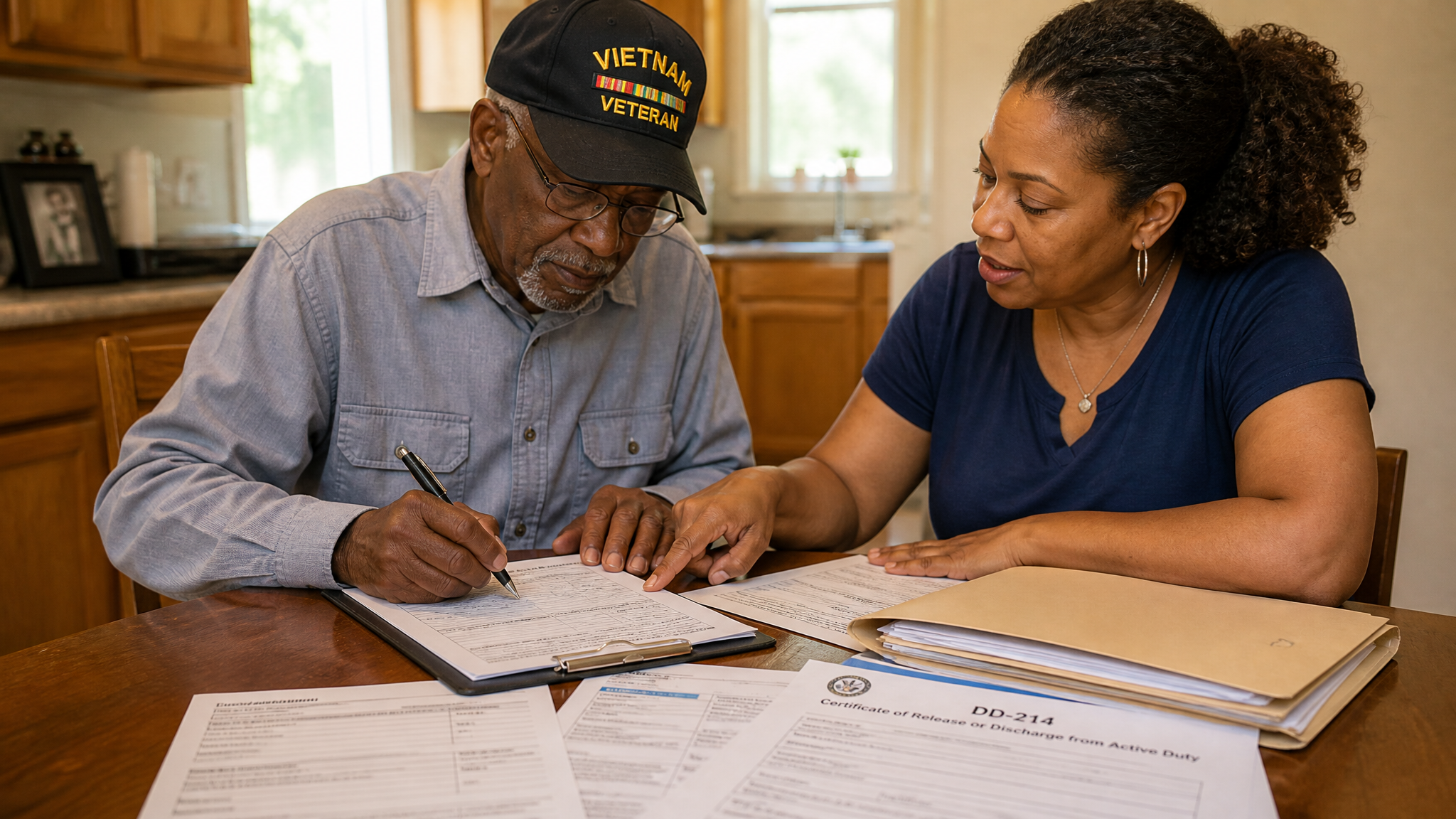
- Step 1 - gather your papers. Have your DD-214, your Social Security number, and your Medicare, TRICARE, or private insurance cards ready. If you are applying on income, add last year's gross household income for you and your spouse.
- Step 2 - submit VA Form 10-10EZ online at va.gov, by phone at 1-877-222-8387, by mail, or in person. Attaching your DD-214 is the single fastest way to move it.
- Step 3 - wait about a week. Most veterans get a written enrollment decision in 5 to 7 days. The letter tells you your priority group and how to appeal if you disagree.
- Step 4 - get your Veteran Health Identification Card (VHIC). This is your photo ID for VA facilities and pharmacies. You can request it at your VA medical center; bring a government photo ID. Care does not wait on the card, but carry it once it arrives.
- Step 5 - set up your online account at My HealtheVet using a Login.gov or ID.me sign-in so you can message your team, refill prescriptions, and see your records from home.
- Step 6 - book your first appointment. Call the enrollment coordinator and ask to be assigned a primary care team by name. Being enrolled and having a care team are two different things - only the second one gets you seen.
Your advocates inside the VA - people paid to be on your side
- Every VA medical center has a Patient Advocate whose entire job is to cut through red tape for you - a delayed appointment, a billing error, a complaint about care. Ask the front desk for the Patient Advocate by name; you do not need permission to use one.
- Older veterans have a dedicated door: Geriatrics and Extended Care (GEC). This team handles home-based primary care, adult day programs, respite, caregiver support, and nursing home placement - the long-term-care side Medicare handles poorly.
- The enrollment coordinator at your medical center can review your priority group, catch copays you no longer owe after a rating increase, and get you assigned to a care team. This is the ten-minute phone call that changes people's bills.
- Family caregivers have their own line - the Caregiver Support Line at 1-855-260-3274 - and may qualify for a stipend, training, and respite through the Program of Comprehensive Assistance for Family Caregivers.
- Women veterans have a Women Veterans Program Manager at every facility to coordinate gender-specific care and privacy - ask for her by title if you need that coordination.
Telehealth - VA care without the drive
- VA Video Connect lets you see your provider by secure video from your own phone, tablet, or computer - especially useful for mental health, follow-ups, and medication check-ins when a long drive is hard on you.
- If your home internet is weak, ATLAS sites put a private telehealth room in community locations - many at local Veterans of Foreign Wars and American Legion posts - so you can take the appointment closer to home.
- The VA will lend you a tablet if you qualify and do not have a suitable device or connection - ask your care team or social worker about the tablet-loan program.
- Telehealth for a service-connected condition, mental health, or preventive care carries no copay, just like the in-person version.
Take control of your care online
- The sign-in changed. The old My HealtheVet and DS Logon passwords are being retired - you now sign in with a Login.gov or ID.me account, which is more secure and works across all VA websites.
- Secure messaging lets you message your care team directly - refill questions, results, non-urgent concerns - and it is usually faster than sitting on hold.
- Prescriptions can be refilled and tracked online, and the mail-order pharmacy delivers to your door - order at least 15 days before you run out.
- Your records and lab results are yours to read online, often before your provider calls - handy for tracking blood pressure, cholesterol, or A1c over time.
- Appointments and travel pay live there too: schedule or cancel visits, and file for mileage reimbursement through the travel self-service tool or the mobile app within 30 days of the appointment. Only use the official va.gov sign-in pages - never a link from an unexpected email or text.
Community care - the ways you qualify to see a non-VA doctor
- You may be eligible for VA-paid care in your own community if any one of these is true - and the VA does not always volunteer it, so ask.
- One - the VA cannot provide the service you need. Two - no VA facility is within the drive-time standard (30 minutes for primary and mental health care, 60 minutes for specialty care).
- Three - the VA cannot see you inside the wait-time standard (20 days for primary and mental health, 28 days for specialty). Four - it is in your best medical interest, as you and your VA provider agree.
- Five - the VA service line does not meet quality standards. Six - you qualified under a prior grandfathered distance rule. Any single one of these opens the door.
- How the referral works: it must be authorized by the VA first, then you see an in-network community provider, and the bill goes to the VA - not to you. If you are offered an appointment outside the standards above, say so out loud and request a community care referral.
Emergency care and the COMPACT Act
- In a real emergency, call 911 or go to the nearest emergency room - VA or not. Do not drive across town to reach a VA hospital when minutes matter.
- The COMPACT Act guarantees free emergent suicidal-crisis care at any emergency room for any veteran - no enrollment required, no copay, no bill - including up to 30 days of inpatient and 90 days of outpatient follow-up.
- For other emergencies, the VA may cover non-VA emergency care if you are enrolled, but strict rules apply - notify the VA within 72 hours of going to a non-VA ER so a claim can be opened. The 72-hour call is the step people forget.
- If you get a bill you think the VA should cover, do not just pay it. Call the VA, open or check the claim, and ask the billing office to review it. Many veterans quietly pay bills the VA was responsible for.
Your safety and dignity at the VA
- The VA has a zero-tolerance policy for harassment of any kind inside its facilities. If you are made to feel unsafe or unwelcome, report it to the Patient Advocate - you have every right to be treated with respect in the house you earned care in.
- Care related to military sexual trauma (MST) is free to every veteran - men and women alike - with no rating, no enrollment barrier, and no time limit. You do not need to have reported it at the time, and you do not need documentation.
- Women veterans can request gender-specific clinics and privacy and a Women Veterans Program Manager to coordinate that care.
- If something happens or you have a concern, you can raise it with the Patient Advocate, the Women Veterans Call Center, or the Veterans Crisis Line - all confidential, all free.
Health care resources - save these numbers
- VA Health Benefits Hotline - 1-877-222-8387. Enrollment, priority groups, copay questions, and the 10-10EZ. This is the number for almost everything above.
- Veterans Crisis Line - dial 988 then press 1, or text 838255. Free, confidential, 24/7, for every veteran regardless of enrollment.
- Caregiver Support Line - 1-855-260-3274. For the spouse, child, or friend helping you at home.
- Women Veterans Call Center - 1-855-829-6636. Answers on gender-specific care, MST care, and connecting to your local Women Veterans Program Manager.
- The forms that matter: VA Form 10-10EZ to enroll, and VA Form 10-10EZR to update your income, insurance, or dependents after you are already in. Report an income drop or a rating increase with the 10-10EZR - it can move your priority group and end copays going forward.
Find where you land
VA health care priority group finder
Your priority group determines your enrollment, copays, and how soon you're seen. Answer a few questions about your rating and eligibility flags to see which of the eight priority groups you most likely fall into.
What is your VA disability rating?
Check anything that is true for you
You do not need all of these - the VA places you in the highest group you qualify for.
You likely fall in
Priority Group 8
Standard copays
Veterans whose income is above the VA thresholds. Being in Group 8 does not mean you are turned away - you still receive full VA health care.
Check official VA eligibilityEstimate only. Your exact group depends on the VA's review and income limits that vary by ZIP code. Confirm on va.gov.
This calculator is free. No sign-up, no catch.
Most people in this business hide tools like this behind a paywall or a sign-up form. We don’t. Use it as much as you need. And if you want a real accredited agent to look at your actual claim, we’re one call away — it’s free to talk, and free to file your claim.
Albert L. Thombs Jr. — VA-accredited claims agent (#45147), a disabled veteran with a team of advocates who do this every day.
The eight priority groups
What are the priority groups?
When you enroll in VA health care, the VA places you in one of eight priority groups. The group decides how soon you are seen, what your copays are, and whether your medications are free. Tap any group below to see who is in it and what it means for you.
This is the top of the list. It covers veterans the VA has rated 50% or higher, veterans who cannot work because of service-connected conditions (TDIU), and Medal of Honor recipients. You are enrolled first, ahead of every other group.
Costs: Your care and your medications for service-connected needs are free - no copays.
The VA assigns you to the highest group you qualify for. Exact placement depends on the VA's review and on income limits that vary by ZIP code. Confirm your group on va.gov or by calling 1-877-222-8387.
This is where most veterans lose money
When you file matters more than you think
Health care, compensation, and every dollar the VA owes you all start on a date - and that date is set by a single form filed on time, not by how strong your case is when you finish. Older veterans lose thousands every year simply because nobody told them to plant a flag in the ground first. Here is exactly how the timing works, what to gather, and how to find out whether you already have a claim in motion.
File something TODAY
The single most expensive mistake is waiting. The day the VA receives your Intent to File is the day your effective date is locked - and your back pay is counted from that date, not the day you finish gathering evidence.
You then have 12 months
An Intent to File holds your place for one full year. That gives you time to collect records and build your case while your effective date keeps counting. Miss the 12-month window and you start over at a later date - and lose every month of back pay in between.
PACT Act deadlines still matter
Toxic-exposure enrollment and many PACT Act filing windows are time-sensitive. If you served in a covered location, do not assume the door stays open forever - lock your date now and sort out the details after.
What information you need to gather
You do not need all of this before you file - file first, then collect. But this is the evidence that decides how fast your claim moves and how high it rates:
- Your DD-214 (or other separation documents) - proof of service and character of discharge.
- Your service treatment and personnel records - what happened to your body while you served.
- Current medical records and a list of your diagnoses - what you are being treated for now.
- Any private doctor notes, imaging, or test results that connect a condition to your service.
- For health care enrollment: recent household income information (this affects your priority group, not whether you qualify).
Not sure if you already have an active claim?
Many older veterans have a claim that was started years ago - by themselves, a family member, or a service organization - and never realize it is still open, denied, or waiting on evidence. We can find out for you.
To pull your file and check your claim status, the VA requires written authorization. You sign a VA Form 21-22a, appointing an accredited agent to represent you - then we look directly into your VA record, tell you exactly what is there, and what your next move should be. No guessing, no waiting on hold.
Albert L. Thombs Jr., VA Accredited Claims Agent #45147. Checking your status is free, and by law you are never charged to file an initial claim.
Your complete benefit picture
10%
the rating that ends your VA copays - and not just for the rated condition. A 10% rating wipes out every outpatient and inpatient copay you would otherwise owe, which is why even a small rating is worth chasing.

Two ways to move forward — both free
Not sure if this applies to you?
Ask our free assistant a few plain questions and get an honest read on what you and your family may qualify for, at no cost. It takes just a few minutes, and there is no sign-up and no obligation of any kind. You will get a clear, plain-language picture of where you stand and what might be worth filing. And if you would rather talk to a real person, an accredited agent is only a message away.
Have a question? Get free information
Ask a question, learn what you may be owed, or find out where you stand. Confidential, free, and no obligation to go any further.
Ready to hire us? Register
Decided you want us to work your claim? Registering is free — we match you with an accredited advocate and get you started. We cannot begin until you sign VA Form 21-22a, and fees, if any, are always disclosed up front.
The assumption that costs the most
There is no income limit that locks you out
Income does not decide whether you get VA health care. It only decides which of the 8 priority groups you sit in and whether you owe a copay. Even Group 8 - the highest-income group - gets full VA health care, a primary care team, and the pharmacy.
The PACT Act widened the door further. Many toxic-exposure veterans can now enroll directly, without filing a disability claim first, and the enhanced window for combat veterans stretched from 5 years after discharge to 10 years. You can also keep Medicare alongside VA care - having both is allowed, and common.
Free toxic-exposure screening
Every enrolled veteran can get one - ask at your VA facility or call 1-800-698-2411.
Report an income drop
Nothing changes until you tell the VA. Unreimbursed medical costs also come off the income they count, and that alone can move you a whole group.
A clear path forward
Your step-by-step action plan
No rush and no pressure - but a little order helps. Applying is always free.
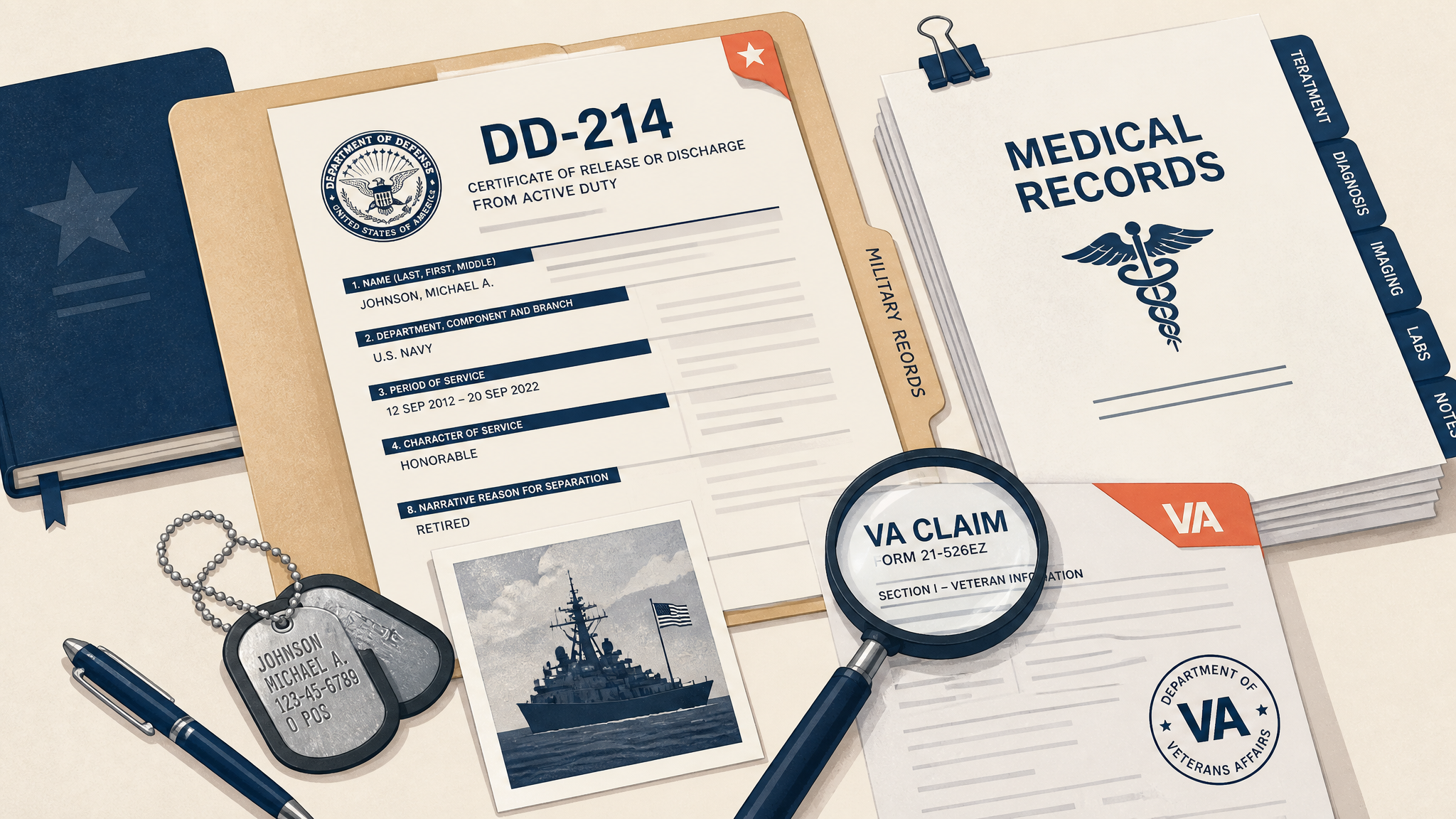
FIG. 01 - Gather your paperwork
First
Gather your documents
Have your DD-214, last year gross household income (for income-based groups), and your insurance cards including Medicare.
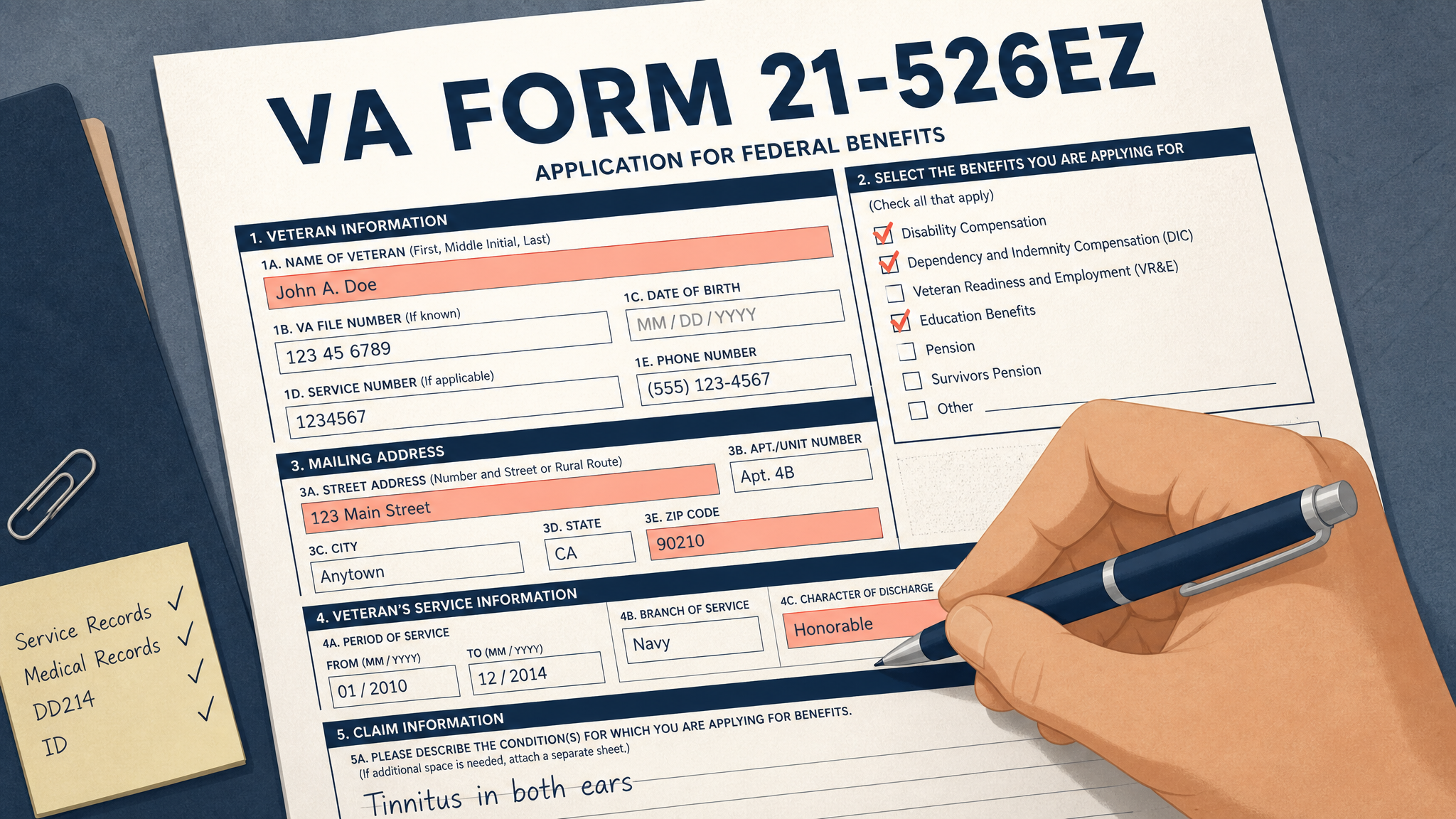
FIG. 02 - Fill out the form
Apply once
File VA Form 10-10EZ
Apply online at va.gov, by phone at 1-877-222-8387, by mail, or in person at any VA medical center. Most decisions come back in writing in 5 to 7 days.
FIG. 03 - File the claim
Once enrolled
Get assigned a care team
Being enrolled and having a doctor are two different things. Call the enrollment coordinator at your VA medical center and ask to be assigned a primary care team, then schedule that first visit.
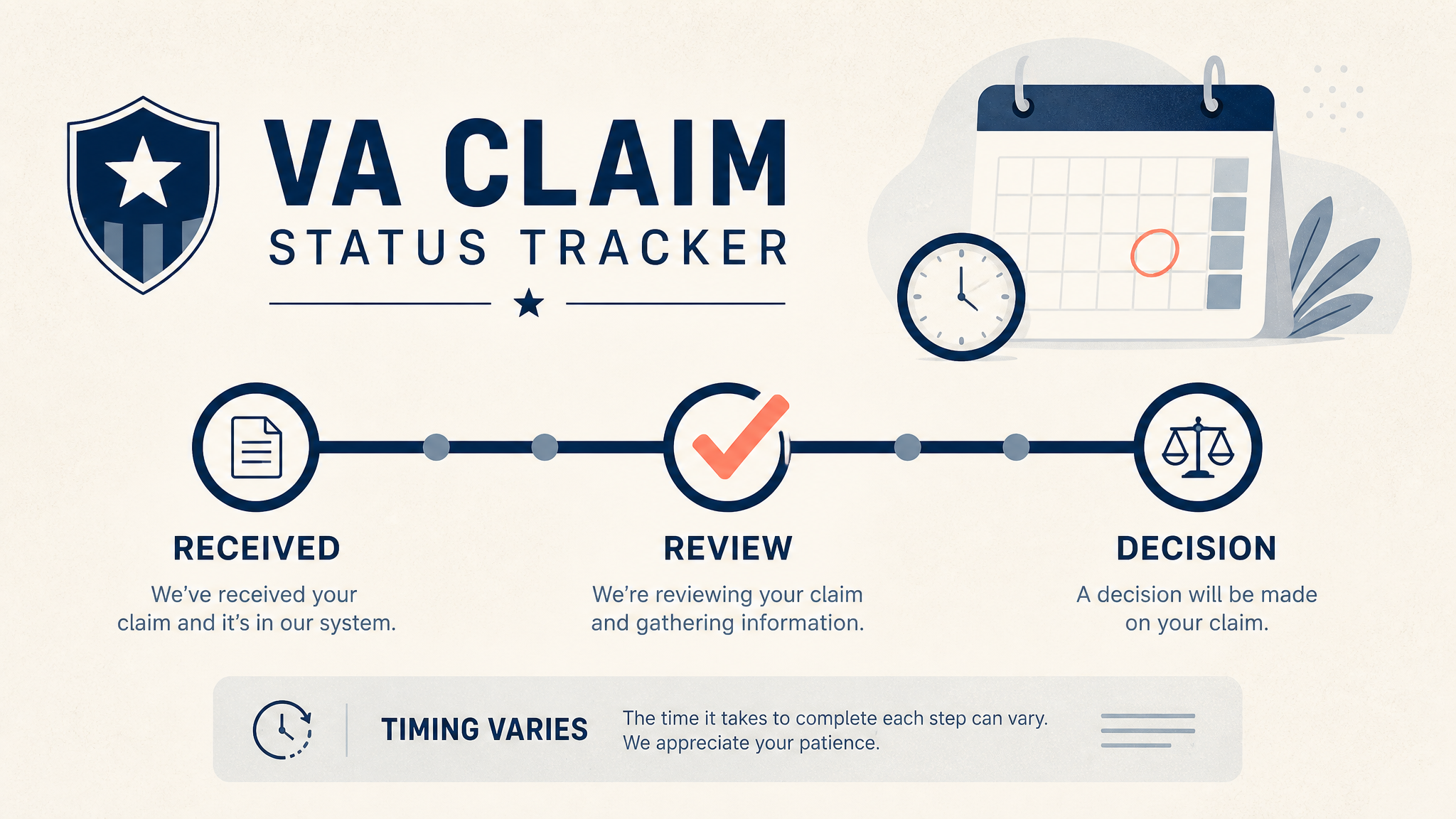
FIG. 04 - After you file
Then keep it working
Set up online access and claim your travel pay
Refills, secure messages, and lab results all live in your online account - and mileage to VA-authorized care is reimbursed at 41.5 cents per mile, filed within 30 days.
Who to call & where to go
These are free, official VA lines. Have your Social Security number handy when you call.
MyVA411 - Main VA Line
Not sure who to call? Start here. One number for anything VA - they route you to the right office.
Rather have us handle it?
No phone tag, no hold music. Call our office and a real, VA-accredited person walks you through it - start to finish.
702-992-4883Download the forms
Not sure where to start?
Apply once with VA Form 10-10EZ - online at va.gov, by phone at 1-877-222-8387, by mail to the Health Eligibility Center, or in person at any VA medical center or clinic. Bring your DD-214, your Medicare and any other insurance cards, and last year's gross household income if you are applying on an income basis. Attaching your discharge papers is the single fastest way to move the application. Most veterans get a written enrollment decision in 5 to 7 days, and that letter tells you your priority group and how to appeal if you disagree. Applying is free, staying enrolled is free, and no one can charge you a fee to file this form.
More benefits for veterans
These often go hand in hand - tap any card to learn more.











































Free information — get a free benefit review
Tell us how to reach you and an accredited team member will help you understand this benefit and claim everything you have earned. No cost, no obligation.
Ready to hire us? Register with us
For veterans who’ve decided they want us on their claim — registering is free too, and it does not make you our client or obligate you to anything. Here is exactly how it works:
- You register. This simply starts the conversation — you are not our client yet, and you owe us nothing.
- You sign and return VA Form 21-22a. It appoints us as your accredited representative and gives us access to your VA file.
- Once we have your signed 21-22a and access to your case, we verify everything is in order.
It involves the registration form and signing VA Form 21-22a — by law we can’t accept your claim, work on it, or contact the VA for you until that power of attorney is signed. You decide whether to move forward.
Answers, in plain language
Common questions about VA Health Care
What is VA Health Care?
Enrolled VA health care is the largest integrated health system in the country - primary care, hospital care, surgery, specialists, mental health, and a pharmacy - and for most older veterans it costs far less than they assume. Service-connected care is free, a 10% rating ends inpatient and outpatient care copays while a 50% rating (Priority Group 1) ends medication copays too, and even the veterans who do pay are capped at real, published dollar amounts rather than the open-ended bills that come with private insurance.
Who qualifies for VA Health Care?
You may be eligible for VA-paid care in your own community if any one of these is true - and the VA does not always volunteer it, so ask. One - the VA cannot provide the service you need. Two - no VA facility is within the drive-time standard (30 minutes for primary and mental health care, 60 minutes for specialty care). Three - the VA cannot see you inside the wait-time standard (20 days for primary and mental health, 28 days for specialty). Four - it is in your best medical interest, as you and your VA provider agree.
How much does VA Health Care pay?
These apply only to veterans without a service-connected rating of 10% or higher, and only to care that is not connected to service. Everyone else reads this section for reference, not for a bill. Outpatient care: $15 for a primary care visit, $50 for a specialty visit such as cardiology, surgery, or an eye doctor, and $50 for a specialty test like an MRI or a CT scan. If you have a primary care visit and a specialty visit on the same day, the total is capped at the single specialty rate. Urgent care depends on your group. Groups 1 through 5 pay nothing for the first three visits each calendar year, then $30 per visit.
How do I apply for VA Health Care?
Apply once with VA Form 10-10EZ - online at va.gov, by phone at 1-877-222-8387, by mail to the Health Eligibility Center, or in person at any VA medical center or clinic. Bring your DD-214, your Medicare and any other insurance cards, and last year's gross household income if you are applying on an income basis. Attaching your discharge papers is the single fastest way to move the application. Most veterans get a written enrollment decision in 5 to 7 days, and that letter tells you your priority group and how to appeal if you disagree. Applying is free, staying enrolled is free, and no one can charge you a fee to file this form.
What does it cost to get help with VA Health Care, and are you VA-accredited?
The most expensive mistake older veterans make with VA health care is assuming they earn too much to bother applying. There is no income cutoff that removes you from the system - income only decides which priority group you sit in and whether you owe a copay. Group 8, the highest-income group, still gets full VA health care. And a great many veterans who were placed in an income-based group years ago never went back and updated the VA after a rating increase or a drop in income, so they are still paying copays the law no longer requires. Ten minutes on the phone with enrollment can move you groups and end the copays going forward.