
Veteran Benefits
GI Bill Education Benefits (Post-9/11, Montgomery & Transfer to Family)
The GI Bill helps veterans and their families pay for college, trade school, certifications, apprenticeships, and more. The Post-9/11 GI Bill is the most-used version, covering tuition, housing, and books. Many older veterans still have unused entitlement they can use themselves for a second career - or transfer to a spouse or child.

There’s a free calculator on this page - estimate your GI Bill tuition, housing & book benefits. No sign-up, no cost.
Who this is for
The GI Bill is not just for young troops. Many older veterans still have unused months they can spend on a second career, a certification, or trade school - or pass to a spouse or child. But the rules on transferring and on switching programs are strict, and a wrong move can cost you.
In plain language
What GI Bill Education Benefits (Post-9/11, Montgomery & Transfer to Family) covers
- Post-9/11 (Chapter 33) - tuition, housing allowance, and book stipend
- Montgomery GI Bill (Chapter 30) and when to switch
- Transferring unused benefits to a spouse or children
- The Yellow Ribbon Program and the "Forever GI Bill" time limits

GI Bill Education BenefitsOfficial video - U.S. Dept of Veterans Affairs
5 things most veterans aren't aware of
These apply to nearly every VA claim - and they change how much you get and when.
Your filing date sets your back pay
Benefits are generally paid back to the day you file - not the day you are approved. Filing an intent to file today can protect months, even years, of retroactive pay.
One condition can trigger others (secondary claims)
A service-connected condition that causes another - like sleep apnea from PTSD, or a bad knee from a bad hip - can be rated on its own. Each secondary condition adds to your rating.
A medical nexus is what wins the claim
The VA needs a documented link between your condition and your service. A clear nexus opinion is often the difference between an approval and a denial.
Accredited help is free to file an initial claim
By law, an accredited agent cannot charge a fee to prepare and file your original claim. If someone asks for money up front to file, that is a red flag.
A denial is not the end of the road
You have three appeal lanes - Higher-Level Review, a Supplemental Claim with new evidence, and the Board of Veterans Appeals. Many denials are overturned on review.
36 months
Of education benefits under the Post-9/11 GI Bill (Chapter 33)
100%
In-state public tuition and fees paid at the full benefit tier
Transfer
Unused months to a spouse or child while you still serve
The full picture
Everything you need to know
Nothing hidden behind a click, and nothing you have to go looking for on another website. Here is the whole story in plain language - the facts and the figures first - so you can decide what fits your situation.
Key facts & current figures
- The Post-9/11 GI Bill (Chapter 33) provides up to 36 months of education benefits - it pays tuition and fees, a monthly housing allowance, and a books & supplies stipend (up to about $1,000 a year; confirm on va.gov).
- Tuition is paid in full at public in-state schools; private and foreign schools are covered up to a national maximum, with the Yellow Ribbon Program helping cover the gap at participating schools.
- You can transfer unused benefits to a spouse or children - but the transfer must be requested while you are still serving (generally after 6 years of service, agreeing to serve 4 more), through the DoD milConnect portal.
- The Montgomery GI Bill (Chapter 30) is a separate, older program; if you qualify for both you can switch to Post-9/11 (an irrevocable choice) and may get a partial refund of your $1,200 contribution.
- Thanks to the "Forever GI Bill," veterans whose last discharge was on or after Jan 1, 2013 have no expiration date on Post-9/11 benefits; earlier discharges generally had a 15-year window.
General figures, current as of December 2025 and reviewed each year. Your exact amount depends on your situation - always confirm on va.gov.
What the Post-9/11 GI Bill pays
- Up to 36 months of benefits: tuition and fees paid directly to the school, a monthly housing allowance (based on the E-5 with-dependents rate for your school's ZIP code), and a books & supplies stipend up to about $1,000 per year (confirm on va.gov).
- Public in-state tuition is covered in full. Private and foreign schools are capped at a national maximum rate; the Yellow Ribbon Program can cover part or all of the remaining tuition at participating schools.
- The benefit covers far more than four-year degrees - trade and technical schools, licensing and certification tests, apprenticeships and on-the-job training, and national testing fees can all qualify.
Montgomery GI Bill (Chapter 30) and choosing between them
- The Montgomery GI Bill - Active Duty is an older program that pays a flat monthly amount for up to 36 months and required a $1,200 contribution during service.
- If you qualify for both, you may elect the Post-9/11 GI Bill - but the switch is irrevocable, so compare carefully. Most veterans attending a traditional school do better on Post-9/11 because it pays tuition plus housing.
- Veterans who switch from Chapter 30 may receive a proportional refund of the $1,200 contribution, paid out only after they have used all their Post-9/11 months.
Transferring benefits to a spouse or children
- Transfers are approved by the Department of Defense and must be requested while still serving - generally after 6 years of service with an agreement to serve 4 more - through the milConnect portal.
- A spouse can use transferred benefits right away and after you separate; a child can use them only after you have served 10 years, must have a high school diploma (or be 18), and must finish by age 26.
- Once approved, the family member applies with VA Form 22-1990e. After you leave service you can still reallocate months among people you already named, but you cannot add new beneficiaries.
Time limits and stacking with other benefits
- Under the "Forever GI Bill" (Colmery Act), veterans whose last discharge was on or after Jan 1, 2013 have no expiration; those discharged earlier generally must use benefits within 15 years.
- Veterans with two or more qualifying periods of active duty may be entitled to up to 48 months combined across the Montgomery and Post-9/11 programs (the Rudisill rule).
- The GI Bill can also work alongside VR&E (Chapter 31); a counselor can help you decide the best order to protect the most benefits.
See what your GI Bill is worth
Post-9/11 GI Bill benefit estimator
The GI Bill is not just for young troops - many older veterans still have unused months they can spend on a second career, a certification, or trade school. Tell us your qualifying service and school, and we'll estimate your benefit percentage, the tuition and fees the VA would cover, your monthly housing allowance range, and your books stipend - plus where the Yellow Ribbon Program can close any gap.
Your qualifying active-duty service
Months served after Sept 11, 2001
Add up all your qualifying active-duty time - it sets your benefit percentage.
Your service places you in the 100% benefit tier - at least 36 months of qualifying service.
What kind of school?
At a public school the VA covers up to 100% of the in-state resident rate at your tier. Out-of-state students can often close the gap through the Yellow Ribbon Program.
Yearly tuition & fees
What the school charges a year
Enter the in-state resident rate
How will you attend?
Tuition & fees are paid in full at your tier no matter your pace, but the housing allowance and book stipend are prorated by how many credits you take. Online-only students receive a reduced housing rate.
Estimated tuition & fees covered / year
$12,000
at your 100% Post-9/11 GI Bill tier
- Books & supplies
- $1,000/yr
- Housing allowance
- ~$1,400-$2,800/mo
- Entitlement
- up to 36 months
Estimate only. Your housing allowance is set by your school’s ZIP code and changes yearly, and the private-school cap is updated each August. Confirm exact amounts on va.gov.
Discharged on or after Jan 1, 2013? Your Post-9/11 GI Bill benefits never expire under the Forever GI Bill.
This calculator is free. No sign-up, no catch.
Most people in this business hide tools like this behind a paywall or a sign-up form. We don’t. Use it as much as you need. And if you want a real accredited agent to look at your actual claim, we’re one call away — it’s free to talk, and free to file your claim.
Albert L. Thombs Jr. — VA-accredited claims agent (#45147), a disabled veteran with a team of advocates who do this every day.
Your complete benefit picture
Tuition + housing + books
The Post-9/11 GI Bill pays your school directly, sends a monthly housing allowance based on your school's ZIP code, and adds up to $1,000 a year for books. Discharged on or after Jan 1, 2013? It never expires. Confirm your tier and rates on va.gov.

Two ways to move forward — both free
Not sure if this applies to you?
Ask our free assistant a few plain questions and get an honest read on what you and your family may qualify for, at no cost. It takes just a few minutes, and there is no sign-up and no obligation of any kind. You will get a clear, plain-language picture of where you stand and what might be worth filing. And if you would rather talk to a real person, an accredited agent is only a message away.
Have a question? Get free information
Ask a question, learn what you may be owed, or find out where you stand. Confidential, free, and no obligation to go any further.
Ready to hire us? Register
Decided you want us to work your claim? Registering is free — we match you with an accredited advocate and get you started. We cannot begin until you sign VA Form 21-22a, and fees, if any, are always disclosed up front.
Pass it on
You can move unused GI Bill months to your family
If you qualify at the 100% tier, the Post-9/11 GI Bill covers full in-state public tuition, and the Yellow Ribbon program can close the gap at many private and out-of-state schools.
While you are still serving, you can transfer unused entitlement to a spouse or child through milConnect - a decision worth making before you separate.
Montgomery to Post-9/11
Switching from the Montgomery GI Bill (Chapter 30) to Post-9/11 is irrevocable, but can refund part of your $1,200 contribution - compare both before you elect.
How family members apply
After you transfer entitlement, your dependent files VA Form 22-1990e using their own Login.gov or ID.me account.
A clear path forward
Your step-by-step action plan
No rush and no pressure - but a little order helps. Applying is always free.
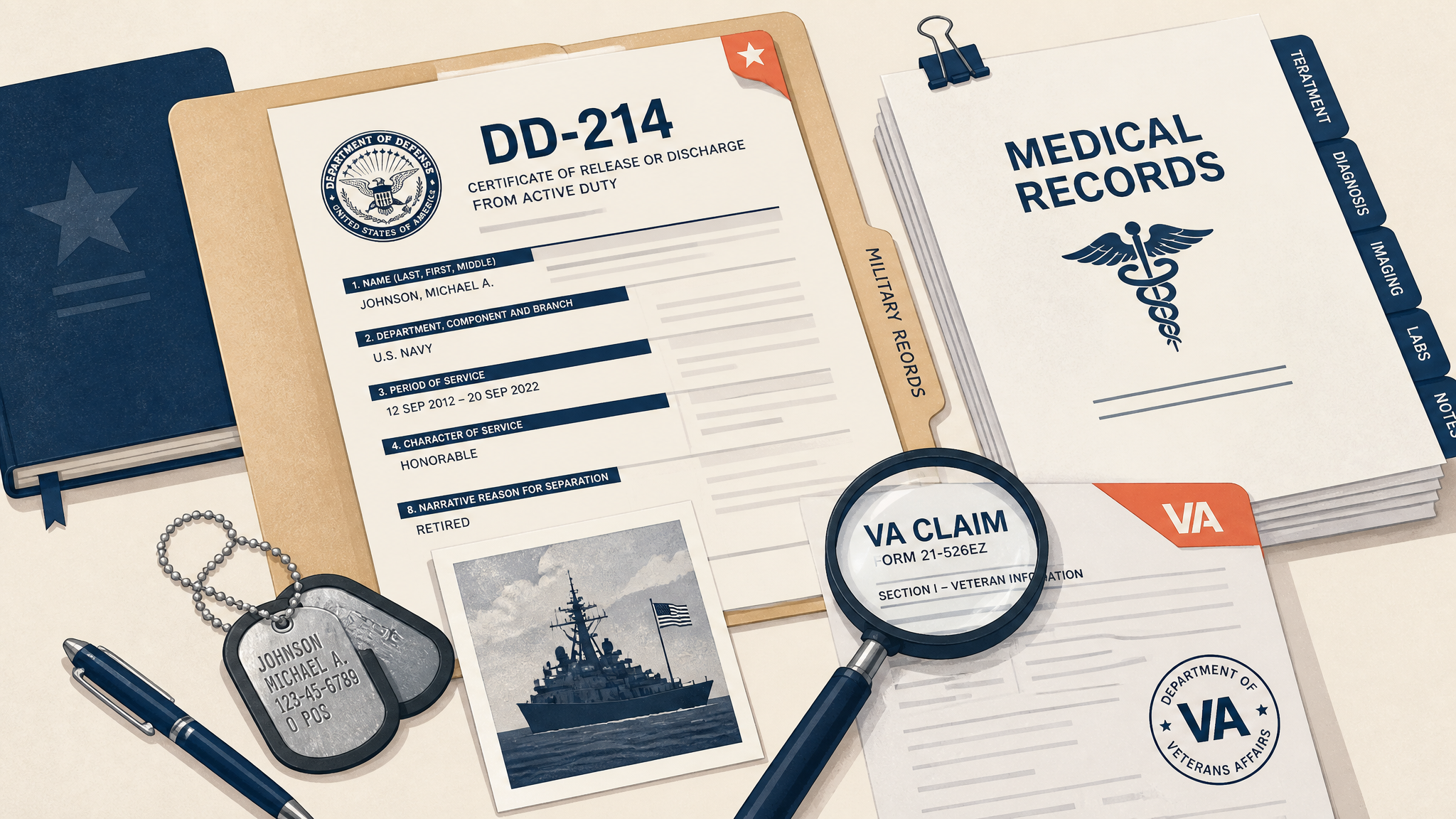
FIG. 01 - Gather your paperwork
First
Compare your programs
Use the VA GI Bill Comparison Tool to weigh Post-9/11, Montgomery, and VR&E against your school and goals.
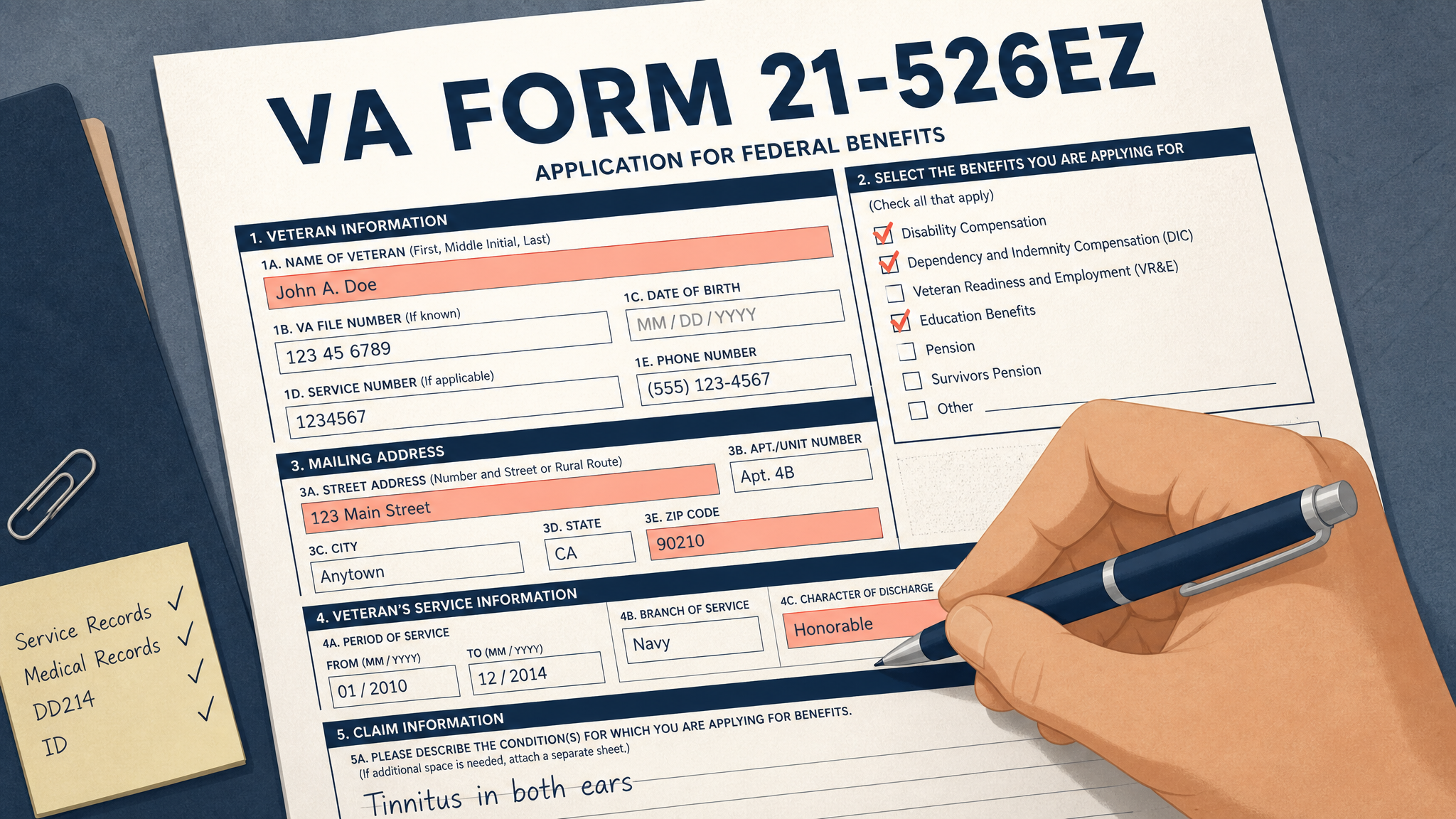
FIG. 02 - Fill out the form
To apply
File Form 22-1990
Submit your Application for VA Education Benefits on va.gov to get your Certificate of Eligibility.

FIG. 03 - File the claim
Before you separate
Transfer to family
Request the transfer through milConnect while on active duty - you generally owe additional service to lock it in.
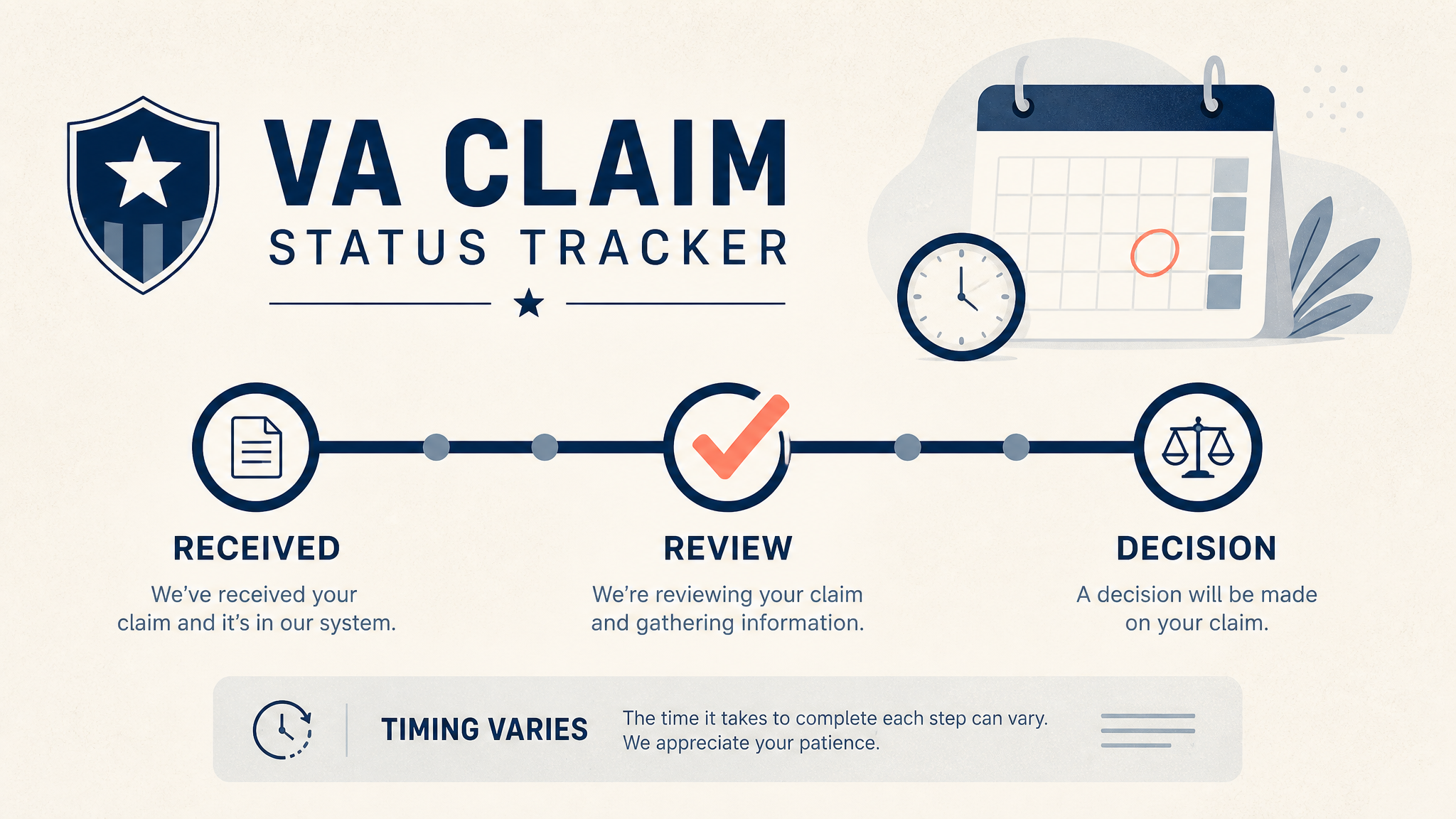
FIG. 04 - After you file
At school
Have the school certify
Give your Certificate of Eligibility to the school certifying official so VA pays tuition and starts your housing allowance.
Who to call & where to go
These are free, official VA lines. Have your Social Security number handy when you call.
Education / GI Bill
GI Bill, DEA (Chapter 35), and the Fry Scholarship.
VA Benefits Hotline
Compensation, pension, and general claim questions.
Rather have us handle it?
No phone tag, no hold music. Call our office and a real, VA-accredited person walks you through it - start to finish.
702-992-4883Not sure where to start?
Apply for the GI Bill on va.gov using VA Form 22-1990 (or 22-1995 to change your program or school). To transfer benefits to a dependent, the service member requests it through milConnect while still serving; the dependent then applies with VA Form 22-1990e using their own Login.gov or ID.me account. Your school's certifying official and your VSO can help you enroll and get your Certificate of Eligibility.
More benefits for veterans
These often go hand in hand - tap any card to learn more.













































Free information — get a free benefit review
Tell us how to reach you and an accredited team member will help you understand this benefit and claim everything you have earned. No cost, no obligation.
Ready to hire us? Register with us
For veterans who’ve decided they want us on their claim — registering is free too, and it does not make you our client or obligate you to anything. Here is exactly how it works:
- You register. This simply starts the conversation — you are not our client yet, and you owe us nothing.
- You sign and return VA Form 21-22a. It appoints us as your accredited representative and gives us access to your VA file.
- Once we have your signed 21-22a and access to your case, we verify everything is in order.
It involves the registration form and signing VA Form 21-22a — by law we can’t accept your claim, work on it, or contact the VA for you until that power of attorney is signed. You decide whether to move forward.
Answers, in plain language
Common questions about GI Bill Education Benefits (Post-9/11, Montgomery & Transfer to Family)
What is GI Bill Education Benefits (Post-9/11, Montgomery & Transfer to Family)?
The GI Bill helps veterans and their families pay for college, trade school, certifications, apprenticeships, and more. The Post-9/11 GI Bill is the most-used version, covering tuition, housing, and books. Many older veterans still have unused entitlement they can use themselves for a second career - or transfer to a spouse or child.
Who qualifies for GI Bill Education Benefits (Post-9/11, Montgomery & Transfer to Family)?
This benefit is generally for: Veteran, Spouse or child with transferred benefits, Veteran planning a second career. Post-9/11 (Chapter 33) - tuition, housing allowance, and book stipend Montgomery GI Bill (Chapter 30) and when to switch
How do I apply for GI Bill Education Benefits (Post-9/11, Montgomery & Transfer to Family)?
Apply for the GI Bill on va.gov using VA Form 22-1990 (or 22-1995 to change your program or school). To transfer benefits to a dependent, the service member requests it through milConnect while still serving; the dependent then applies with VA Form 22-1990e using their own Login.gov or ID.me account. Your school's certifying official and your VSO can help you enroll and get your Certificate of Eligibility.
What does it cost to get help with GI Bill Education Benefits (Post-9/11, Montgomery & Transfer to Family), and are you VA-accredited?
Two things trip veterans up. First, transfers must be set up while you are still in uniform - once you separate or retire you can no longer add a spouse or child, only adjust months among people you already named. Second, switching from the Montgomery to the Post-9/11 GI Bill is permanent, so run the numbers first. If you are already out and never transferred, you can still use any remaining months yourself. It is free to talk with us, and no one may charge you to file a first-time VA claim. The Aging Veteran is led by Albert L. Thombs Jr., a VA-accredited claims agent (accreditation #45147) and disabled veteran; any appeal work is handled on a no-fee-unless-you-win basis.