
Veteran Benefits
Medicare & VA Health Care
Turning 65 does not cancel your VA health care - but it does force a real decision about Medicare. Because VA and Medicare do not coordinate the way private insurance does, the smart move for most veterans is to keep both. This page explains what Part B costs in 2026, why skipping it can trigger a lifelong penalty, and why your VA pharmacy already protects you on the drug side.

Who this is for
When you turn 65, one question quietly decides how much you pay for health care for the rest of your life: should you sign up for Medicare Part B, or lean on your VA health care alone? Get it right and you have two safety nets. Get it wrong and you can be locked into a permanent penalty on your premium - one that never goes away. Here is the plain-language breakdown, with the real 2026 numbers, so you can decide with your eyes open.
In plain language
What Medicare & VA Health Care covers
- Why VA health care and Medicare do not coordinate (and how that differs from CHAMPVA)
- Whether you should enroll in Medicare Part B or rely on the VA alone
- The real 2026 Part B premium, deductible, and coinsurance
- The permanent late-enrollment penalty - and why VA drug coverage protects you from the Part D penalty

Medicare & VA CoordinationOfficial video - U.S. Dept of Veterans Affairs
5 things most veterans aren't aware of
These apply to nearly every VA claim - and they change how much you get and when.
Your filing date sets your back pay
Benefits are generally paid back to the day you file - not the day you are approved. Filing an intent to file today can protect months, even years, of retroactive pay.
One condition can trigger others (secondary claims)
A service-connected condition that causes another - like sleep apnea from PTSD, or a bad knee from a bad hip - can be rated on its own. Each secondary condition adds to your rating.
A medical nexus is what wins the claim
The VA needs a documented link between your condition and your service. A clear nexus opinion is often the difference between an approval and a denial.
Accredited help is free to file an initial claim
By law, an accredited agent cannot charge a fee to prepare and file your original claim. If someone asks for money up front to file, that is a red flag.
A denial is not the end of the road
You have three appeal lanes - Higher-Level Review, a Supplemental Claim with new evidence, and the Board of Veterans Appeals. Many denials are overturned on review.
$202.90/mo
2026 standard Medicare Part B premium
10% forever
Penalty for every 12 months you delay Part B
$283
2026 Part B annual deductible
The full picture
Everything you need to know
Nothing hidden behind a click, and nothing you have to go looking for on another website. Here is the whole story in plain language - the facts and the figures first - so you can decide what fits your situation.
Key facts & current figures
- VA health care and Medicare are two separate systems - unlike CHAMPVA, they do NOT coordinate or pay as "second payer" to each other. VA care covers you at VA facilities; Medicare covers you in the community.
- You are not required to take Medicare Part B to keep your VA health care - but the VA still strongly encourages it, because it gives you care outside the VA and a backup if eligibility ever changes.
- VA health care is NOT "creditable coverage" for Part B - so if you skip Part B now and enroll later, you can owe a permanent 10% premium penalty for every 12 months you could have had it.
- 2026 Part B: standard premium $202.90 per month, an annual deductible of $283, then Medicare pays 80% and you pay 20% of covered services.
- Your VA drug coverage IS creditable for Medicare Part D - so you can delay Part D with no penalty and keep using the VA pharmacy (you have a 63-day window to pick up Part D if you ever lose VA drug coverage).
- Higher earners pay more for Part B (an IRMAA surcharge); the standard $202.90 applies at or below $109,000 individual / $218,000 joint income.
General figures, current as of December 2025 and reviewed each year. Your exact amount depends on your situation - always confirm on va.gov.
VA and Medicare do not talk to each other
- This is the single most important thing to understand: VA and Medicare do not coordinate benefits. The VA does not bill Medicare, and Medicare does not pay the VA. Each one covers you in its own setting.
- That is the opposite of CHAMPVA, which IS a true second payer to Medicare. So advice that works for a CHAMPVA spouse does not apply to a veteran's own VA care.
- Because they do not coordinate, having both is what gives you real flexibility - VA care (often with low or no copays for service-connected veterans) plus the ability to see any Medicare doctor or hospital in the community.
Should you take Part B?
- You can keep VA health care without ever enrolling in Part B - it is genuinely optional for your VA eligibility.
- But the VA itself recommends enrolling, and for most veterans it is the safer choice: it lets you get care outside the VA (handy if a VA facility is far away or wait times are long), and it protects you if your VA priority group or eligibility ever changes.
- The risk of waiting is the penalty below. The risk of taking it is simply the monthly premium. For many older veterans, the peace of mind and the community access are worth it.
The 2026 numbers
- Part B premium: the standard 2026 amount is $202.90 per month for most people (higher for upper-income earners through the IRMAA surcharge).
- Part B deductible: $283 for the year; after that, Medicare generally pays 80% and you pay 20% of the approved amount for covered services.
- Part A (hospital) is premium-free for almost everyone who worked about 10 years - there is rarely a reason not to take Part A at 65.
The penalty that never goes away
- Because VA health care is not creditable coverage for Part B, delaying it without other qualifying coverage means a 10% premium penalty for each full 12-month period you could have been enrolled - and that penalty is added for as long as you have Part B.
- Example: wait three years with no qualifying coverage and your premium is roughly 30% higher, permanently - on top of the normal premium.
- The clean exception is if you (or your spouse) are still actively working with employer group coverage - that can give you a penalty-free Special Enrollment Period later. Check before you assume it applies.
Your VA pharmacy protects your Part D
- Good news on the drug side: VA prescription coverage is considered creditable coverage for Medicare Part D. You can skip Part D and keep filling prescriptions through the VA with no late penalty.
- If you ever lose VA drug coverage, you have a 63-day window to enroll in a Part D plan without penalty. Many veterans simply keep using the VA pharmacy and never buy Part D at all.
The fear I hear most
Afraid to tell the VA you have Medicare or other insurance?
I hear it every week. A veteran quietly hides that he has Medicare, Medicaid, or a plan through a spouse - certain that if he says it out loud, his free VA care disappears or it starts coming out of his disability check. None of that is true. Telling the VA what you have can only help you. Here is exactly why, in plain English.
It can even save you money. When your private insurance pays the VA for non-service-connected care, the VA applies that money against your copay - dollar for dollar - which can lower it or wipe it out.

“If I tell the VA I have Medicare, my care won’t be free anymore.”
Care for your service-connected conditions is always free at the VA. Nothing you carry on the side - Medicare, Medicaid, or private insurance - changes that.
“The VA will bill my Medicare or Medicaid and stick me with the rest.”
By law the VA does not bill Medicare or Medicaid. For non-service-connected care it may bill your private insurance - and you never owe the part your insurer does not pay.
“It will come out of my disability check or my pension.”
Medicare and Medicaid are separate programs. They do not reduce, tax, or use up your VA disability compensation or pension. Those checks keep coming in full.
Start here
“How do I even know what I already have?”
A lot of veterans are not sure what coverage is already in their name. That is normal - and easy to check. Here is where each one lives and the number to call to find out in minutes.
Medicare
Look for the red, white, and blue Medicare card. If you already draw Social Security, Part A usually started on its own at 65. Not sure? They can tell you in one call.
Medicare: 1-800-633-4227 · Sign-up is through Social Security: 1-800-772-1213
Medicaid
Medicaid is run by your state, so the name is different everywhere. Plenty of low-income seniors qualify and never applied - and it can cover things Medicare will not, like long-term nursing care.
Ask your state Medicaid office, or call 1-800-633-4227 for your state’s number
Your VA priority group
Your priority group sets any VA copay. Care for a service-connected condition has no copay at all. Your number is on your VA enrollment letter.
MyVA411: 1-800-698-2411
Who gets Medicare - and does being service-connected change it?
Not everyone gets every benefit - but Medicare is close. Here is who qualifies, and then the question I get asked most.
At 65
Almost every American qualifies at 65 - veteran or not. This is the big one.
Under 65
You qualify after 24 months on Social Security Disability (SSDI) - or right away with ALS or End-Stage Renal Disease.
Part A cost
Part A (hospital) is premium-free if you or a spouse paid Medicare taxes about 10 years (40 quarters). Most veterans have.
Does my VA rating change my Medicare?
No. Your service-connected rating does not change whether you get Medicare or what it costs - Medicare looks at your age and work record, not your VA file. What your rating does change is your VA care: service-connected conditions are treated free at the VA no matter what else you carry. The two run on separate tracks. That is exactly why holding both puts you in the strongest position - free VA care for your service-connected conditions, and Medicare waiting for everything else.
The one people miss
Where Medicaid fits - and why it is worth a phone call
Medicaid is separate from Medicare. It is the needs-based program for people with limited income and savings, and it is run by your state, so the name and the rules look a little different everywhere. Two things almost no one tells aging veterans:
Your VA benefits do not lock you out. Having VA health care or a disability rating does not disqualify you from Medicaid. Many veterans qualify and simply never applied.
It covers what Medicare will not - most of all, long-term nursing-home care. If Medicaid is paying for your nursing home, the VA limits your pension to $90 a month, but that $90 is yours to keep and does not count against your Medicaid.
What each one covers - and why both beat either alone
Your VA health care
- Service-connected conditions - free
- VA hospitals, clinics & specialists
- VA pharmacy (very low or no drug cost)
- Community Care when the VA sends you out
Medicare
- Any doctor or hospital that takes Medicare
- Care close to home, no VA referral needed
- A backup if VA eligibility ever changes
- Emergencies at a non-VA hospital
Together they cover you everywhere - the VA for your service-connected care, Medicare for the rest of life.
The decision at 65
Take Part B, or lean on the VA alone?
There is no single right answer - it depends on your life. Here is who each choice tends to fit, followed by the real costs and the one mistake that follows you for the rest of your life.
Enroll in Part B
What the VA recommends for most
A good fit if:
- You want to see doctors and specialists outside the VA
- A VA facility is far away or has long waits
- You want a backup if your VA priority group ever changes
- You can absorb the monthly premium comfortably
Rely on the VA alone
Allowed - but mind the penalty
Can make sense if:
- You are happy getting all your care at the VA
- You are still working with employer group coverage (a penalty-free window comes later)
- The premium is a genuine strain right now
Unless you have employer coverage, skipping Part B now can trigger the permanent penalty below.
What Part B costs in 2026
Part B premium
$202.90
per month (standard 2026 rate)
Part B deductible
$283
per year, then you pay 20%
Part A premium
$0
premium-free for most who worked ~10 years
Higher earners pay an added IRMAA surcharge; the standard $202.90 applies at or below $109,000 (individual) or $218,000 (joint) in income. Part A covers hospital stays - take it at 65, it is almost always free.
The penalty that never goes away
VA health care is not “creditable coverage” for Part B. So if you skip it now - with no employer plan - you add 10% for every 12 months you could have had it, and that higher premium sticks for as long as you have Part B.
Illustration using the 2026 base premium; the actual penalty is calculated on the base premium each year. The point stands - waiting is expensive, and permanent.
Don’t mix these up: VA vs. CHAMPVA with Medicare
This is the single most common source of bad advice. The two work with Medicare in opposite ways.
Your VA health care
Does NOT coordinate with Medicare
Two separate systems. The VA does not bill Medicare and Medicare does not pay the VA. That is exactly why having both is what gives you real coverage in and out of the VA.
A spouse’s CHAMPVA
IS a second payer to Medicare
For a CHAMPVA family member, Medicare pays first and CHAMPVA pays second, picking up much of what Medicare leaves - which is why a CHAMPVA spouse is usually required to keep Part B.
Your VA pharmacy protects your Part D
Good news on the drug side: VA prescription coverage is creditable for Medicare Part D. You can skip Part D with no penalty and keep using the VA pharmacy. If you ever lose VA drug coverage, you have a 63-day window to pick up a Part D plan.
Where you actually sign up
Medicare enrollment is through Social Security, not the VA - online at ssa.gov, or by phone at 1-800-772-1213. Enroll in the 7-month window around your 65th birthday to avoid the penalty.
Still working, or just not sure? Tell me your situation and I’ll help you time Part B so you never owe a penalty.
Know which card is which
The cards in your wallet, and what each one actually does
Most households end up carrying three or four of these, and they look enough alike that the wrong one gets slid across the counter. That is not a small mistake. Hand a clinic your Veteran Health ID card instead of your CHAMPVA card and the claim will not pay, because the first card is not insurance at all. Here is every card, drawn the way it really looks, with every field on it named - and then plainly which one to present, and when.
U.S. Department of Veterans Affairs
Veteran Health Identification Card
Name
Your name here
SERVICE CONNECTED
Issued by the Veterans Health Administration. Free.
What is printed on it
- Photo
- A current color headshot of you
- Name
- Your full name
- Branch emblem
- The emblem of your last branch of service
- Eligibility line
- SERVICE CONNECTED, PURPLE HEART or FORMER POW - only if it applies to you
- Member ID
- Your DoD-assigned identifier (the EDIPI) - this is how the VA pulls your record
- Plan ID
- The health plan number assigned to the VA itself, not to you
- Expiration date
- You may reapply within one year of that date
- Braille
- The letters VA, raised, for low-vision veterans
There is no Social Security number and no date of birth on this card, and the magnetic stripe and barcode carry no personal information at all. That is by design.
What it does
- Checks you in for an appointment at any VA medical center
- With the eligibility line showing, gets you through the gate to the commissary, the exchange and MWR facilities
- Works as proof of service for a civilian veteran discount
What it will never do
- It is not an insurance card. It will not pay for a single dollar of care outside the VA
- A surviving spouse or a dependent child will never have one - this card is for the veteran only
How you get it: You must be enrolled in VA health care first. Request it at va.gov/records/get-veteran-id-cards or walk into your VA medical center with a government photo ID.
Lost or expired: va.gov/records/get-veteran-id-cards, or ask at your VA medical center.
CHAMPVA
CHAMPVA identification card
Name
Your name here
Member No. 000-00-0000
Issued by the VHA Office of Integrated Veteran Care - the office that used to be called the Office of Community Care.
What is printed on it
- Name
- The covered spouse, surviving spouse or child - one card per person
- Member Number
- This is that person’s Social Security number, printed right on the front of the card
- Effective date
- The date the coverage started
Because the member number is a Social Security number, treat this card the way you treat your Social Security card. Do not photograph it, do not text it, and do not leave it loose in a wallet you set down.
What it does
- Proves your coverage to a civilian doctor, hospital, lab or pharmacy - they bill it directly
- Unlocks Meds by Mail for free maintenance prescriptions once your Other Health Insurance form is on file
- Is the card that makes you eligible to buy into a VADIP dental plan
What it will never do
- It will not get you treated inside a VA hospital as a patient - CHAMPVA buys you civilian care
- It is not Medicare, and in most cases it pays second, behind whatever other health insurance you carry
How you get it: It comes in the mail with your welcome letter after your VA Form 10-10d is approved. Allow up to six weeks after the approval letter.
Lost card, or your other insurance changed: call 800-733-8387.
Medicare Health Insurance
Medicare card
Name
Your name here
1EG4-TE5-MK73
Issued by the Centers for Medicare & Medicaid Services. Red, white and blue.
What is printed on it
- Name
- Your name as Social Security has it
- Medicare Number
- Eleven characters of letters and numbers, shown like 1EG4-TE5-MK73. The dashes are only there to help you read it - never type them on a form
- HOSPITAL (PART A)
- The date your hospital coverage starts
- MEDICAL (PART B)
- The date your doctor coverage starts, or blank if you declined Part B
That number has not been your Social Security number since 2019. It also never uses the letters S, L, O, I, B or Z - so anything that looks like the letter O is really a zero, and anything that looks like a 1 next to a letter is really the number one.
What it does
- This is the card a civilian provider bills first, before CHAMPVA sees the claim
- Keeping Part B is what keeps CHAMPVA and civilian coverage working together cleanly
What it will never do
- It does nothing inside the VA. The VA does not bill Medicare for your VA care
- It is not proof of veteran or survivor status for any VA program
How you get it: It arrives about three months before your 65th birthday if you already draw Social Security, or after you enroll yourself.
Lost card or forgotten number: sign in at Medicare.gov, read it off a Medicare Summary Notice, or call 1-800-MEDICARE.
U.S. Department of Veterans Affairs
Veteran ID Card
Name
Your name here
Digital card - lives in your VA.gov account
Issued by the VA. Digital only since September 2022 - there is no plastic version anymore.
What is printed on it
- Photo
- A headshot you upload yourself
- Name
- Your full name
- Branch
- Your branch of service
- Card number
- An identifier for the card itself - it is not tied to any benefit
This is the card people most often confuse with the VHIC, and the difference matters. It proves you served. That is the whole job.
What it does
- Proves your service for a restaurant, hotel or store discount so you are not carrying your DD214 around
- Any honorably or generally discharged veteran can get one, enrolled in VA health care or not
What it will never do
- It will not prove eligibility for any federal benefit
- It will not get you onto a base, into a commissary or into an exchange
- It is not accepted as airport identification, and it will not check you in at a VA hospital
How you get it: Apply at va.gov/records/get-veteran-id-cards/vic. It lands in your VA.gov account, not your mailbox.
If you already hold a VHIC you do not need this card at all - the VHIC does the same job for discounts.
Which card do I hand over?
Four counters, four answers. Read the left column, hand over what is in the middle.
Checking in for an appointment at a VA medical center
Your VHIC
Nothing else checks you in. If yours has expired, they can still see you - but reapply, because the front desk will ask every visit.
Sitting in a civilian doctor or dentist office on CHAMPVA
Your CHAMPVA card AND your Medicare card
The office needs both, because Medicare pays first and CHAMPVA pays behind it. Handing over only one is the most common reason a CHAMPVA claim stalls.
At the gate of a base, or the commissary or exchange register
Your VHIC with the eligibility line, or a DoD ID card
The card has to actually show SERVICE CONNECTED, PURPLE HEART or FORMER POW. The first time through, stop at the Visitor Control Center to get registered.
Asking for a veteran discount at a store or restaurant
Whichever you already carry
A VHIC, a Veteran ID Card, a DoD ID, or a state driver license with the veteran designation all work. Do not hand over your DD214.
When the office says they do not take it
Read these four lines to the billing clerk
Most front desks have simply never keyed a CHAMPVA claim before, so they say no. They are not refusing you - they cannot find the payer. Hand them this and the conversation usually ends there.
- Verify my eligibility
- Payer ID VAHAC, or call 888-820-1756
- Send the medical claim to
- Payer ID 84146
- Send the dental claim to
- Payer ID 84147
- Get preauthorization
- 833-930-0816
A provider does not have to be in any network to bill CHAMPVA. They only have to be licensed and willing to send the claim.
Three traps worth naming
Nobody will call you for these numbers
Medicare will never phone and ask you to read your Medicare number aloud, and neither will the VA. If someone does, hang up.
Keep your other insurance on file
CHAMPVA pays second in most cases. If the office of Integrated Veteran Care does not have your current other-insurance information, claims get denied or held - not because you lost coverage, but because the file is stale. Update it whenever a plan changes.
Your 1095-B is not mailed anymore
As of 2026 CHAMPVA no longer mails IRS Form 1095-B automatically. If your state return or your records need proof of minimum essential coverage, you have to request it.
Not sure which card you are holding, or which one you are owed? Tell me who is in the household and what arrived in the mail, and I will tell you exactly which cards should be in that wallet.
Your complete benefit picture
$202.90/mo
the 2026 Part B premium - a number most veterans never weigh, because nobody told them VA health care does not count as creditable coverage for Part B.

Two ways to move forward — both free
Not sure if this applies to you?
Ask our free assistant a few plain questions and get an honest read on what you and your family may qualify for, at no cost. It takes just a few minutes, and there is no sign-up and no obligation of any kind. You will get a clear, plain-language picture of where you stand and what might be worth filing. And if you would rather talk to a real person, an accredited agent is only a message away.
Have a question? Get free information
Ask a question, learn what you may be owed, or find out where you stand. Confidential, free, and no obligation to go any further.
Ready to hire us? Register
Decided you want us to work your claim? Registering is free — we match you with an accredited advocate and get you started. We cannot begin until you sign VA Form 21-22a, and fees, if any, are always disclosed up front.
The trap
VA care is creditable for drugs. It is not creditable for Part B.
Your VA pharmacy is creditable coverage for Medicare Part D. You can skip Part D with no penalty and keep filling prescriptions at the VA. That one fact saves veterans real money every single year.
Part B is the opposite. VA health care is not creditable, so every 12 months you go without Part B adds a permanent 10 percent to your premium once you finally enroll. The penalty does not expire, and it is not forgiven.
Two systems, not one
Unlike CHAMPVA, Medicare and VA health care do not pay as second payer to each other. Each one pays where it applies and nowhere else.
Community care is not Medicare
A VA community care authorization is billed to the VA, not to Medicare. Never hand a provider both cards and assume the billing office will sort it out.
A clear path forward
Your step-by-step action plan
No rush and no pressure - but a little order helps. Applying is always free.
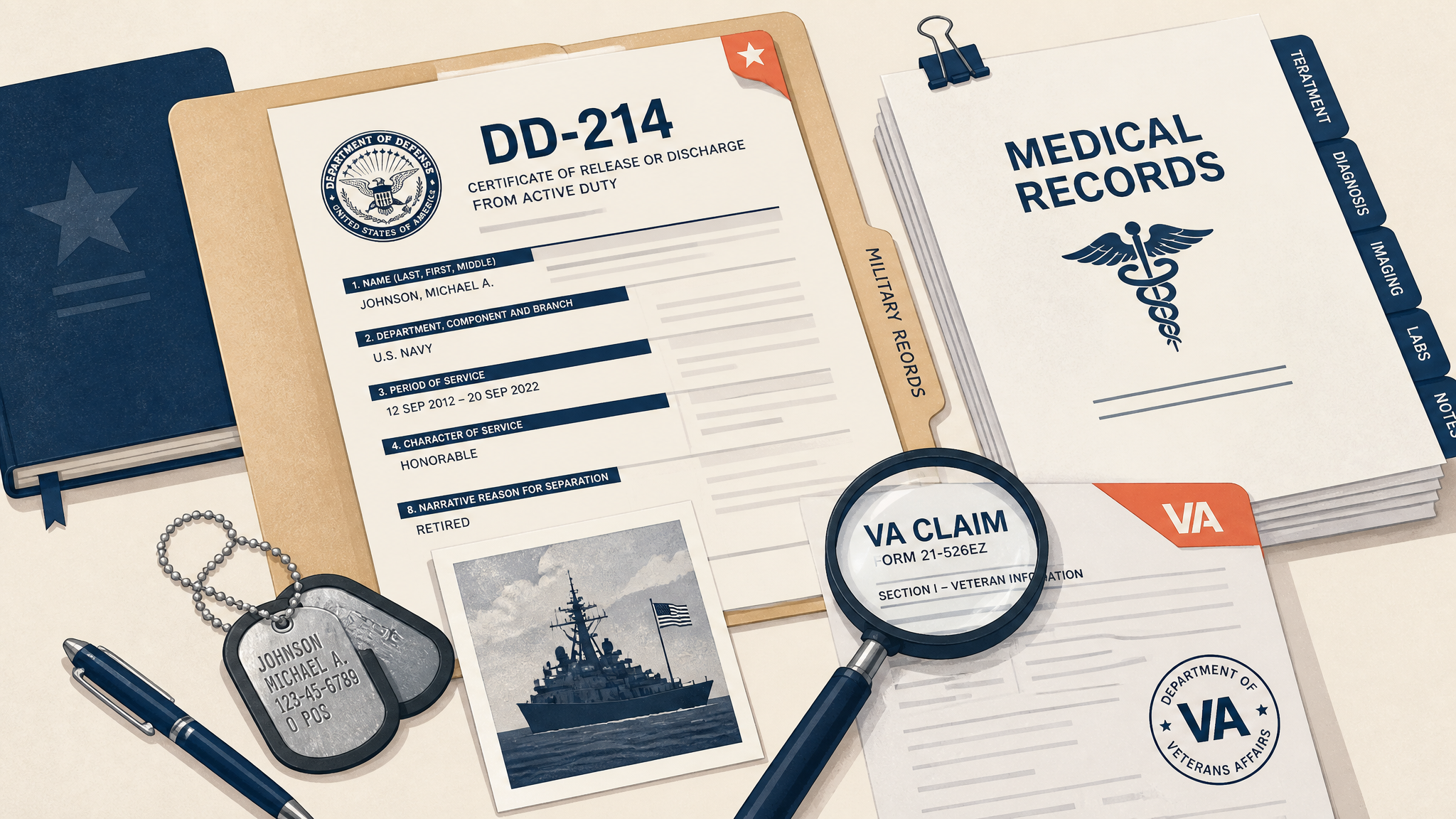
FIG. 01 - Gather your paperwork
3 months before 65
Open your Initial Enrollment Period
It runs the 3 months before your birthday month, that month, and the 3 months after. Enrolling inside that window avoids the late penalty entirely.
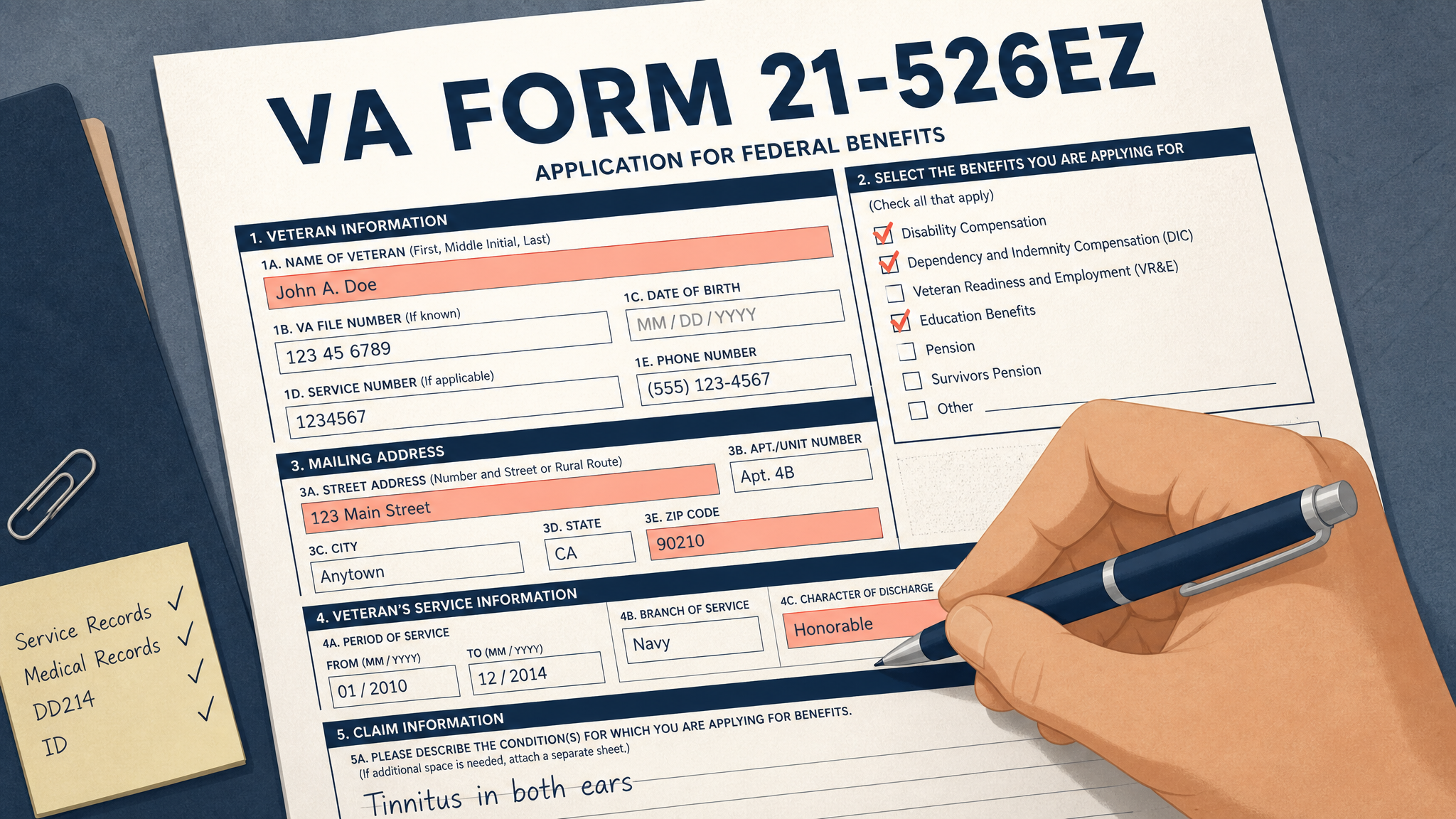
FIG. 02 - Fill out the form
Decide on Part B
Price the premium against the risk
Part B buys care outside the VA - the emergency room ten minutes from home, a specialist without waiting on community care. For most older veterans that second net is worth $202.90 a month.
FIG. 03 - File the claim
Skip Part D
Stay with the VA pharmacy
Keep the letter saying your VA drug coverage is creditable. If you ever lose VA drug coverage you have 63 days to pick up Part D with no penalty.
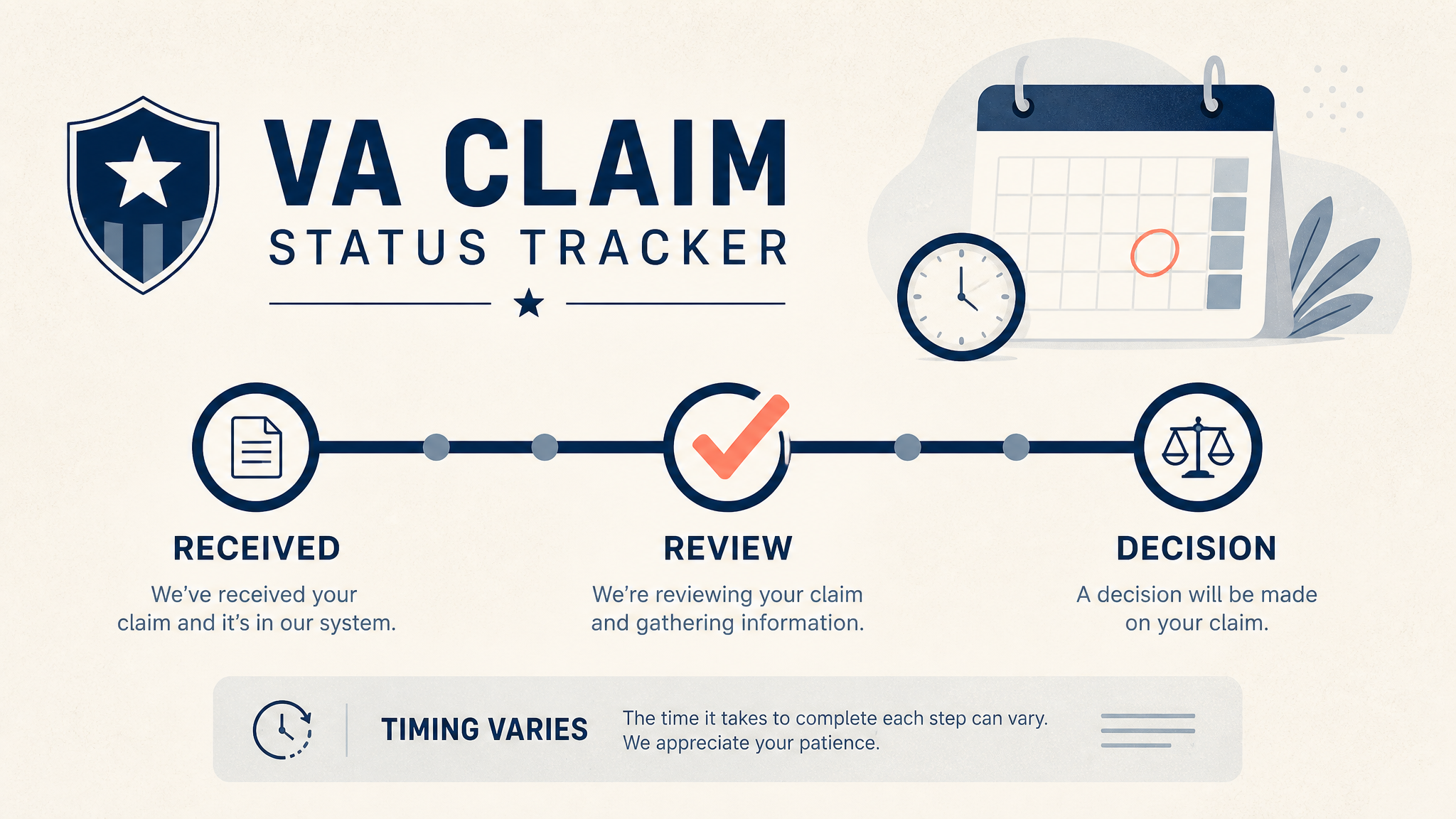
FIG. 04 - After you file
Every January
Check your IRMAA bracket
The standard premium applies at or below $109,000 individual and $218,000 joint. Above that, the surcharge is set from your tax return two years earlier.
Who to call & where to go
These are free, official VA lines. Have your Social Security number handy when you call.
MyVA411 - Main VA Line
Not sure who to call? Start here. One number for anything VA - they route you to the right office.
Rather have us handle it?
No phone tag, no hold music. Call our office and a real, VA-accredited person walks you through it - start to finish.
702-992-4883Not sure where to start?
You sign up for Medicare through Social Security, not the VA - online at ssa.gov, by phone at 1-800-772-1213, or at your local Social Security office. Enroll during your Initial Enrollment Period (the 7 months around your 65th birthday) to avoid a penalty. If you are still working with employer coverage, ask us about the Special Enrollment Period before you decide.
More benefits for veterans
These often go hand in hand - tap any card to learn more.





































Free information — get a free benefit review
Tell us how to reach you and an accredited team member will help you understand this benefit and claim everything you have earned. No cost, no obligation.
Ready to hire us? Register with us
For veterans who’ve decided they want us on their claim — registering is free too, and it does not make you our client or obligate you to anything. Here is exactly how it works:
- You register. This simply starts the conversation — you are not our client yet, and you owe us nothing.
- You sign and return VA Form 21-22a. It appoints us as your accredited representative and gives us access to your VA file.
- Once we have your signed 21-22a and access to your case, we verify everything is in order.
It involves the registration form and signing VA Form 21-22a — by law we can’t accept your claim, work on it, or contact the VA for you until that power of attorney is signed. You decide whether to move forward.
Official VA links
Answers, in plain language
Common questions about Medicare & VA Health Care
What is Medicare & VA Health Care?
Turning 65 does not cancel your VA health care - but it does force a real decision about Medicare. Because VA and Medicare do not coordinate the way private insurance does, the smart move for most veterans is to keep both. This page explains what Part B costs in 2026, why skipping it can trigger a lifelong penalty, and why your VA pharmacy already protects you on the drug side.
Who qualifies for Medicare & VA Health Care?
This benefit is generally for: Veteran, Veteran turning 65, Veteran on VA health care. Why VA health care and Medicare do not coordinate (and how that differs from CHAMPVA) Whether you should enroll in Medicare Part B or rely on the VA alone
How do I apply for Medicare & VA Health Care?
You sign up for Medicare through Social Security, not the VA - online at ssa.gov, by phone at 1-800-772-1213, or at your local Social Security office. Enroll during your Initial Enrollment Period (the 7 months around your 65th birthday) to avoid a penalty. If you are still working with employer coverage, ask us about the Special Enrollment Period before you decide.
What does it cost to get help with Medicare & VA Health Care, and are you VA-accredited?
Do not confuse this with CHAMPVA. For a CHAMPVA spouse, Medicare and CHAMPVA work together and Part B is usually required. For a veteran's own VA health care, Part B is optional but usually wise - and the late penalty is permanent, so the decision at 65 matters. If you are still working past 65 with employer insurance, the rules shift in your favor; talk it through before you turn anything down. It is free to talk with us, and no one may charge you to file a first-time VA claim. The Aging Veteran is led by Albert L. Thombs Jr., a VA-accredited claims agent (accreditation #45147) and disabled veteran; any appeal work is handled on a no-fee-unless-you-win basis.