
Veteran Benefits
VA Claims Myths vs. Facts - What Veterans Get Wrong
Misinformation about VA disability claims is everywhere - some of it decades old, some of it born out of real frustration with a slow system. This page takes the most common myths veterans believe and sets the record straight with the actual rules, the actual law, and the actual process. Nothing here is opinion - it is how the system works right now, verified against current 38 CFR regulations and VA policy.

Who this is for
Every veterans' hall, Facebook group, and barbershop has someone repeating a myth about VA disability claims as if it were gospel. Some of those myths have stopped real veterans from filing real claims - or cost them years of benefits they could have had. Here are the facts, straight, with no filler.
In plain language
What VA Claims Myths vs. Facts - What Veterans Get Wrong covers
- Whether it is too late to file a VA claim
- How back pay actually works (effective date, not injury date)
- Whether the VA really denies claims until veterans die
- Whether a VA rating hurts your employment
- Filing VA and Social Security claims at the same time
- How VA disability interacts with military retirement pay (CRDP/CRSC)
- Whether hiring an agent or attorney speeds up your claim
- Whether SSDI disqualifies you from VA compensation

The full picture
Everything you need to know
Nothing hidden behind a click, and nothing you have to go looking for on another website. Here is the whole story in plain language - the facts and the figures first - so you can decide what fits your situation.
Key facts & current figures
- It is never too late to file a VA disability claim - there is no deadline after separation from service, and conditions that appear decades later can still be service-connected.
- Back pay does not go back to the date of your injury - it goes back to the effective date of your claim, which is usually the date you filed.
- A VA disability rating does not disqualify you from employment - and it may give you Veterans' Preference Points for federal jobs.
- You can file for VA disability compensation and Social Security disability benefits at the same time - they are separate programs with separate criteria.
- Veterans rated ##50%## or higher can receive full military retirement pay and full VA compensation simultaneously through CRDP - no offset.
General figures, current as of December 2025 and reviewed each year. Your exact amount depends on your situation - always confirm on va.gov.
Myth: It is too late to file because I left the military years ago
- Fact: There is no time limit to file a VA disability claim. You can file 1 year, 10 years, or 40 years after separation.
- Filing shortly after separation can make the evidence easier to gather, but conditions that develop decades later - like cancer, diabetes, or hearing loss - can still be service-connected.
- The PACT Act (2022) removed filing deadlines for many toxic-exposure conditions entirely. If you served near burn pits, Agent Orange, or contaminated water, your window is open right now.
- Many veterans we work with filed their first claim in their 60s, 70s, and 80s and received full benefits including back pay to the date they filed.
Myth: Back pay goes back to the date of my injury
- Fact: VA back pay is calculated from the effective date of your claim - usually the date you filed VA Form 21-526EZ - not the date of the injury itself.
- If you file within one year of separation, the effective date can be set to the day after discharge, which is the maximum possible back pay.
- For supplemental or reopened claims, the effective date is typically the date you filed the new evidence. For claims won on appeal, back pay can go to the original filing date.
- The takeaway: the sooner you file, the more back pay you can receive. Do not wait for perfect evidence - file an intent to file (VA Form 21-0966) to lock in today's date while you gather records.
Myth: The VA denies every claim until the veteran dies
- Fact: This is understandable frustration turned into a myth. The VA does deny claims - about 25-30% on initial decision - but the majority of claims are approved.
- When a claim is denied, it is almost always because of missing evidence: no current diagnosis, no service records, or no medical link between the condition and service.
- A denial is not the end. You can file a Supplemental Claim with new evidence, request a Higher-Level Review, or appeal to the Board of Veterans' Appeals. Many denials are overturned at these stages.
- The system is slow, not rigged. The veterans who win are the ones who keep filing with the right evidence - not the ones who give up after one denial.
Myth: The VA is out to get veterans
- Fact: VA employees - many of them veterans themselves - process millions of claims a year. The system has real problems: backlogs, inconsistent examiners, and bureaucratic friction.
- But the problems are systemic, not personal. The VA is not targeting individual veterans. The fix is not to distrust the system - it is to learn the system and file claims that give the VA what it needs to say yes.
- That said, you should never trust the system to do the work for you. The VA decides claims based on the evidence in the file. If the evidence is incomplete, the claim will be denied - not because of malice, but because the rules require it.
Myth: A VA disability rating will hurt my job prospects
- Fact: A VA disability rating does not appear on background checks, and employers generally cannot ask about it.
- Most civilian jobs evaluate you on your qualifications and ability to perform the work. A VA rating does not disqualify you from any job unless the specific position has medical fitness standards that your condition prevents you from meeting.
- For federal employment, a VA disability rating can actually help: it may qualify you for Veterans' Preference Points, giving you an advantage in the hiring process.
- A rating of 100% P&T does not mean you cannot work (unless you are rated under TDIU, which has income limits). Many veterans with 100% ratings hold full-time jobs.
Myth: Hiring an attorney or agent speeds up (or slows down) my claim
- Fact: The speed of your claim depends on the complexity of the case, the availability of evidence, and the VA's current workload - not whether you have representation.
- What an experienced representative does do is help you submit the right evidence the first time, avoid common mistakes that cause denials, and navigate appeals more efficiently.
- A representative cannot cut the VA's processing line, but they can make it far less likely that you waste months on a preventable denial and have to start over.
- VA-accredited representatives - agents, attorneys, and VSOs - are governed by 38 CFR Part 14 and cannot charge for initial claims. For appeals, fees are regulated and typically a percentage of past-due benefits.
Myth: I have to wait for my VA claim to finish before filing for Social Security
- Fact: You can file for VA disability compensation and Social Security disability (SSDI) at the same time. They are completely separate programs with separate criteria.
- The VA evaluates service connection - whether your condition is related to military service. Social Security evaluates total disability - whether you can work, regardless of what caused the condition.
- The evidence may overlap, but approval in one does not guarantee or prevent approval in the other.
- If you have a 100% Permanent and Total VA rating, Social Security may expedite your SSDI claim under its Wounded Warriors program.
Myth: Receiving Social Security disqualifies me from VA compensation
- Fact: You can receive both VA disability compensation and Social Security benefits (SSDI or SSI) at the same time. Neither program cancels the other.
- VA disability compensation is tax-free and is based on service-connected conditions. SSDI is based on your work history and total disability. They are independent programs.
- The one interaction to know: SSI (Supplemental Security Income, the needs-based program) does count VA compensation as income, which can reduce or eliminate SSI payments. SSDI does not have this problem.
- Many veterans receive full VA compensation and full SSDI simultaneously. There is no rule against it.
Myth: VA disability compensation reduces my military retirement pay
- Fact - with a twist: This one used to be true and is still partially true for lower ratings, which is why it persists.
- If your VA rating is ##50% or higher##, you qualify for Concurrent Retirement and Disability Payments (CRDP), which lets you collect full military retirement pay and full VA compensation with no offset.
- If your rating is 40% or lower, your retirement pay is reduced dollar-for-dollar by the amount of VA compensation you receive. But because VA compensation is tax-free and retirement pay is taxed, you may still come out ahead financially.
- If your disability is combat-related (regardless of percentage), you may qualify for Combat-Related Special Compensation (CRSC) instead of CRDP - this restores the offset as a tax-free payment.
- The bottom line: for most retirees rated 50% or above, there is no pay reduction at all. For those below 50%, the tax-free nature of VA compensation usually results in a net financial gain even with the offset.
The ever-changing 38 CFR - why secondhand advice can hurt
- The VA claim system is governed by Title 38 of the Code of Federal Regulations (38 CFR), which is updated every year. Rules that were true five years ago may no longer apply.
- Every veteran's claim is unique - same condition, same symptoms, different outcome - because the underlying service event, the medical records, and the C&P exam findings are all different.
- Advice from other veterans can be helpful for morale, but it should never replace guidance from a current, accredited representative who knows the current regulations.
- If someone tells you "the VA does not do that anymore" or "you cannot file for that," verify it before you accept it. The answer may have changed since they last checked.
Your complete benefit picture
You do not have to sort this out alone
The biggest myth of all is the one that keeps veterans from filing in the first place: that the system is rigged and there is no point. The system is slow, the system is bureaucratic, the system can be frustrating - but it is not rigged. Veterans who file with the right evidence, the right diagnosis, and the right forms get approved every single day. The ones who lose are usually the ones who heard a myth, believed it, and never tried.

Two ways to move forward — both free
Not sure if this applies to you?
Ask our free assistant a few plain questions and get an honest read on what you and your family may qualify for, at no cost. It takes just a few minutes, and there is no sign-up and no obligation of any kind. You will get a clear, plain-language picture of where you stand and what might be worth filing. And if you would rather talk to a real person, an accredited agent is only a message away.
Have a question? Get free information
Ask a question, learn what you may be owed, or find out where you stand. Confidential, free, and no obligation to go any further.
Ready to hire us? Register
Decided you want us to work your claim? Registering is free — we match you with an accredited advocate and get you started. We cannot begin until you sign VA Form 21-22a, and fees, if any, are always disclosed up front.
Worth knowing
Before you file, keep this in mind
The biggest myth of all is the one that keeps veterans from filing in the first place: that the system is rigged and there is no point. The system is slow, the system is bureaucratic, the system can be frustrating - but it is not rigged. Veterans who file with the right evidence, the right diagnosis, and the right forms get approved every single day. The ones who lose are usually the ones who heard a myth, believed it, and never tried.
A clear path forward
Your step-by-step action plan
No rush and no pressure - but a little order helps. Applying is always free.
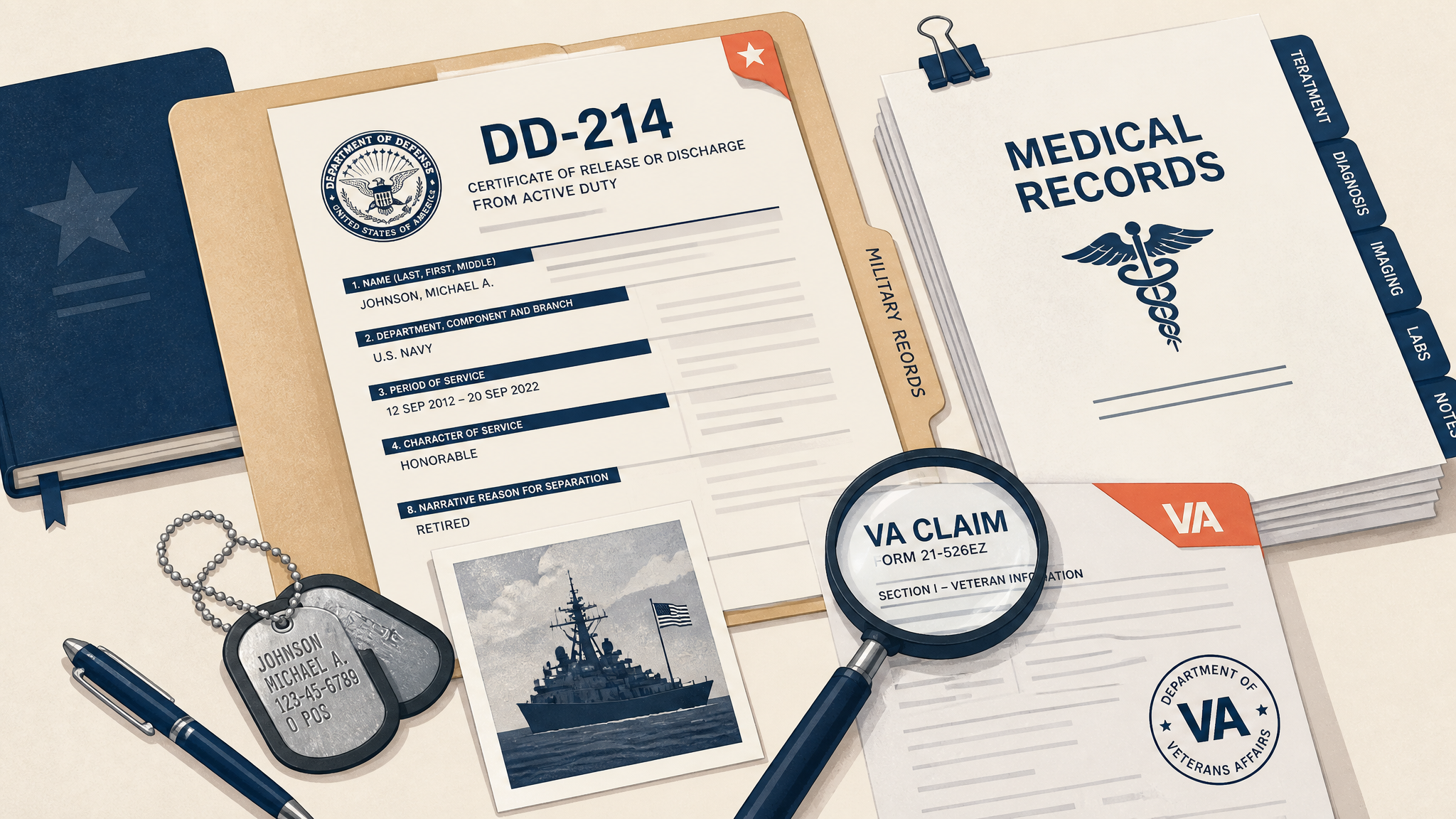
FIG. 01 - Gather your paperwork
First
See what you qualify for
Every veterans' hall, Facebook group, and barbershop has someone repeating a myth about VA disability claims as if it were gospel. Some of those myths have stopped real veterans from filing real claims - or cost them years of benefits they could have had. Here are the facts, straight, with no filler.
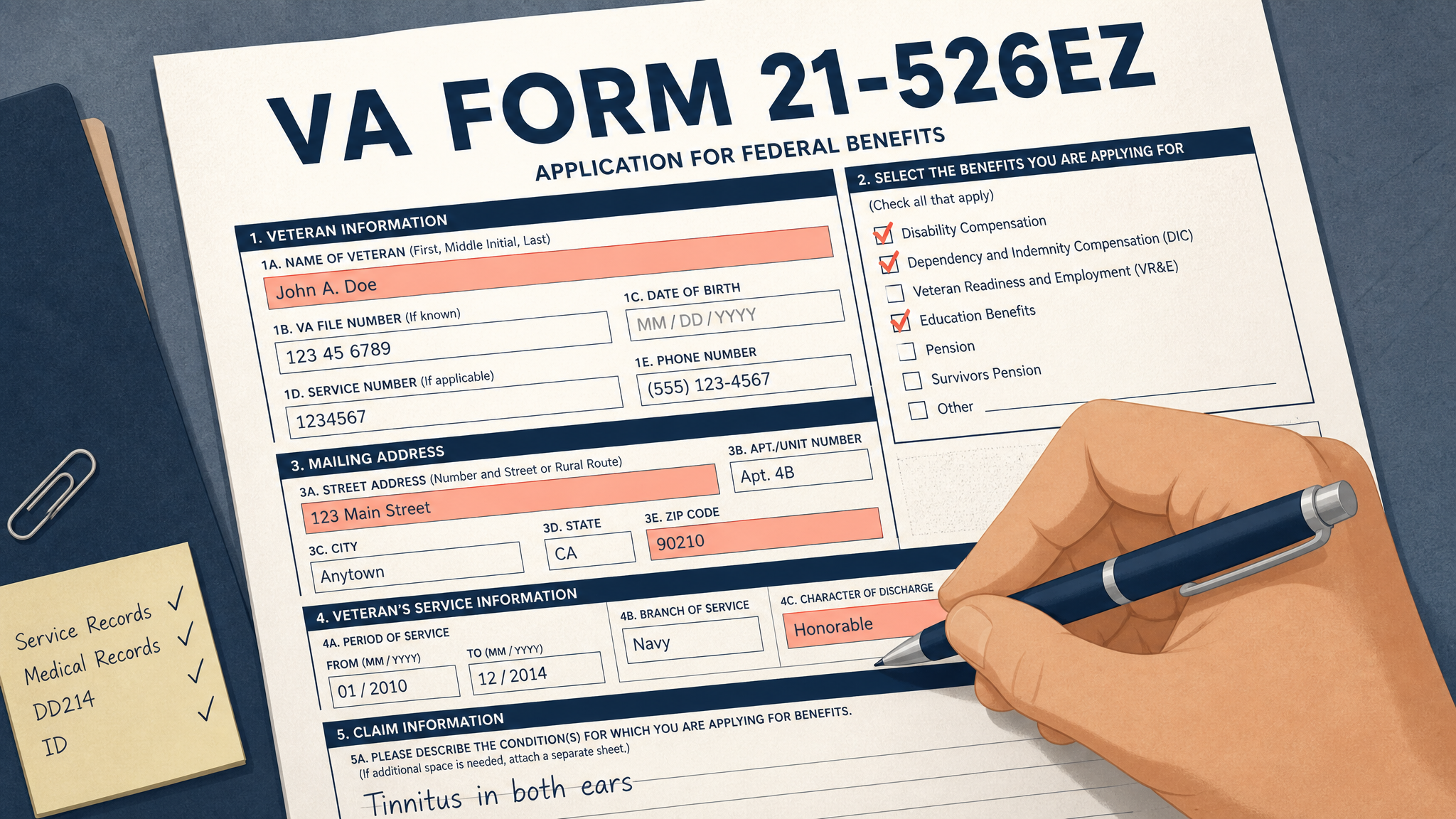
FIG. 02 - Fill out the form
Gather
Collect your documents
Pull your DD-214 and any records that support your claim - we can help you figure out exactly what you need.
FIG. 03 - File the claim
File it - always free
Apply for the benefit
If a myth stopped you from filing, the fix is simple: file now. Submit VA Form 21-526EZ online at VA.gov, by mail, or through an accredited representative. A prior denial does not prevent you from filing a new or supplemental claim with new evidence. If your claim was denied years ago, the law and the evidence standards may have changed in your favor since then (especially under the PACT Act). Call the VA Benefits Hotline at 800-827-1000 or talk to an accredited agent or VSO - it is always free.
Who to call & where to go
These are free, official VA lines. Have your Social Security number handy when you call.
MyVA411 - Main VA Line
Not sure who to call? Start here. One number for anything VA - they route you to the right office.
VA Benefits Hotline
Compensation, pension, and general claim questions.
Rather have us handle it?
No phone tag, no hold music. Call our office and a real, VA-accredited person walks you through it - start to finish.
702-992-4883Not sure where to start?
If a myth stopped you from filing, the fix is simple: file now. Submit VA Form 21-526EZ online at VA.gov, by mail, or through an accredited representative. A prior denial does not prevent you from filing a new or supplemental claim with new evidence. If your claim was denied years ago, the law and the evidence standards may have changed in your favor since then (especially under the PACT Act). Call the VA Benefits Hotline at ##800-827-1000## or talk to an accredited agent or VSO - it is always free.
More benefits for veterans
These often go hand in hand - tap any card to learn more.


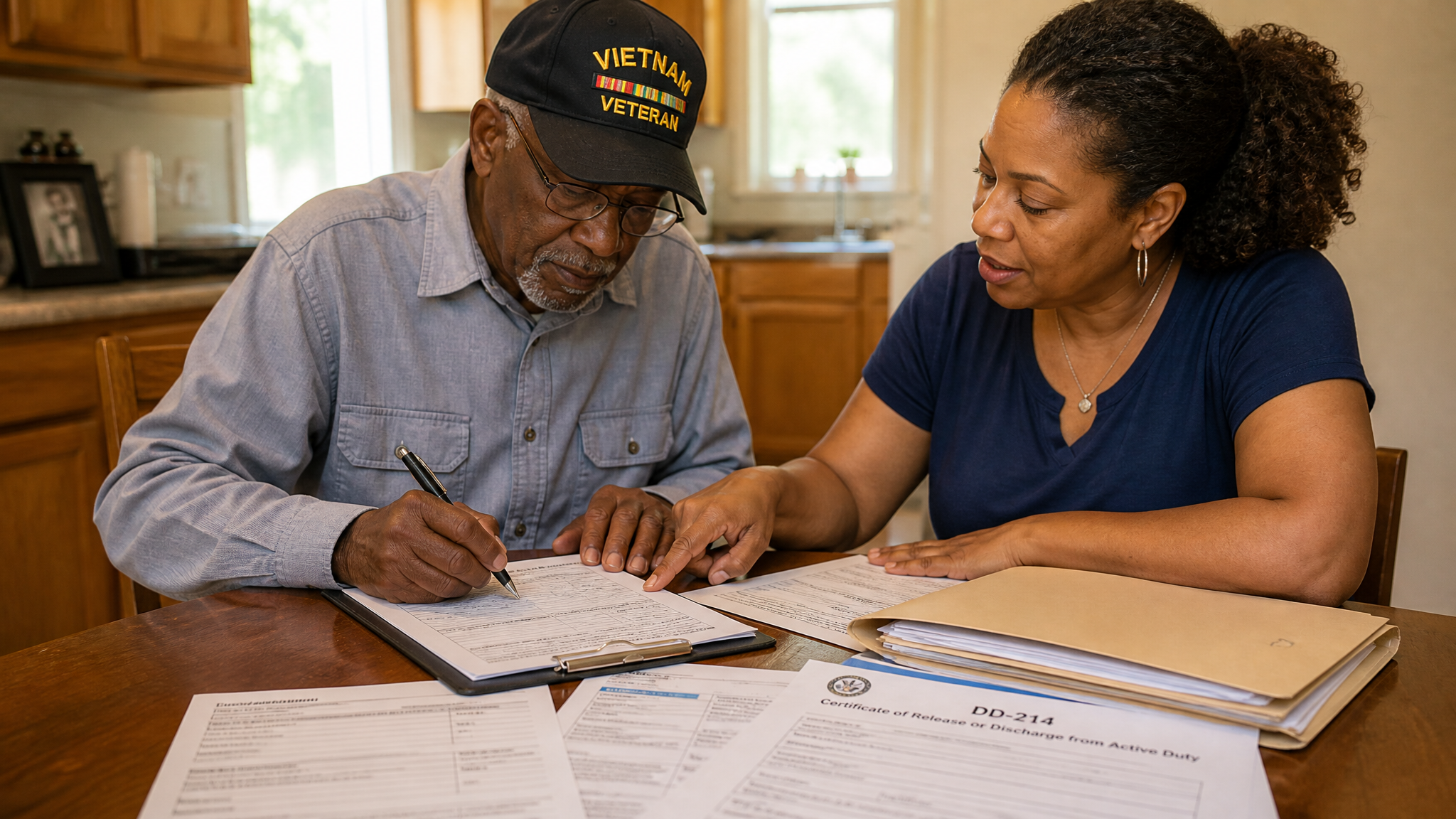










































Free information — get a free benefit review
Tell us how to reach you and an accredited team member will help you understand this benefit and claim everything you have earned. No cost, no obligation.
Ready to hire us? Register with us
For veterans who’ve decided they want us on their claim — registering is free too, and it does not make you our client or obligate you to anything. Here is exactly how it works:
- You register. This simply starts the conversation — you are not our client yet, and you owe us nothing.
- You sign and return VA Form 21-22a. It appoints us as your accredited representative and gives us access to your VA file.
- Once we have your signed 21-22a and access to your case, we verify everything is in order.
It involves the registration form and signing VA Form 21-22a — by law we can’t accept your claim, work on it, or contact the VA for you until that power of attorney is signed. You decide whether to move forward.
Official VA links
Answers, in plain language
Common questions about VA Claims Myths vs. Facts - What Veterans Get Wrong
What is VA Claims Myths vs. Facts - What Veterans Get Wrong?
Misinformation about VA disability claims is everywhere - some of it decades old, some of it born out of real frustration with a slow system. This page takes the most common myths veterans believe and sets the record straight with the actual rules, the actual law, and the actual process. Nothing here is opinion - it is how the system works right now, verified against current 38 CFR regulations and VA policy.
Who qualifies for VA Claims Myths vs. Facts - What Veterans Get Wrong?
Fact: You can receive both VA disability compensation and Social Security benefits (SSDI or SSI) at the same time. Neither program cancels the other. VA disability compensation is tax-free and is based on service-connected conditions. SSDI is based on your work history and total disability. They are independent programs. The one interaction to know: SSI (Supplemental Security Income, the needs-based program) does count VA compensation as income, which can reduce or eliminate SSI payments. SSDI does not have this problem.
How much does VA Claims Myths vs. Facts - What Veterans Get Wrong pay?
Fact: VA back pay is calculated from the effective date of your claim - usually the date you filed VA Form 21-526EZ - not the date of the injury itself. If you file within one year of separation, the effective date can be set to the day after discharge, which is the maximum possible back pay. For supplemental or reopened claims, the effective date is typically the date you filed the new evidence. For claims won on appeal, back pay can go to the original filing date.
How do I apply for VA Claims Myths vs. Facts - What Veterans Get Wrong?
If a myth stopped you from filing, the fix is simple: file now. Submit VA Form 21-526EZ online at VA.gov, by mail, or through an accredited representative. A prior denial does not prevent you from filing a new or supplemental claim with new evidence. If your claim was denied years ago, the law and the evidence standards may have changed in your favor since then (especially under the PACT Act). Call the VA Benefits Hotline at 800-827-1000 or talk to an accredited agent or VSO - it is always free.
What does it cost to get help with VA Claims Myths vs. Facts - What Veterans Get Wrong, and are you VA-accredited?
The biggest myth of all is the one that keeps veterans from filing in the first place: that the system is rigged and there is no point. The system is slow, the system is bureaucratic, the system can be frustrating - but it is not rigged. Veterans who file with the right evidence, the right diagnosis, and the right forms get approved every single day. The ones who lose are usually the ones who heard a myth, believed it, and never tried. It is free to talk with us, and no one may charge you to file a first-time VA claim. The Aging Veteran is led by Albert L. Thombs Jr., a VA-accredited claims agent (accreditation #45147) and disabled veteran; any appeal work is handled on a no-fee-unless-you-win basis.