
Toxic Exposure
Burn Pits & Airborne Hazards
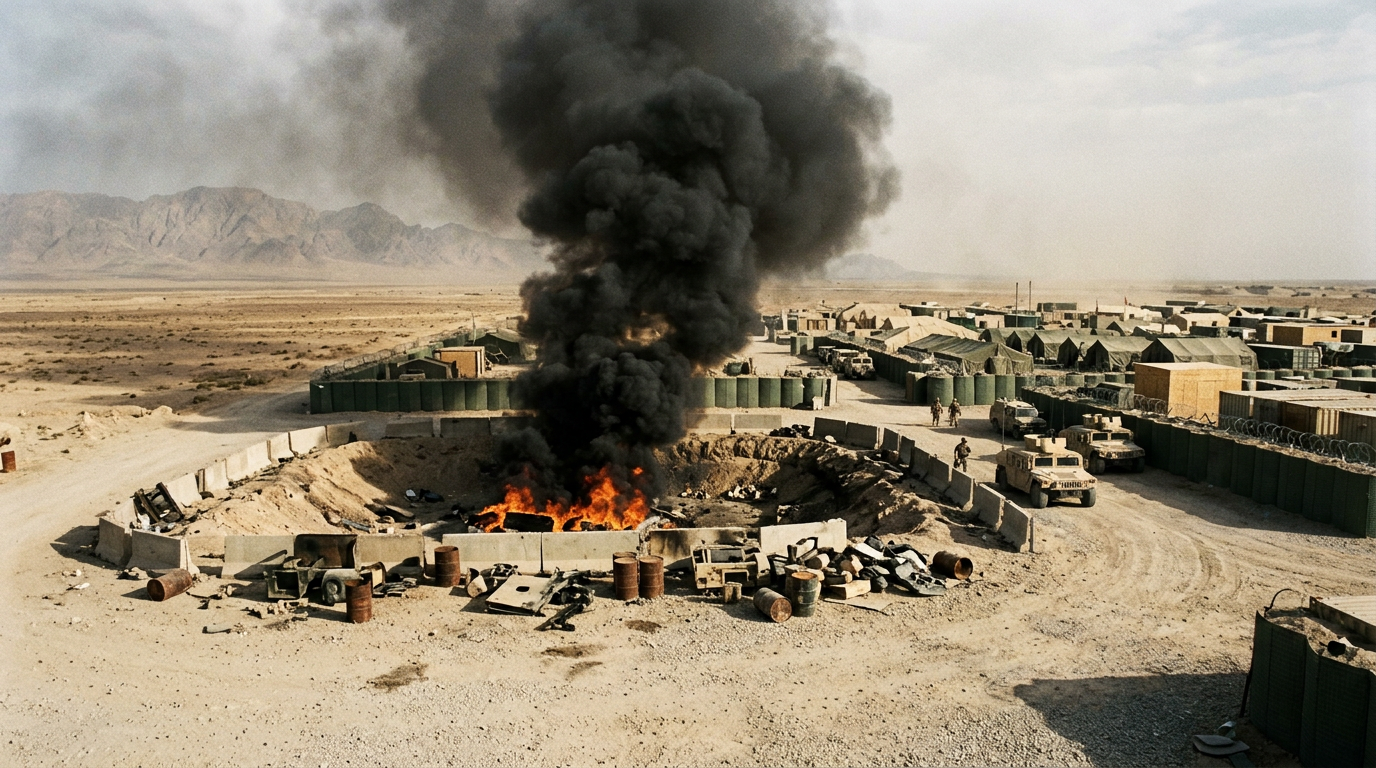
Burn pits & airborne hazards - Gulf War from Aug 2, 1990; Post-9/11 from Sep 11, 2001. Open-air burn pits, dust, and fumes across Iraq, Afghanistan, and the wider Gulf. The PACT Act made dozens of cancers and breathing conditions presumptive for those who served there.
Locations & service that qualify
Where and when you had to serve
- Gulf War theater: Iraq, Kuwait, Saudi Arabia, Qatar, Bahrain, Oman, UAE, or Somalia (on or after Aug 2, 1990)
- Afghanistan, Djibouti, Syria, Egypt, Jordan, Lebanon, Uzbekistan, or Yemen (on or after Sep 11, 2001)
Gulf War veterans also have a separate presumptive path for Gulf War Illness - chronic, undiagnosed multisymptom illness (fatigue, widespread pain, headaches, digestive, skin, respiratory, and sleep problems), plus conditions like chronic fatigue syndrome, fibromyalgia, and functional gastrointestinal disorders such as IBS.
Watch & learn
Official VA videos on this exposure
Straight from the VA - short, plain-language videos on this exposure and what a presumptive claim means for you.
VA Disability Claims for Burn Pits, Agent Orange, and More (PACT Act)Official video - U.S. Department of Veterans Affairs - theSITREP
The automatic (presumptive) path
23 presumptive conditionsPresumptive conditions for this exposure
If you have one of these and you served in a qualifying place and time above, the VA presumes toxic exposure caused it - you do not have to prove the link.
What these presumptive conditions are - and who qualifies
The conditions above are the cancers and breathing illnesses Congress and the VA have already tied to burn-pit and airborne-hazard exposure. For these you do not have to prove the smoke, dust, or fumes caused your disease - the law does it for you, removing the single hardest part of a toxic-exposure claim: the cause-and-effect fight the VA usually wins.
You qualify when two plain facts are true - you served in one of the covered locations during the covered dates above, and you now carry one of these diagnoses. You do not need to have stood next to a burn pit, kept a log, or saved a photograph; being there during the window is enough. Gulf War illness is a separate presumptive path of its own, covered below.
What a "presumptive" actually means
A presumptive condition is one the VA has agreed, in advance, to treat as caused by your service. Normally you have to prove three things - a current diagnosis, an in-service event or exposure, and a medical nexus linking the two. A presumptive erases the hardest of the three: you no longer have to prove the exposure caused the disease, because the law already presumes it did.
That one word changes how hard your claim is to win. Without a presumptive the VA can argue about cause forever; with one, the fight shrinks to two clean questions - do your records show qualifying service, and do you have the diagnosis. Get those two facts on paper and the VA is supposed to grant the claim. When they still deny it, it is almost always a paperwork problem you can fix, not a medical one.
- Brain cancer
- Gastrointestinal (stomach or digestive) cancer, any type
- Glioblastoma
- Head cancer, any type
- Kidney cancer
- Cancer of the lymph system (lymphoma), any type
- Melanoma (a type of skin cancer)
- Neck cancer, any type
- Pancreatic cancer
- Reproductive cancer, any type
- Respiratory (breathing-related) cancer, any type
- Asthma (diagnosed after service)
- Chronic bronchitis
- Chronic obstructive pulmonary disease (COPD)
- Chronic rhinitis (ongoing nasal inflammation)
- Chronic sinusitis (ongoing sinus inflammation)
- Constrictive or obliterative bronchiolitis
- Emphysema
- Granulomatous disease
- Interstitial lung disease (ILD)
- Pleuritis
- Pulmonary fibrosis
- Sarcoidosis
Know the signs
Symptoms to watch for
These are the early signs most often tied to this exposure. If any sound familiar, get it documented by a doctor - a diagnosis is what turns an exposure into a rated claim.
- Breathing problems: a lingering cough, wheezing, shortness of breath, or asthma, sinus, and nasal congestion that started after deployment.
- Cancers: unexplained weight loss, a new lump, blood in the stool or urine, a cough that brings up blood, or lasting fatigue.
- Gulf War illness (the separate path): chronic fatigue, widespread muscle and joint pain, headaches, memory or concentration trouble, stomach and digestive problems, skin issues, and sleep problems lasting six months or more.
How to talk to your doctor about these conditions
When you see your doctor, do not just list symptoms - connect them to your service out loud. Say plainly, 'I was exposed to burn pits and airborne hazards in [location] in [year], and I have had these problems since,' and ask that the exposure and the timeline be written into the visit notes. A doctor who never hears the word 'deployment' will never record the link the VA is looking for.
Be specific about the three tracks. For breathing problems, ask for pulmonary function testing and a chest scan and have the doctor note when the cough or shortness of breath began. For cancers, ask for the full workup and make sure the pathology and diagnosis date are documented. For Gulf War illness (the separate path), describe every chronic symptom - fatigue, pain, headaches, gut, sleep - and ask that they be recorded as chronic and lasting six months or more, because here the undiagnosed symptoms themselves are the claim.

What it takes to get service connection
If you served in a covered location during a covered time above and you have a listed cancer or breathing condition, the burn-pit exposure is presumed - you do not have to prove you stood near a pit. Gulf War Illness has its own separate presumptive path for chronic, undiagnosed multisymptom illness. Anything not on a list can still be pursued as a direct/TERA claim with a nexus.
Build the file
The medical evidence this claim needs
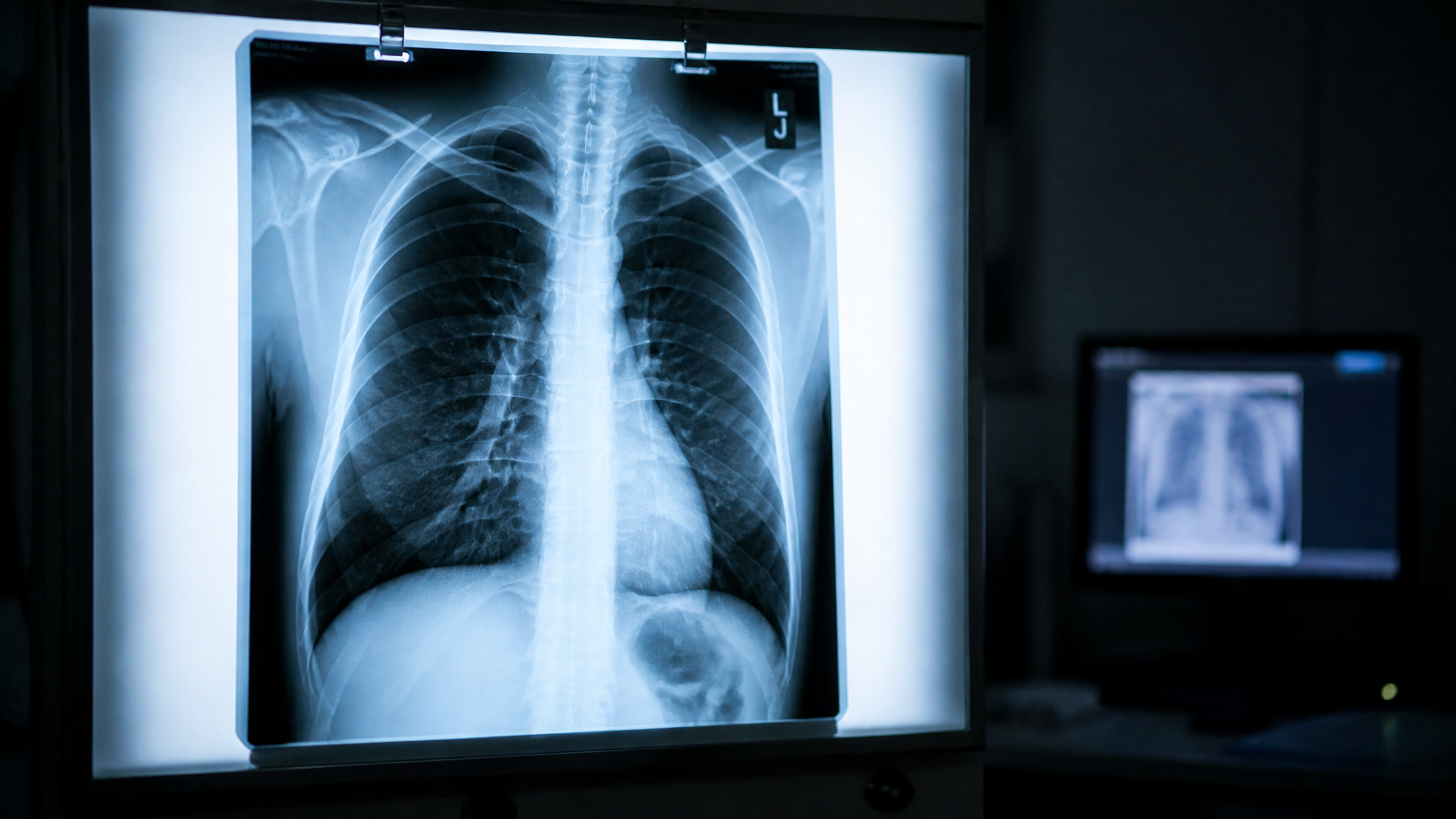
Even a presumptive claim needs proof of the diagnosis and your qualifying service. Here is exactly what to gather.
- A current diagnosis or, for Gulf War Illness, documentation of chronic symptoms lasting six months or more.
- Proof of qualifying service in a covered location and time - DD-214, orders, deployment and travel records.
- Pulmonary function tests, imaging, or biopsy results for a breathing condition or cancer.
- A VA toxic-exposure screening on record, which helps flag your exposure.
Why this evidence can be hard to get
Getting this evidence is often harder than it should be. Deployment and travel records for burn-pit locations can be thin, scattered across systems, or simply missing, and a base that closed years ago may have left little behind. If your only proof of being there is your own memory, the VA can stall.
The medicine can be just as difficult. Breathing conditions get quietly blamed on smoking or age; early cancers hide for years; and Gulf War illness has no single test to point to, so a rushed provider may write "cause unknown" instead of documenting the chronic pattern. This is why an accurate exposure record - the ILER - and a strong nexus opinion matter so much, and why building them is the part we handle for you.
Why these get denied
How this exposure gets denied - and how to beat it
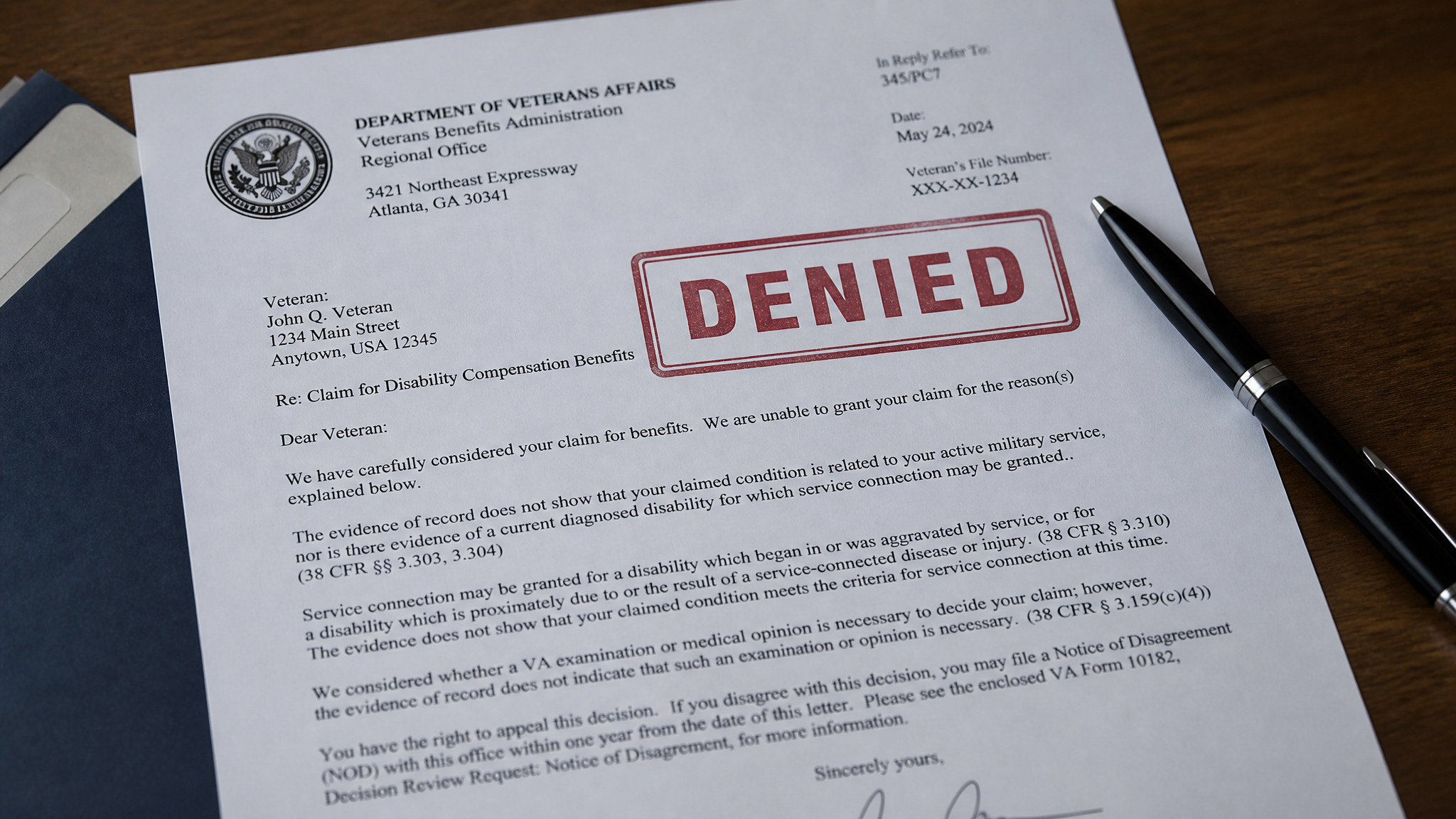
A denial is not the end. These are the most common reasons this exact claim gets kicked back - and what fixes each one.
- The VA cannot confirm you were in a covered location - use orders, travel vouchers, awards, or buddy statements to prove it.
- Symptoms are documented but there is no formal diagnosis - a presumptive cancer or breathing illness still needs the diagnosis; for Gulf War Illness the chronic, undiagnosed symptoms ARE the claim, so make sure they are recorded.
- A breathing condition is blamed on smoking - a doctor can still tie it to service exposure; do not let this end the claim.
Not on the list, but you were still exposed?
A condition that is not presumptive is not a dead end. If your exposure was real, it can still be claimed through TERA - a direct, facts-found claim built on your records and a medical nexus.
See the TERA (facts-found) pathThis is a plain-language summary to help you self-check - it is not the complete legal list, and qualifying also depends on exactly where and when you served. Always confirm current lists on va.gov, or let us check your specific service for you.
The pieces the VA actually weighs
Four things decide a toxic-exposure claim
Whether your exposure is presumptive or facts-found, the same four pieces decide how it lands. Get these right and the VA has little room to deny you; leave one weak and even a strong claim can stall. This is exactly the work an accredited agent does with you - and why the ILER and the TERA memo matter as much as the diagnosis itself.
Establish chronicity
Chronicity means showing your condition has been continuous or recurring since service - not a one-time complaint. A line of dated records, or even lay statements describing the same symptoms year after year, builds it. The VA leans on gaps in treatment to argue a condition "resolved" on its own; an unbroken timeline shuts that door before it opens.
Prove a nexus
A nexus is a medical opinion that links your condition to your service "at least as likely as not" - a 50 percent or better probability. For a presumptive you may not need one; for everything else, a clear nexus letter from a qualified provider is what wins the claim. Vague wording sinks it - the opinion has to state that standard in plain terms.
Make sure your ILER is accurate
Your ILER - the Individual Longitudinal Exposure Record - is the VA and DoD's official record of what you were exposed to, and where. The VA reads it before it reads your statement. If it is blank, wrong, or missing a deployment, the VA may decide you were never exposed - so you have the right to review it and request corrections, and doing so can make or break the claim.
Get a TERA memo
A TERA memo is the formal determination that you took part in a Toxic Exposure Risk Activity. It is what carries a claim that is not automatically presumptive: it establishes the exposure in the record, unlocks expanded VA health care, and gives your nexus opinion something official to attach to. Without it, a facts-found claim often has nothing solid to stand on.
The two words that decide your claim
Presumptive vs. TERA - what they mean, and why they are not the same thing
The VA handles toxic exposure two different ways. Getting these straight is the difference between a claim that moves and a claim that stalls - so here is exactly what each one means.
What a "presumptive" condition actually is
A presumptive condition is one the VA has already agreed is caused by a toxic exposure. If you have a listed condition and you served in a qualifying place and time, the VA presumes the link - you do not have to prove the exposure caused your illness. That is the whole point: it removes the hardest part of the claim. The 2022 PACT Act added more than 20 new presumptive conditions and new qualifying locations, which is why so many older veterans - and previously denied veterans - now qualify.
The PACT Act and TERA are two separate things - and one is NOT a presumptive
Do not let anyone blur these together. The PACT Act is the law behind the presumptive lists - it says the VA assumes certain conditions are service-connected. TERA - Toxic Exposure Risk Activity - is NOT a presumptive. A TERA finding only confirms that you took part in an activity that carried a risk of toxic exposure. It opens the door to expanded VA health care and a direct, "facts-found" claim - but it does not automatically connect your condition. You still prove it with your exposure records (the ILER), a TERA memo, and a medical nexus.
PACT Act / presumptive
Listed condition + qualifying service = the VA presumes the link. You do not prove causation.
TERA / facts-found
Not on a list, peacetime, or never deployed? TERA opens the door - you still prove the link with records and a nexus.

The expanded Agent Orange - it is part of the PACT Act
The PACT Act did not just cover burn pits. It expanded Agent Orange too - and this is still a presumptive path, not TERA. It added two new presumptive conditions for Agent Orange: high blood pressure (hypertension) and MGUS (monoclonal gammopathy of undetermined significance). It also added new qualifying locations - Thailand, Laos, Cambodia, Guam, American Samoa, and Johnston Atoll during set periods. If you were denied before for one of these, that denial was under the old rules - the claim can be reopened under the PACT Act now.
The filing plan
A dated plan you can actually follow to file
Now that you know your exposure (Burn Pits & Airborne Hazards), here is the order to file in - with a realistic timeframe on each step. Follow it top to bottom and you will not leave money, dates, or evidence on the table.

FIG. 01 - FILE YOUR INTENT TO FILE
01Lock in your date - file an Intent to File first
DAY 1VA Form 21-0966
Before you gather a single record, put the VA on notice. An Intent to File freezes your effective date for up to one year.
The Intent to File (VA Form 21-0966) does one powerful thing: it sets your effective date today, then gives you up to one year to actually submit the claim. Back pay is calculated from your effective date - so filing the Intent to File on Day 1, before you have every document, can be worth months of retroactive benefits. File it online at va.gov, by phone, or on paper. Do this first, even if the rest of your evidence is weeks away.

FIG. 02 - PULL YOUR SERVICE RECORDS
02Prove where and when you served
WEEK 1The claim rises or falls on placing you in the exposure. Pull the paper that puts your boots on that ground.
For a presumptive exposure, the VA only needs to see that you served in a qualifying location during a qualifying time - so gather your DD-214, orders, and deployment records that name the place and the dates. Your service treatment records and personnel file matter too. If your exposure is not presumptive, this is also where you start building the TERA (facts-found) record - the documents that show the activity that carried the risk. Missing dates or the wrong base name is the most common reason a solid claim stalls, so get this right early.

FIG. 03 - GET A CURRENT DIAGNOSIS
03Get a current, written diagnosis
WEEKS 1-2A presumption connects an exposure to a condition - but you still have to show you actually have the condition, in writing, now.
The VA cannot rate a condition it cannot see. Get a current diagnosis from a doctor - VA or private - that names the condition exactly as it appears on the presumptive list. If you are already in VA health care, your records may already carry it; if not, get seen and get it documented. For a facts-found (TERA) claim, this diagnosis is one leg of the case and the medical nexus is the other. A claim with an exposure and a service history but no current diagnosis has a hole the rater will use to deny it.

FIG. 04 - FILE THE CLAIM
04File the claim itself
WEEKS 2-3VA Form 21-526EZ
This is the actual claim. File it inside your Intent-to-File year and attach everything you gathered.
The Application for Disability Compensation (VA Form 21-526EZ) is the claim. List every condition you are claiming - do not leave one off because you are unsure; an underclaimed condition is a benefit you walk away from. Attach your service records and your diagnosis, and file it within the one-year window your Intent to File opened. Filing a Fully Developed Claim - where you submit all your evidence up front - is usually the fastest lane to a decision.

FIG. 05 - ADD STATEMENTS & NEXUS
05Add buddy statements and a nexus where you need them
WEEKS 2-3VA Form 21-4138
For a presumptive claim you may not need a nexus at all. For a facts-found claim, this step is the whole ballgame.
If your condition and service are presumptive, the VA presumes the link - you do not have to prove causation, so a nexus is not required. Where records are thin, a buddy statement (VA Form 21-4138) from someone who served with you can place you at the exposure. For a TERA / facts-found claim, you do need a medical nexus - a doctor stating your condition is at least as likely as not caused by the exposure. Know which path you are on so you spend your effort where it actually counts.

FIG. 06 - ATTEND YOUR C&P EXAM
06Attend your C&P exam - and be ready
MONTH 2-4The VA will usually schedule a Compensation & Pension exam. This appointment can decide your rating - do not treat it as routine.
When the VA schedules a C&P exam, go - a missed exam can sink a claim. Describe your symptoms on your worst days, not your best, and be specific about how the condition limits your work and daily life. Bring a short written summary so nothing gets left out under pressure. If the examiner does not measure or ask about something the rating requires, say so on the record. An inadequate exam is one of the most common reasons a deserving claim comes back low - and it is a reason you can name in an appeal.

FIG. 07 - READ THE DECISION, PROTECT YOUR APPEAL
07Read the decision - and protect your one-year appeal window
DECISIONWhen the decision letter arrives, read the rating and the reasons closely. If it is wrong or too low, the clock starts now.
Your rating decision letter states what was granted, at what percentage, and why. If a condition was denied or rated too low, you generally have one year from the date of that decision to appeal - through a Higher-Level Review, a Supplemental Claim (with new evidence), or a Board appeal. Do not let that year lapse; a missed deadline can cost you the earlier effective date. A denial is not the end - many strong claims are won on appeal once the record is corrected. This is exactly the point where getting help pays for itself.
This is a general roadmap - your exact timeframes depend on the VA's workload and how complete your evidence is when you file. It is not legal advice. When you want a second set of eyes on any step, that is what we are here for.

Two ways to move forward — both free
Think this exposure is yours? Let us check your service - free.
We look at every unit, every location, and every job you actually did - not just your MOS - and tell you honestly what may be presumptive for you and what to file. No forms, no obligation.
Have a question? Get free information
Ask a question, learn what you may be owed, or find out where you stand. Confidential, free, and no obligation to go any further.
Ready to hire us? Register
Decided you want us to work your claim? Registering is free — we match you with an accredited advocate and get you started. We cannot begin until you sign VA Form 21-22a, and fees, if any, are always disclosed up front.
Information only - not legal advice
For information purposes only - this is not legal, financial, or medical advice. The Aging Veteran is a private service and is not part of, or endorsed by, the U.S. Department of Veterans Affairs. Benefits are subject to VA eligibility rules. Always confirm your specifics on va.gov or with a qualified professional.