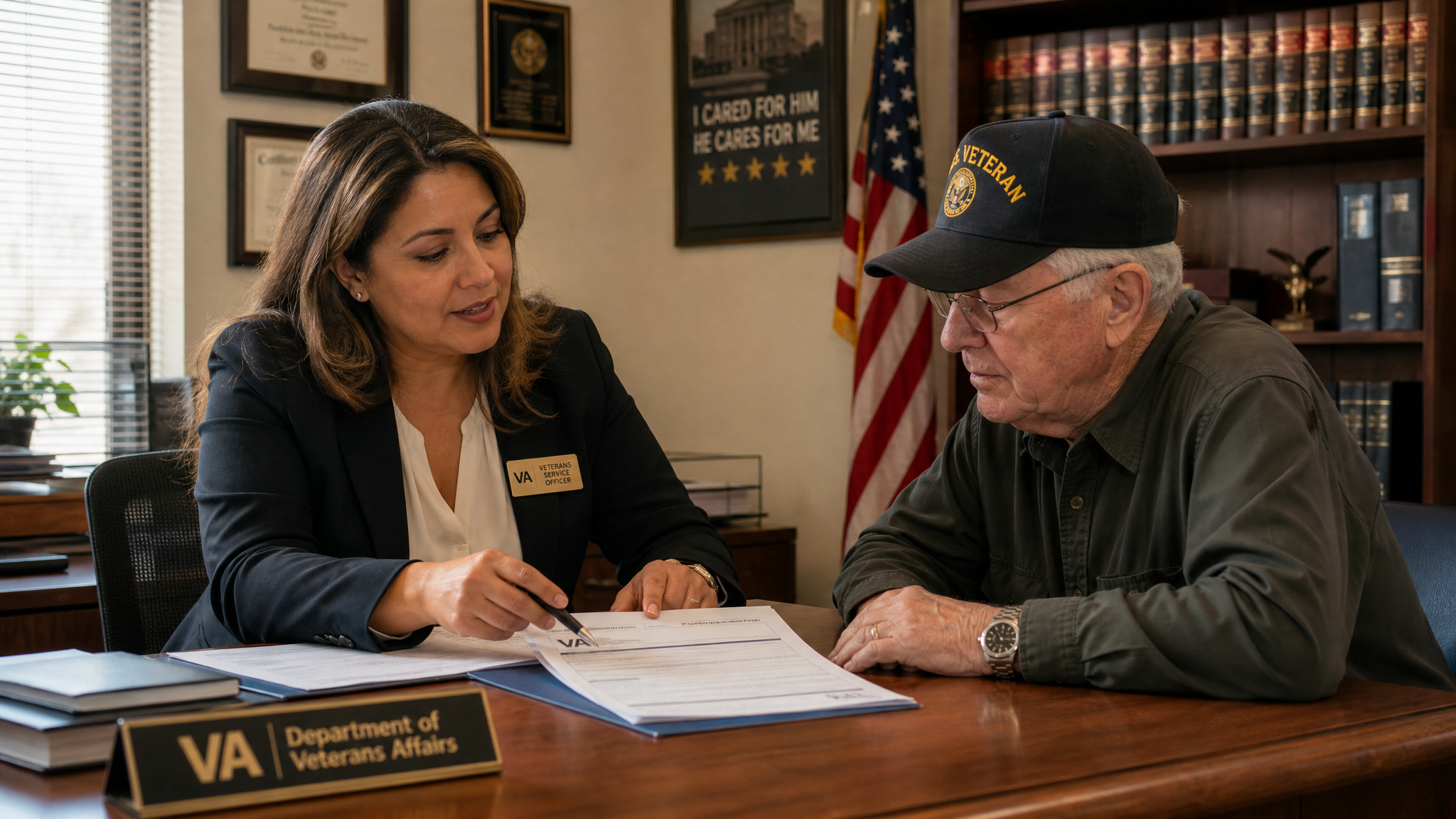

DIC can protect your family after your death. There is no age limit on filing VA claims, and knowing the rules now can help you protect benefits your survivors may need.
If you are a veteran in your forties, fifties, sixties, seventies, or beyond, it is easy to assume you waited too long or missed your chance. You did not. No age limit on filing is one of the most important things to understand, and learning about Dependency and Indemnity Compensation now can help you protect your family, your health, and the benefits you earned.
Many families are never told this benefit exists until after a death, when it is much harder to sort out records and timelines. Knowing DIC before it is needed gives you and your loved ones a better chance to act calmly and clearly when the time comes.
What DIC is and why it matters
DIC can protect surviving family after the death of a service member or veteran. Dependency and Indemnity Compensation is a tax-free monthly benefit that may be paid to eligible survivors when a veteran died from a service-connected condition, or when certain total-disability rules were met before death.
It may be paid to a surviving spouse, dependent children, and in some cases dependent parents. It is not means-tested for a spouse or child, which means income, savings, and the home generally do not count against eligibility.
Parents' DIC is different. Parents' DIC is income-based, so that part follows separate rules for a surviving parent.
There is no age limit, and it is not too late to learn this
It is not too late to get informed. A lot of veterans believe, “I am too old,” “I waited too long,” or “Nobody told me, so I must be out of the game.” Those beliefs stop families from getting benefits that may still be available.
The VA does not decide service connection based on your age. The issue is service connection, or whether the veteran met another DIC path such as the total-disability rule. That is why learning about this now matters, even if you never filed anything years ago.
If your family would need help later, being aware today gives you time to gather records, understand rating history, and make sure the right people know what to file. Awareness now protects your family far better than waiting until a crisis.
Who may qualify for DIC
Surviving spouses, children, and some parents may qualify depending on the facts. In general, DIC usually requires that the veteran's death be linked to a service-connected condition, unless another rule applies.
For a surviving spouse, eligibility usually needs one of these:
- Marriage of 1+ year
- A shared child
- Marriage within 15 years of discharge tied to the fatal condition
There is also an important rule for some surviving spouses even when the death was not service-connected. Under 38 U.S.C. 1318, if the veteran was rated totally disabled for the 10 years right before death, a surviving spouse may receive DIC even if death was not service-connected.
Another point many families miss is remarriage. Remarriage may not end DIC if the remarriage happened at 57 or older, or at 55 or older for remarriages on or after Jan 5, 2021.
What DIC may pay
The base rate may be around $1,699.36 a month for a surviving spouse in 2026, tax-free, depending on the survivor's situation and the VA's final decision. That published base amount is adjusted each year with the cost-of-living adjustment, often called COLA.
Several additions may stack on top of the base amount if the facts fit. Add-ons can stack, which is why families should not assume the basic rate is the whole picture.
- +$421.00 for each child under 18
- +$421.00 for Aid and Attendance
- +$197.22 for Housebound
- +$360.85 if the veteran was totally disabled for the 8 continuous years before death
- +$359.00 transitional benefit for 2 years when there is a child under 18 on the award
For deaths before January 1, 1993, DIC is paid based on the veteran's military pay grade instead of the flat rate. At some senior grades, that may pay more than the standard amount.
And one more important point: DIC is never taxed as federal income.
The filing deadline that matters most
The first year after death matters most. If the claim is filed within one year of the death, the effective date is generally the date the veteran died under 38 CFR 3.400.
If the claim is filed later, the survivor generally loses the unpaid months in between. Late filing can cost months of benefits, which is why this is one of the most important DIC rules for families to know.
The hard truth is simple. The VA does not go looking for surviving spouses. Nobody at the regional office is going to call and say that an old rating history may now make someone eligible. The claim has to be filed.
If you are reading this and a death was recent, that first-year rule is the reason not to talk yourself out of the benefit. This is not pressure. It is an awareness issue, because the earlier filing date may protect money your family may need.
How survivors get started
The main form is VA Form 21P-534EZ for a surviving spouse or child. A surviving parent generally files VA Form 21P-535.
It helps to gather a few key records first. Bring the death certificate, your marriage certificate, and the information showing the cause of death.
If the veteran had a claim open at death, survivors should also ask about substitution. Ask about substitution on the same form so the VA can review whether that path applies.
For the full details on this benefit, including more on eligibility and payment structure, see our complete page here: /survivors/dic.
A final word for aging veterans and their families
Knowing this now is a real advantage. Even if DIC is a survivor benefit, understanding it while you are still able to gather records, review rating history, and talk with your family may help protect the people you love later.
If you were never told about this benefit, or you gave up on VA benefits years ago, please do not assume that means your family is out of options. Do not talk yourself out of earned benefits. There is no age limit on filing a first VA claim, and whether DIC is available depends on the facts of the case, not on how old you are now.
This article is general educational information only. It is not legal, medical, or financial advice, and The Aging Veteran is not the VA or part of the federal government.
When you are ready, free help is available from Albert L. Thombs Jr., a VA-accredited claims agent with accreditation #45147, and his team. You can call 702-992-4883 with no pressure. No one can charge a veteran to file an initial claim, and if you want help understanding DIC or other VA benefits, you are welcome to reach out when the time is right for you.
A quick, honest note
This article is general information, not legal advice, and every rate or example is an estimate. Your own claim depends on your records and the facts the VA finds. Albert L. Thombs Jr. is a VA-accredited claims agent (accreditation #45147). If you would like a real person to look at your situation, you are always welcome to reach out - there is no cost to ask.