
Survivors
Dependency & Indemnity Compensation (DIC)
Dependency and Indemnity Compensation is a tax-free monthly benefit for the surviving spouse, children, and dependent parents of a veteran who died from a service-connected condition. It recognizes that when a veteran passes from something the service caused, the family should not be left to carry that loss alone. The amount is set by law and does not depend on your income, and it can be paid on top of certain other benefits. Estimate yours below, with no sign-up required, and reach out anytime if you want a caring set of eyes on your situation.
Estimate your survivor benefit
Use the interactive estimator below to see what your family's monthly DIC could look like. Every figure uses published VA rates - there is nothing to sign up for, and nothing is shared until you ask for help.
For the families left behind
Survivor benefits are more than one check
When a veteran passes, their family can be entitled to steady monthly income, health coverage, education for their children, help with the home, and a dignified burial. Most families never hear the full list - and some of it has a deadline.
This page walks you through it gently, one step at a time. Start with the DIC estimate, then see the other benefits that come with survivor status.
$1,699/mo
Base surviving-spouse DIC, before any add-ons
100% tax-free
DIC is never taxed as federal income
1-year window
To claim accrued benefits already earned
The full DIC picture
Everything you need to know about DIC
Nothing hidden behind a click, and nothing you have to go looking for on another website. The rates, the add-ons, the eligibility rules, the deadlines, and the two doors most families never hear about - all of it in plain language, right here.
Key facts & current figures
- 2026 base rate for a surviving spouse: $1,699.36/mo, tax-free, adjusted every year with the COLA.
- Add-ons stack on top: +$421.00 per child under 18, +$421.00 for Aid & Attendance, +$197.22 for Housebound, +$360.85 if the veteran was totally disabled the 8 continuous years before death, and a +$359.00 2-year transitional benefit when there is a child under 18 on the award.
- For deaths before January 1, 1993, DIC is paid on the veteran's military pay grade, not the flat rate - and at senior grades that pays more than the standard amount.
- Eligibility usually needs marriage of 1+ year, a shared child, or marriage within 15 years of the discharge tied to the fatal condition.
- Remarriage does NOT end your DIC if you remarry at 57 or older, or at 55 or older for remarriages on or after Jan 5, 2021.
- The 10-year rule (38 U.S.C. 1318(b)(1)): if the veteran was rated totally disabled for the 10 years right before death, a surviving spouse can receive DIC even when the death was NOT service-connected.
- File within one year of the death and the award is effective the date the veteran died (38 CFR 3.400). File later and you generally lose every month in between.
- The Widow's Tax is gone: since 2023 you can receive VA DIC and a military Survivor Benefit Plan (SBP) annuity in full, with no dollar-for-dollar offset.
General figures, current as of December 2025 and reviewed each year. Your exact amount depends on your situation - always confirm on va.gov.
The 10-year rule most families never hear about
- Under 38 U.S.C. 1318(b)(1), a surviving spouse can receive DIC even if the veteran did not die from a service-connected condition.
- The test is the rating, not the cause of death: the veteran must have been rated totally disabled - 100 percent schedular, or unemployable under TDIU - continuously for the 10 years immediately before death.
- Shorter windows also qualify: rated totally disabled continuously from the date of discharge and for at least 5 years before death (38 U.S.C. 1318(b)(2)), or at least 1 year for a former prisoner of war who died after Sept 30, 1999 (38 U.S.C. 1318(b)(3)).
- This is the single most overlooked survivor benefit in the system, because the cause of death on the certificate does not have to be service-connected at all. If the certificate says heart attack, stroke, or cancer, pull the rating history before you assume the answer is no.
Remarriage, and the end of the Widow's Tax
- Remarrying at 57 or older has preserved DIC since late 2003; remarrying at 55 or older preserves it for remarriages on or after Jan 5, 2021.
- If your DIC was stopped after a remarriage that should have been protected, you can ask the VA to reinstate it - and that happens more often than it should.
- The old SBP-DIC offset - the Widow's Tax - was fully phased out by 2023. Survivors now receive the military SBP annuity and VA DIC in full, at the same time.
- If your SBP payment is still being reduced by your DIC amount, that is a paperwork problem at DFAS, not the law. It needs to be corrected, and the difference can be years of money.
Deaths before January 1, 1993 are paid on a different scale
- For deaths on or after Jan 1, 1993, every eligible surviving spouse gets the same flat base rate - $1,699.36/mo in 2026.
- For deaths before Jan 1, 1993, the rate is set by the veteran's military pay grade at separation, and at senior grades it is higher than the flat rate.
- Enlisted grades E-1 through E-6 pay the same $1,699.36; E-7 pays $1,758.09, E-8 $1,856.02, E-9 $1,935.72, and a veteran who served as a service-level senior enlisted advisor pays $2,089.58.
- Officer grades run from $1,794.49 at O-1 up to $3,628.08 at O-10 - and $3,893.83 for a veteran who served as Chairman of the Joint Chiefs or a service chief. If you are a widow of a career senior NCO or officer who died before 1993 and you are being paid the flat rate, that is worth a second look.
Children: under 18, in school to 23, and the helpless child
- A child under 18 is normally carried on the surviving spouse's award at +$421.00/mo per child, rather than paid separately.
- A surviving child between 18 and 23 who is attending an accredited school can receive continued DIC in their own right, using VA Form 21-674 to have the school attendance recognized.
- A child who became permanently unable to support themselves before turning 18 - what the VA calls a helpless child - can be carried on DIC with no age cap at all. Adults in their forties and fifties are still eligible under this rule, and it gets missed for decades.
- The VA generally will not pay DIC to a child 18 or older who is wholly supported at federal expense while attending school - a service academy, for example.
DIC for surviving parents is a completely different benefit
- A surviving parent of a service member or veteran whose death was service-related can receive a monthly benefit - but unlike a spouse's DIC, Parents' DIC is income-based.
- When countable income goes over the limit set by law, no benefit is payable. The rates and the income limits change every year.
- If the surviving parent lives with a spouse, that spouse's income counts too - and that spouse may be the veteran's other parent or a spouse from a remarriage.
- Unreimbursed medical expenses can be used to reduce countable income, which is what brings a parent under the limit in a lot of real cases. A parent files on VA Form 21P-535.
The one-year clock that decides how far back the money goes
- Under 38 CFR 3.400, a DIC claim received within one year of the date of death takes an effective date of the day the veteran died.
- File on day 366 and the award generally starts the day the VA receives the claim. Every month in between is simply gone - there is no appeal that gets it back.
- Separately, if the veteran died with a claim or appeal still pending, 38 U.S.C. 5121A gives an eligible survivor one year to substitute into that case and keep the veteran's original effective date, which is often where the largest retroactive payment lives.
- Both clocks run from the date of death, and both run quietly. If you are anywhere near either one, that is the reason to call today rather than next month.
Your interactive DIC estimator
Answer a few plain questions. The estimate updates as you go - no personal details required.
Who are you to the veteran?
How did the veteran pass?
Why this matters: DIC is a flat, tax-free amount that ignores your income. Survivors Pension is need-based and depends on income and net worth. You cannot collect both at once - the VA pays whichever is greater, so it is worth checking both.
Your DIC estimate
Dependent children under 18
Each child adds +$421.00/mo
Additional amounts you may qualify for
Estimated monthly DIC
$1,699.36
About $20,392 per year, tax-free
- Base surviving-spouse rate
- $1,699.36
- Estimated over 10 years
- $203,923+
Estimate only. Rates adjust yearly with the COLA. Confirm the current amount on va.gov.
Do you qualify for DIC as a spouse?
Most surviving spouses qualify by meeting any one of these. Check the ones that are true for you.
Even if none are checked, you may still qualify under the 10-year rule (if the veteran was rated 100% or TDIU for the 10 years before death). And remarriage does not end your DIC if you remarried at age 57 or older - or 55 or older for remarriages on or after Jan 5, 2021.
Your family's complete benefit picture
$203,923+
That is the base surviving-spouse DIC alone over 10 years - before add-ons, and before the health, education, housing, and burial benefits below. It is worth getting a full review.
Do not miss this
Accrued benefits - the money already earned
If the veteran had a claim pending or was owed money when they passed, that money does not disappear. It becomes an accrued benefit the family can claim - but there is a hard one-year deadline from the date of death.
Example: a veteran with a disability increase pending passes before it is decided. Once approved, the back pay owed can be paid to the surviving spouse - if the claim is filed in time on VA Form 21P-534EZ or 21P-601.
One-year deadline
File within one year of the date of death. File on VA Form 21P-534EZ (with DIC) or 21P-601 (on its own).
Who gets paid, in order
Surviving spouse first, then the veteran's children, then a dependent parent, and finally whoever paid the burial costs.
A clear path forward
Your first-year action plan
There is no rush and no pressure - but a little order helps. Here is the path most families follow.
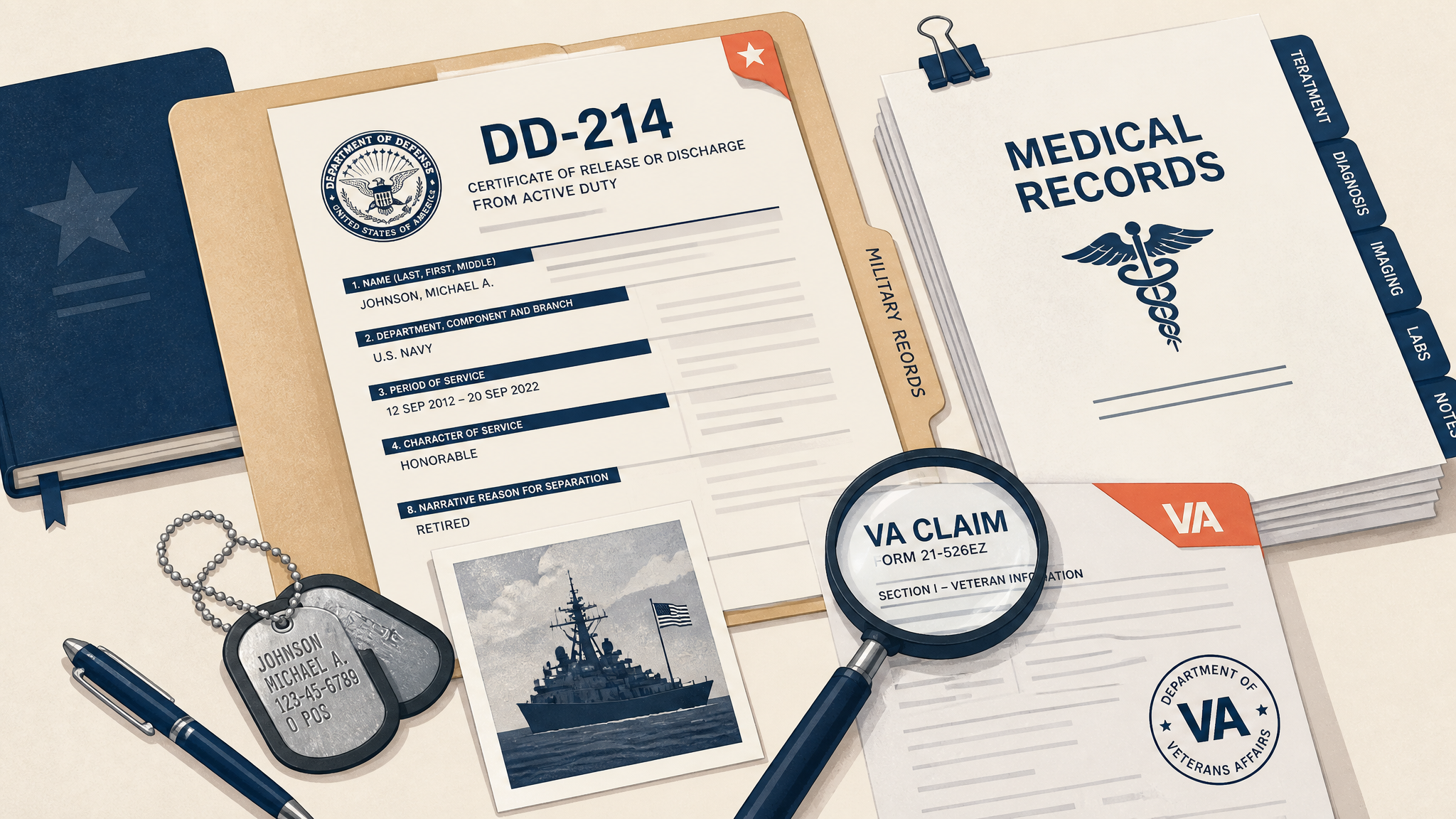
Right away
Report the death to the VA
Call the VA at 800-827-1000 to report the veteran's passing. This stops any pending payments cleanly and opens the door to survivor benefits.
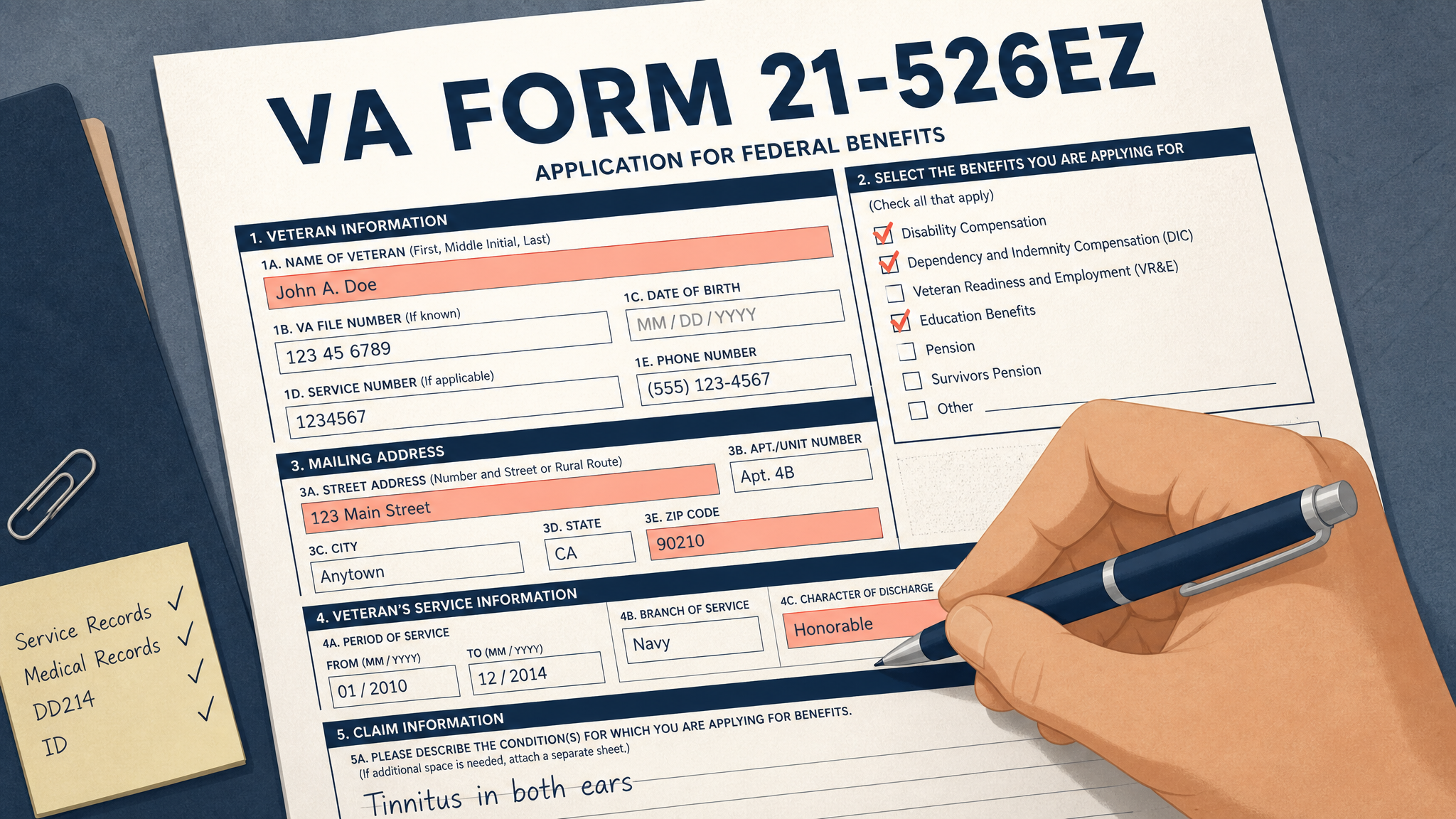
Within weeks
File for DIC or Survivors Pension
Submit VA Form 21P-534EZ with the death certificate and marriage certificate. This one form can start DIC, Survivors Pension, and accrued benefits at once.
Within 1 year
Claim accrued benefits
Ask for any money the VA already owed the veteran on a pending or existing claim. Miss the one-year window and this money can be lost for good.
After the award
Turn on companion benefits
Once DIC is approved, layer on CHAMPVA health coverage, education for your children, home-loan help, and burial honors.
Other benefits that come with survivor status
DIC is the start. These benefits often stack on top - tap any card to learn more.




Get a free survivor-benefits review
Tell us how to reach you and an accredited team member will walk you through everything your family may be owed. No cost, no obligation.
Ready to hire us? Register with us
For veterans who’ve decided they want us on their claim — registering is free too, and it does not make you our client or obligate you to anything. Here is exactly how it works:
- You register. This simply starts the conversation — you are not our client yet, and you owe us nothing.
- You sign and return VA Form 21-22a. It appoints us as your accredited representative and gives us access to your VA file.
- Once we have your signed 21-22a and access to your case, we verify everything is in order.
It involves the registration form and signing VA Form 21-22a — by law we can’t accept your claim, work on it, or contact the VA for you until that power of attorney is signed. You decide whether to move forward.

Two ways to move forward — both free
You should not have to figure this out alone
Talk with our free assistant whenever you feel ready, or speak with an accredited specialist who understands exactly what your family is going through.
Have a question? Get free information
Ask a question, learn what you may be owed, or find out where you stand. Confidential, free, and no obligation to go any further.
Ready to hire us? Register
Decided you want us to work your claim? Registering is free — we match you with an accredited advocate and get you started. We cannot begin until you sign VA Form 21-22a, and fees, if any, are always disclosed up front.