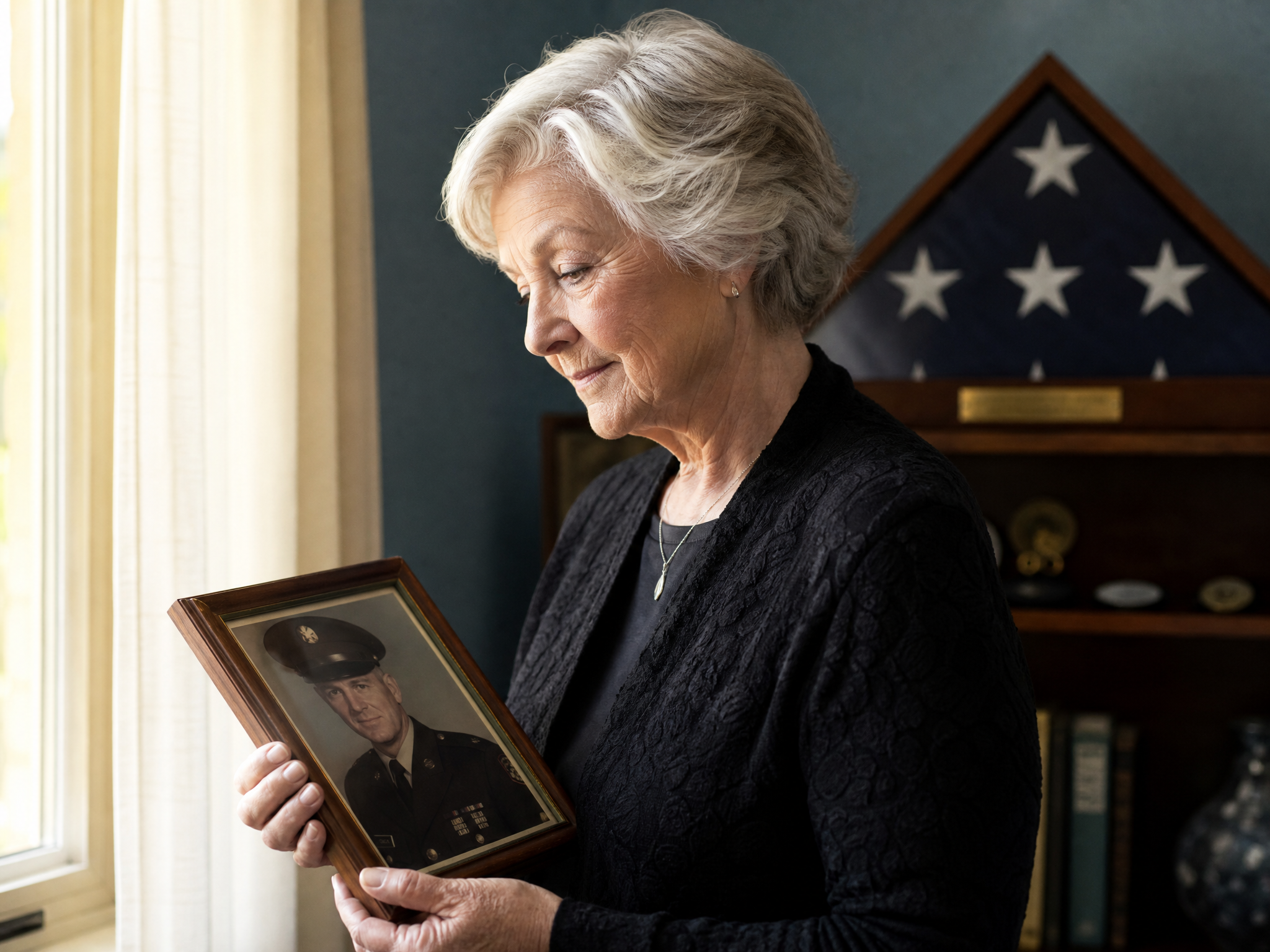
Survivors
Housing Assistance for Surviving Spouses
Certain surviving spouses are eligible for a VA-backed home loan to buy, build, improve, or refinance a home - with no down payment, no mortgage insurance, and no funding fee.

Who this is for
If your spouse died from a service-connected condition, the VA home loan benefit did not die with him. You can buy with no down payment, skip private mortgage insurance, and - because you receive DIC - pay no VA funding fee at all, which on a $400,000 loan is real money left in your pocket. Most surviving spouses are never told this benefit transferred to them.
In plain language
What Housing Assistance for Surviving Spouses covers
- VA-backed loans need no down payment and no private mortgage insurance
- Available to eligible surviving spouses of veterans who died in the line of duty or from a service-connected cause
- No VA funding fee for a surviving spouse receiving DIC
- Also covers building, improving, and refinancing - including an Interest Rate Reduction Refinance Loan
- Help managing the loan and avoiding foreclosure through VA loan technicians
- Eligibility can survive a remarriage that happened on or after Dec 16, 2003 and after age 57

Survivors' Housing Assistance (SSVF)Official video - U.S. Dept of Veterans Affairs
5 things most veterans aren't aware of
These apply to nearly every VA claim - and they change how much you get and when.
Your filing date sets your back pay
Benefits are generally paid back to the day you file - not the day you are approved. Filing an intent to file today can protect months, even years, of retroactive pay.
One condition can trigger others (secondary claims)
A service-connected condition that causes another - like sleep apnea from PTSD, or a bad knee from a bad hip - can be rated on its own. Each secondary condition adds to your rating.
A medical nexus is what wins the claim
The VA needs a documented link between your condition and your service. A clear nexus opinion is often the difference between an approval and a denial.
Accredited help is free to file an initial claim
By law, an accredited agent cannot charge a fee to prepare and file your original claim. If someone asks for money up front to file, that is a red flag.
A denial is not the end of the road
You have three appeal lanes - Higher-Level Review, a Supplemental Claim with new evidence, and the Board of Veterans Appeals. Many denials are overturned on review.
$0 down
A VA-backed loan needs no down payment and no mortgage insurance
Fee waived
Surviving spouses receiving DIC are exempt from the VA funding fee
90 days
MIA or POW for at least 90 days also qualifies a spouse
The full picture
Everything you need to know
Nothing hidden behind a click, and nothing you have to go looking for on another website. Here is the whole story in plain language - the facts and the figures first - so you can decide what fits your situation.
Key facts & current figures
- An eligible surviving spouse can get a VA-backed home loan with no down payment and no private mortgage insurance.
- You must have remained unmarried - unless you remarried on or after Dec 16, 2003 and after turning 57, which preserves eligibility.
- The veteran must have died in the line of duty or from a service-connected condition - or have been MIA or a POW for at least 90 days.
- Start with a Certificate of Eligibility: submit VA Form 26-1817 with the veteran's DD Form 214 or separation papers.
- Surviving spouses receiving DIC are exempt from the VA funding fee - a saving of thousands of dollars at closing.
- If you paid the funding fee and were actually exempt, you can request a refund - but it is not automatic, you have to ask.
- The benefit also covers building, improving, and refinancing, and the VA has staff who can help you avoid foreclosure.
General figures, current as of December 2025 and reviewed each year. Your exact amount depends on your situation - always confirm on va.gov.
Who qualifies as a surviving spouse
- A surviving spouse of a veteran who died in the line of duty or from a service-connected disability may be eligible for a VA-backed home loan in their own right.
- A spouse of a veteran who was Missing in Action or a Prisoner of War for at least 90 days also qualifies.
- A spouse of a veteran who was rated totally disabled for a required period before death may qualify even when the death itself was not the service-connected condition - the same logic behind the DIC 10-year rule.
- Eligibility is not automatic and not announced. It has to be established with a Certificate of Eligibility, and the VA will not initiate that for you.
The unmarried rule, and the exception most people get wrong
- The general rule is that you must have remained unmarried after the veteran's death.
- The exception is narrow and has two conditions that must both be met: the remarriage happened on or after Dec 16, 2003, *and* it happened after you turned 57.
- A remarriage at 58 in 2001 does not qualify, and a remarriage at 52 in 2010 does not qualify. Both the date and the age have to line up.
- This is different from the DIC remarriage rule, which protects a remarriage at 55 or older on or after Jan 5, 2021. Do not assume one benefit's rule applies to the other - they are separate tests.
The Certificate of Eligibility, and the form that starts it
- The COE is the document that proves your entitlement to a lender. Without it, nothing moves.
- If you receive DIC, submit VA Form 26-1817 along with the veteran's DD Form 214 or separation papers.
- You can request the COE three ways: online at va.gov, by mail, or by asking a VA-approved lender to pull it for you - which is usually the fastest route.
- If you are not receiving DIC but believe you qualify, you will generally need to establish the service-connected cause of death first. A DIC claim and a COE request often move together, and the DIC award is what triggers the fee exemption.
The funding fee you do not pay - and the refund if you already did
- Most VA borrowers pay a one-time funding fee of roughly 1.25% to 3.3% of the loan amount. A surviving spouse receiving DIC pays none of it.
- On a $400,000 loan, a 2.15% first-use funding fee would be about $8,600. For an exempt surviving spouse, that is $8,600 that stays in your pocket - or never gets financed into the balance and paid interest on for thirty years.
- The exemption applies to purchase loans, cash-out refinances, and Interest Rate Reduction Refinance Loans, and it should be printed on your COE.
- If you were charged the fee and were actually exempt - or your DIC claim was later approved with an effective date before closing - you can request a retroactive refund. It is not automatic: you must contact your lender or the VA Regional Loan Center and ask for a recovery audit.
What the loan can actually be used for
- Buy a home, build one, improve an existing home, or refinance - including an IRRRL to lower the rate on a loan you already have.
- No down payment is required in most cases, and there is no private mortgage insurance ever, which is typically $150 to $300 a month a conventional borrower would pay.
- The VA sets appraisal standards that protect you as the buyer, and limits certain closing costs a seller or lender can pass to you.
- The entitlement can generally be reused - it is not a one-time benefit - and the VA guaranty is what makes lenders accept no down payment in the first place.
If you fall behind on payments
- The VA employs loan technicians who can intervene directly with your servicer on your behalf, whether or not the loan is VA-backed.
- They can help arrange repayment plans, special forbearance, or a loan modification before the situation reaches foreclosure.
- Call before you miss the second payment, not after the third. Options narrow sharply once a foreclosure referral has been made.
- Reach the VA about a home loan in trouble at 877-827-3702. This help is free, and it does not require you to hire anyone.
Your family’s complete benefit picture
$8,600
Roughly what the funding fee would cost on a $400,000 loan at 2.15% - the exemption is real money, not a formality

Two ways to move forward — both free
Not sure if this applies to you?
Ask our free assistant a few plain questions and get an honest read on what you and your family may qualify for, at no cost. It takes just a few minutes, and there is no sign-up and no obligation of any kind. You will get a clear, plain-language picture of where you stand and what might be worth filing. And if you would rather talk to a real person, an accredited agent is only a message away.
Have a question? Get free information
Ask a question, learn what you may be owed, or find out where you stand. Confidential, free, and no obligation to go any further.
Ready to hire us? Register
Decided you want us to work your claim? Registering is free — we match you with an accredited advocate and get you started. We cannot begin until you sign VA Form 21-22a, and fees, if any, are always disclosed up front.
Do not miss this
If you already paid the funding fee, the refund is not automatic
Surviving spouses receiving DIC are exempt from the VA funding fee - the charge that normally runs about 1.25% to 3.3% of the loan. It applies to a purchase, a cash-out refinance, and an IRRRL.
Here is the part that costs people thousands: if the fee was charged before the exemption was established, a retroactive refund is possible but the VA will not send it on its own. You have to request a recovery audit through your lender or the VA Regional Loan Center.
Remarriage needs both tests
Eligibility survives remarriage only if you remarried on or after December 16, 2003 AND after turning 57 - both conditions, not either one.
Free help before foreclosure
VA loan technicians will intervene with your servicer whether or not the loan is VA-backed. Call 877-827-3702.
A clear path forward
Your step-by-step action plan
No rush and no pressure - but a little order helps. Applying is always free.
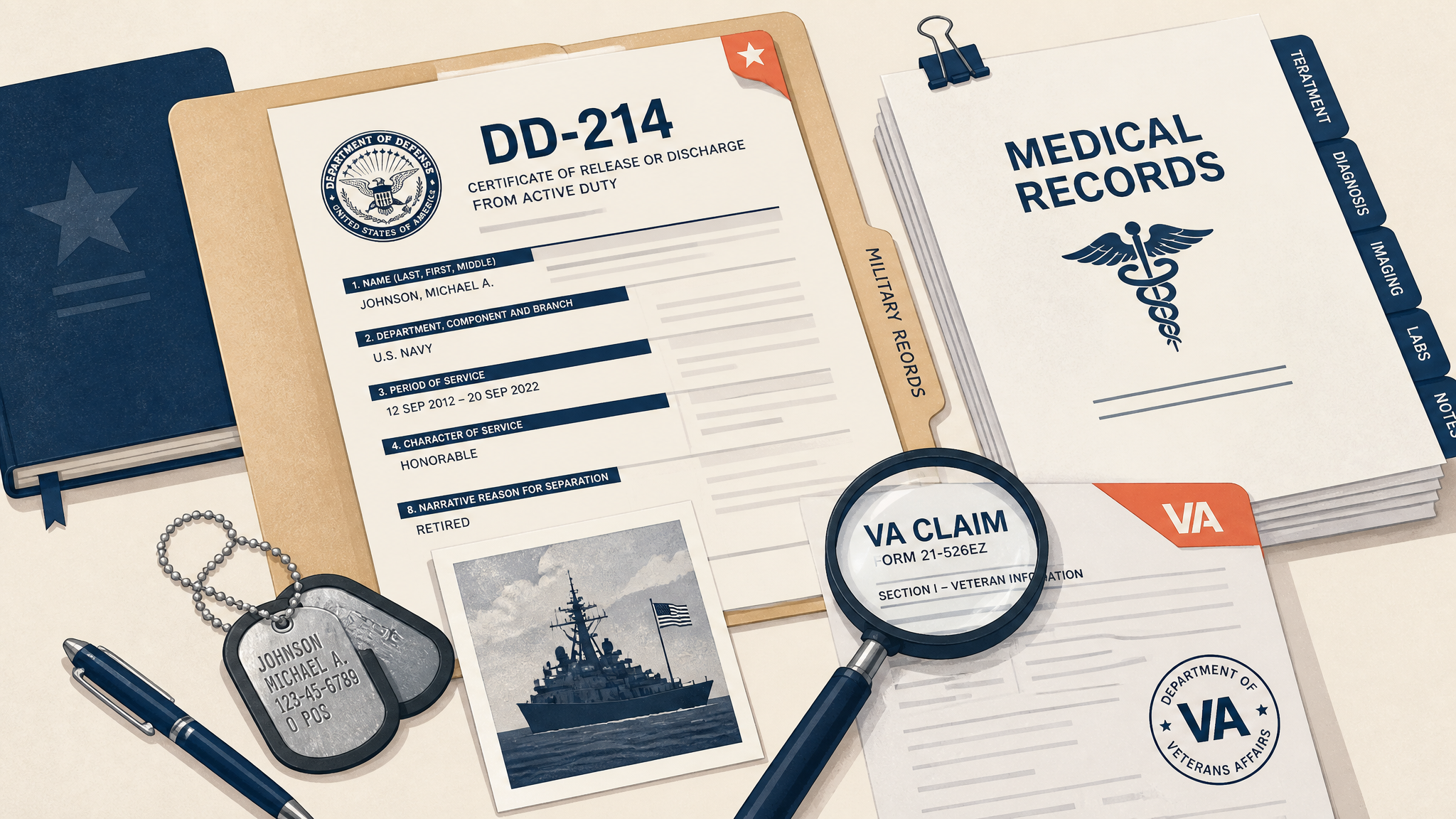
FIG. 01 - Gather your paperwork
First
Request your Certificate of Eligibility
Submit VA Form 26-1817 with a copy of the veteran’s DD Form 214. You can request it online, by mail, or have a VA-approved lender pull it for you.
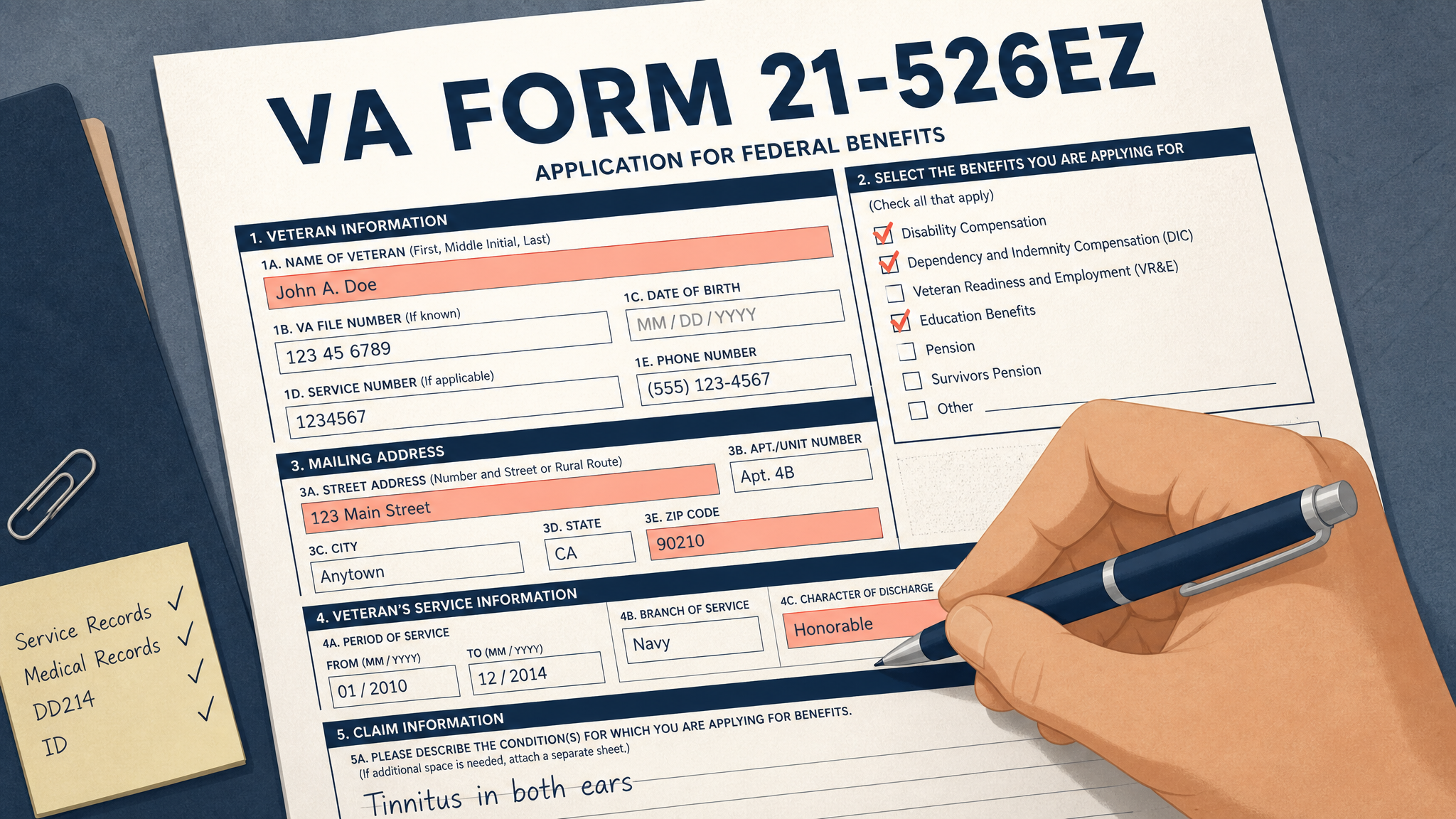
FIG. 02 - Fill out the form
Before closing
Confirm the funding fee exemption in writing
Tell the lender you receive DIC and get the exemption reflected on the closing disclosure. Do not assume it was applied.
FIG. 03 - File the claim
If you already closed
Ask for a recovery audit
If the fee was charged and you were exempt, request a refund through the lender or the VA Regional Loan Center. It will not be issued automatically.
FIG. 04 - After you file
If payments slip
Call the VA before the servicer calls you
Reach a VA loan technician at 877-827-3702. Repayment plans, forbearance, and modification options narrow sharply once a foreclosure referral is made.
Who to call & where to go
These are free, official VA lines. Have your Social Security number handy when you call.
VA Home Loans & Housing Grants
Home loan guaranty and adapted-housing grants (SAH/SHA).
VA Benefits Hotline
Compensation, pension, and general claim questions.
Rather have us handle it?
No phone tag, no hold music. Call our office and a real, VA-accredited person walks you through it - start to finish.
702-992-4883Download the forms
Not sure where to start?
Request a Certificate of Eligibility (COE) using VA Form 26-1817 with the veteran’s DD Form 214 - online at va.gov, by mail, or through a VA-approved lender - then shop lenders. Confirm the funding-fee exemption appears on the COE before you close.
More support for survivors & family
These often go hand in hand - tap any card to learn more.





Free information — get a free benefit review
Tell us how to reach you and an accredited team member will help you understand this benefit and claim everything you have earned. No cost, no obligation.
Ready to hire us? Register with us
For veterans who’ve decided they want us on their claim — registering is free too, and it does not make you our client or obligate you to anything. Here is exactly how it works:
- You register. This simply starts the conversation — you are not our client yet, and you owe us nothing.
- You sign and return VA Form 21-22a. It appoints us as your accredited representative and gives us access to your VA file.
- Once we have your signed 21-22a and access to your case, we verify everything is in order.
It involves the registration form and signing VA Form 21-22a — by law we can’t accept your claim, work on it, or contact the VA for you until that power of attorney is signed. You decide whether to move forward.
Answers, in plain language
Common questions about Housing Assistance for Surviving Spouses
What is Housing Assistance for Surviving Spouses?
Certain surviving spouses are eligible for a VA-backed home loan to buy, build, improve, or refinance a home - with no down payment, no mortgage insurance, and no funding fee.
Who qualifies for Housing Assistance for Surviving Spouses?
A surviving spouse of a veteran who died in the line of duty or from a service-connected disability may be eligible for a VA-backed home loan in their own right. A spouse of a veteran who was Missing in Action or a Prisoner of War for at least 90 days also qualifies. A spouse of a veteran who was rated totally disabled for a required period before death may qualify even when the death itself was not the service-connected condition - the same logic behind the DIC 10-year rule.
How much does Housing Assistance for Surviving Spouses pay?
Most VA borrowers pay a one-time funding fee of roughly 1.25% to 3.3% of the loan amount. A surviving spouse receiving DIC pays none of it. On a $400,000 loan, a 2.15% first-use funding fee would be about $8,600. For an exempt surviving spouse, that is $8,600 that stays in your pocket - or never gets financed into the balance and paid interest on for thirty years. The exemption applies to purchase loans, cash-out refinances, and Interest Rate Reduction Refinance Loans, and it should be printed on your COE.
How do I apply for Housing Assistance for Surviving Spouses?
Request a Certificate of Eligibility (COE) using VA Form 26-1817 with the veteran’s DD Form 214 - online at va.gov, by mail, or through a VA-approved lender - then shop lenders. Confirm the funding-fee exemption appears on the COE before you close.
What does it cost to get help with Housing Assistance for Surviving Spouses, and are you VA-accredited?
Lenders make mistakes on this. Check that your COE actually shows the funding-fee exemption before closing day, because getting a wrongly charged fee refunded afterward takes a written request and a recovery audit, and no one at the closing table will start that for you. It is free to talk with us, and no one may charge you to file a first-time VA claim. The Aging Veteran is led by Albert L. Thombs Jr., a VA-accredited claims agent (accreditation #45147) and disabled veteran; any appeal work is handled on a no-fee-unless-you-win basis. We are an independent accredited practice and are not affiliated with, or endorsed by, the U.S. Department of Veterans Affairs.