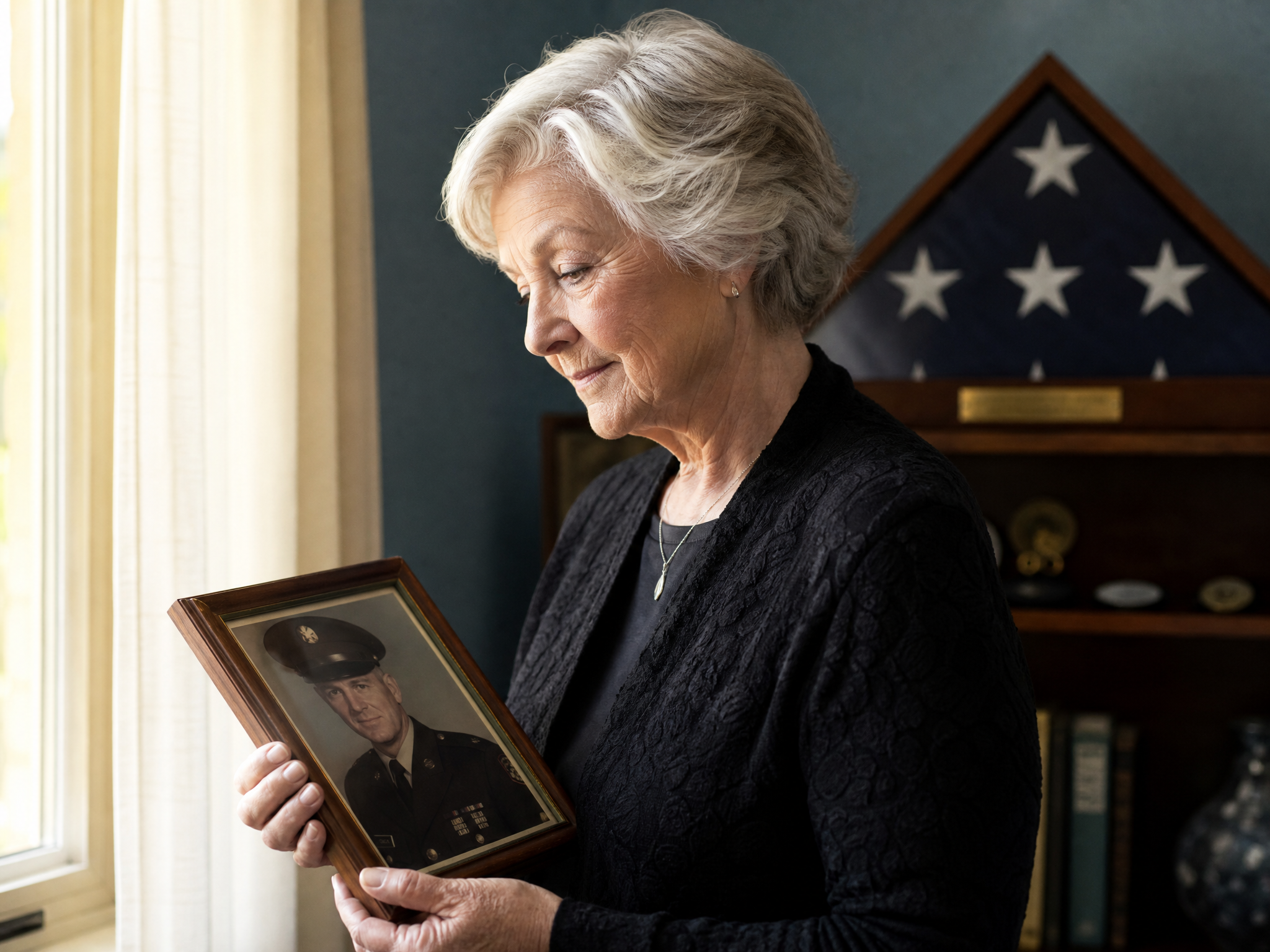
Survivors
Survivors Pension
A tax-free monthly benefit for eligible surviving spouses and unmarried dependent children of deceased wartime veterans with limited income.

There’s a free calculator on this page - estimate your monthly survivors pension. No sign-up, no cost.
Who this is for
If you lost the spouse who served during a wartime period and you are getting by on less than you used to, the VA may owe you a monthly, tax-free check. Survivors Pension fills the gap between your income and a guaranteed minimum for an unmarried surviving spouse or dependent child - and the money you spend on your own care can raise the amount.
In plain language
What Survivors Pension covers
- Based on yearly countable income and net worth limits set by the VA
- Requires the veteran to have served during a recognized wartime period
- The cause of death does not matter - this is the door when the death was not service-connected
- Can be increased with Aid & Attendance or Housebound benefits
- Unreimbursed medical expenses, including in-home care and assisted living, come off your countable income
- A meaningful source of steady income for survivors on a fixed budget

Glad You Asked: VA Pension for SurvivorsOfficial video - U.S. Department of Veterans Affairs
5 things most veterans aren't aware of
These apply to nearly every VA claim - and they change how much you get and when.
Your filing date sets your back pay
Benefits are generally paid back to the day you file - not the day you are approved. Filing an intent to file today can protect months, even years, of retroactive pay.
One condition can trigger others (secondary claims)
A service-connected condition that causes another - like sleep apnea from PTSD, or a bad knee from a bad hip - can be rated on its own. Each secondary condition adds to your rating.
A medical nexus is what wins the claim
The VA needs a documented link between your condition and your service. A clear nexus opinion is often the difference between an approval and a denial.
Accredited help is free to file an initial claim
By law, an accredited agent cannot charge a fee to prepare and file your original claim. If someone asks for money up front to file, that is a red flag.
A denial is not the end of the road
You have three appeal lanes - Higher-Level Review, a Supplemental Claim with new evidence, and the Board of Veterans Appeals. Many denials are overturned on review.
$163,699
Net-worth limit (Dec 2025 - Nov 2026)
Tax-free
The monthly benefit is never taxed as income
Wartime service
Veteran needed one day during a recognized wartime period
The full picture
Everything you need to know
Nothing hidden behind a click, and nothing you have to go looking for on another website. Here is the whole story in plain language - the facts and the figures first - so you can decide what fits your situation.
Key facts & current figures
- For an unmarried surviving spouse or unmarried dependent child of a wartime veteran, based on income and net worth - not on the cause of death.
- 2026 maximum annual rates: surviving spouse $11,699, housebound $14,298, needs Aid & Attendance $18,697 - and higher with a dependent child.
- The VA pays the difference between your countable income and that rate, split into monthly payments - so this is a gap-filler, not a flat check.
- Net worth limit: $163,699 (Dec 1, 2025 to Nov 30, 2026). Your home and your vehicle do not count.
- Unreimbursed medical expenses reduce your countable income, which is what makes most people eligible who assumed they were not.
- The same 3-year look-back on transferred assets applies - do not sign anything over to family before you ask.
General figures, current as of December 2025 and reviewed each year. Your exact amount depends on your situation - always confirm on va.gov.
How income and net worth actually set the amount
- The VA sets a Maximum Annual Pension Rate (MAPR) and pays the gap between your countable income and that rate, divided into twelve monthly payments.
- 2026 MAPRs: surviving spouse $11,699, or $15,311 with a dependent child; permanently housebound $14,298, or $17,902 with a child; needs regular Aid & Attendance $18,697, or $22,304 with a child. Each additional dependent child adds $2,984.
- That means a surviving spouse with $8,000 of countable income and no dependents would receive about $3,699 a year, or roughly $308 a month - and the same spouse who qualifies for Aid & Attendance would receive about $10,697 a year.
- The net worth limit is $163,699 from Dec 1, 2025 to Nov 30, 2026, and it counts assets plus annual income. The home you live in and your vehicle do not count. These figures adjust every December 1.
The wartime service requirement, and the exact dates
- The veteran generally needs at least 90 days of active duty with at least one day during a recognized wartime period (or 24 months of continuous active duty if the veteran entered service on or after September 8, 1980), and a discharge under conditions other than dishonorable.
- The periods that matter for most families we see: World War II (Dec 7, 1941 to Dec 31, 1946), Korea (Jun 27, 1950 to Jan 31, 1955), Vietnam (Aug 5, 1964 to May 7, 1975, or back to Feb 28, 1961 if the veteran served in Vietnam), and the Gulf War (Aug 2, 1990 through a date not yet set) - which means most post-1990 service still counts today.
- Combat is not required. The veteran only had to be on active duty during the qualifying dates. A cook at Fort Ord in 1968 meets this test.
- The dates are on the DD-214. If the family cannot find it, a free copy can be requested - and one day of overlap is enough to open this benefit.
Unreimbursed medical expenses - the deduction that decides most cases
- Countable income is not your gross income. Certain unreimbursed medical expenses you pay out of pocket come off the top before the VA compares you to the MAPR.
- That includes Medicare and supplemental insurance premiums, prescriptions, in-home care, adult day care, and in many cases the care portion of an assisted living or memory care bill.
- This is why a surviving spouse with a $30,000 Social Security income and a $48,000 assisted living bill can end up with countable income near zero - and a full pension payment.
- Keep every receipt and every statement. The burden of proving these expenses is on you, and a well-documented expense schedule is often the difference between a denial and a full award.
Aid & Attendance and Housebound can raise the payment
- If you need regular help with things like bathing, dressing, eating, toileting, or managing medication, the Aid & Attendance rate applies and raises your MAPR from $11,699 to $18,697.
- If you are substantially confined to your home by a permanent disability but do not need hands-on help, the Housebound rate raises it to $14,298.
- You cannot receive both Aid & Attendance and Housebound at once - the VA pays the higher one.
- The medical evidence comes from your doctor on VA Form 21-2680. A vague form gets denied; a form that describes the actual daily help you need gets granted.
The 3-year look-back and the penalty period
- The VA looks back 36 months from the date of the claim at assets you gave away or transferred for less than fair market value.
- A covered transfer that would have pushed you over the net worth limit can create a penalty period of up to 5 years during which no pension is payable.
- This is the trap that catches families who moved a house or a bank account to a child "to protect it." Do not sign anything over to family before asking someone who knows the pension rules.
- If a transfer has already happened, it is still worth asking - some transfers can be undone, and the penalty is calculated only on the portion that exceeded the limit.
DIC or Survivors Pension - which door are you standing at
- DIC is for a death connected to service, or a veteran who was rated totally disabled long enough before death. It is not means-tested and pays $1,699.36/mo as a base rate.
- Survivors Pension is for a wartime veteran whose death had nothing to do with service. It is means-tested and pays the gap up to the MAPR.
- You cannot be paid both for the same period - the VA pays the greater benefit. In almost every case that is DIC, which is why it is worth testing DIC eligibility first even when the death looks unrelated to service.
- One form, VA Form 21P-534EZ, applies for both. Filing it protects your date on whichever benefit turns out to be the right one, so there is no reason to guess before you file.
Estimate your monthly survivors pension
Survivors Pension estimator
As the unmarried surviving spouse or child of a wartime veteran, your tax-free pension is the gap between your countable income and the current 2026 Maximum Annual Pension Rate (MAPR). Unreimbursed medical expenses above 5% of the MAPR lower your countable income, and Aid & Attendance or Housebound raises the rate - so most survivors receive more than a quick guess suggests.
Who is applying?
How much daily help do you need?
Aid & Attendance and Housebound raise the maximum rate, but you cannot receive both at once - the VA pays the higher one. A doctor confirms the level of care you need.
Your household
Do you have a dependent child?
Additional dependent children
Beyond the first dependent above
Your yearly finances
Social Security, pensions, wages, interest - before taxes.
Assisted living, in-home aides, insurance premiums, prescriptions. These can raise your payment.
Enter your yearly income to see your estimate
Pension fills the gap between your income and the maximum rate. Fill in Step 4 and your tax-free monthly amount appears here.
Estimate only. Net worth must be under $163,699. Rates adjust yearly with the COLA - confirm on va.gov.
This calculator is free. No sign-up, no catch.
Most people in this business hide tools like this behind a paywall or a sign-up form. We don’t. Use it as much as you need. And if you want a real accredited agent to look at your actual claim, we’re one call away — it’s free to talk, and free to file your claim.
Albert L. Thombs Jr. — VA-accredited claims agent (#45147), a disabled veteran with a team of advocates who do this every day.
How the money really works
The parts of pension people get wrong
The estimator gives you a number. This shows you why it lands there - the arithmetic, the three levels of the benefit, the net-worth test, and the mistakes that get good claims denied.
Worked example
How care costs turn “too much income” into a real check
Meet a single surviving spouse living on $15,000/yr (Social Security and a small pension), paying $20,000/yr for daily help and needing Aid & Attendance. On paper that income looks too high. Watch what actually happens.
- 1Maximum rate for this situation (Aid & Attendance)$18,697
- Out-of-pocket care counted – $20,000 minus the 5% threshold ($585)-$19,415
- 3Countable income – $15,000 income minus the care deduction$0
- 4Yearly pension the VA pays (rate minus countable income)$18,697
Estimated monthly, tax-free
$1,558
about $18,697 per year
Without counting those care costs, the same surviving spouse would see only about $308/month. The medical deduction is the whole game - and it is exactly what most people miss.
Basic, Housebound, or Aid & Attendance
These are the three levels of the same benefit. The more daily help you need, the higher the maximum rate - here are the 2026 ceilings for a surviving spouse.
Basic pension
You get through the day without regular help from another person.
$975/mo max
up to $11,699 per year
Housebound
A disability keeps you mostly confined to your home.
$1,192/mo max
up to $14,298 per year
Aid & Attendance
You need another person to help with daily activities, or you live in a care facility.
$1,558/mo max
up to $18,697 per year
These are maximum rates. The VA pays the gap between the rate and your countable income, so your actual check depends on your finances. You cannot receive Housebound and Aid & Attendance at once - the VA pays the higher one.
Rates verified against VA published pension MAPR tables, effective December 1, 2025 (2.8% COLA).
The $163,699 net-worth test
To qualify, your assets plus your annual income must stay under this limit (Dec 1, 2025 - Nov 30, 2026). What surprises people is what the VA leaves out.
Counts toward the limit
- Savings, checking, and investment accounts
- Stocks, bonds, and CDs
- A second property or land you do not live on
- Your annual income counts on top of assets
Does NOT count
- The home you live in (and a reasonable lot)
- Your vehicle
- Normal household goods and personal effects
- Out-of-pocket medical costs (they lower income)
The 3-year look-back trap: giving away money or property to get under the limit can backfire. The VA reviews transfers from the last 3 years and can set a penalty period - roughly one month of ineligibility for about every $2,874 transferred. Talk it through before you move any assets.
Why pension claims stall or get denied
The benefit is real, but the paperwork is unforgiving. These are the reasons good claims come back denied - and every one of them is avoidable.
Net worth over the limit
Assets plus annual income top the $163,699 ceiling. Note what does NOT count - your home, your vehicle, and normal household goods.
Gifting inside the 3-year look-back
Money or property transferred for less than fair value in the last 3 years can trigger a penalty period that delays payments.
No qualifying wartime service on file
The VA cannot find the required active duty (90+ days, or 24 months if the veteran entered service on or after September 8, 1980) with at least one day in a recognized wartime period. The DD-214 has to show it.
Care costs never documented
The single biggest miss: income looks too high because nobody subtracted the out-of-pocket aide, assisted-living, or insurance costs that lower it.
Aid & Attendance claimed with no exam
Asking for the higher rate without a physician’s statement (VA Form 21-2680) that spells out the daily help you need.
Your family’s complete benefit picture
You do not have to sort this out alone
Most surviving spouses who tell us they "make too much" for pension have never actually run the math with medical expenses deducted. A spouse paying $3,500 a month for assisted living can be over the income limit on paper and still qualify. The deduction is the whole game, and the VA is not going to compute it for you.

Two ways to move forward — both free
Not sure if this applies to you?
Ask our free assistant a few plain questions and get an honest read on what you and your family may qualify for, at no cost. It takes just a few minutes, and there is no sign-up and no obligation of any kind. You will get a clear, plain-language picture of where you stand and what might be worth filing. And if you would rather talk to a real person, an accredited agent is only a message away.
Have a question? Get free information
Ask a question, learn what you may be owed, or find out where you stand. Confidential, free, and no obligation to go any further.
Ready to hire us? Register
Decided you want us to work your claim? Registering is free — we match you with an accredited advocate and get you started. We cannot begin until you sign VA Form 21-22a, and fees, if any, are always disclosed up front.
Worth knowing
Aid & Attendance can raise your payment
If you need daily help with things like bathing or dressing, or you are largely confined to home, an added Aid & Attendance or Housebound amount can increase your monthly pension.
The VA pays the gap between your countable income and the Maximum Annual Pension Rate - and your home and vehicle do not count toward the net-worth limit.
3-year look-back
The VA reviews assets transferred for less than fair value in the 36 months before filing - ask before signing anything over to family.
No combat required
The veteran only needed to serve during qualifying wartime dates, not to have seen combat.
A clear path forward
Your step-by-step action plan
No rush and no pressure - but a little order helps. Applying is always free.
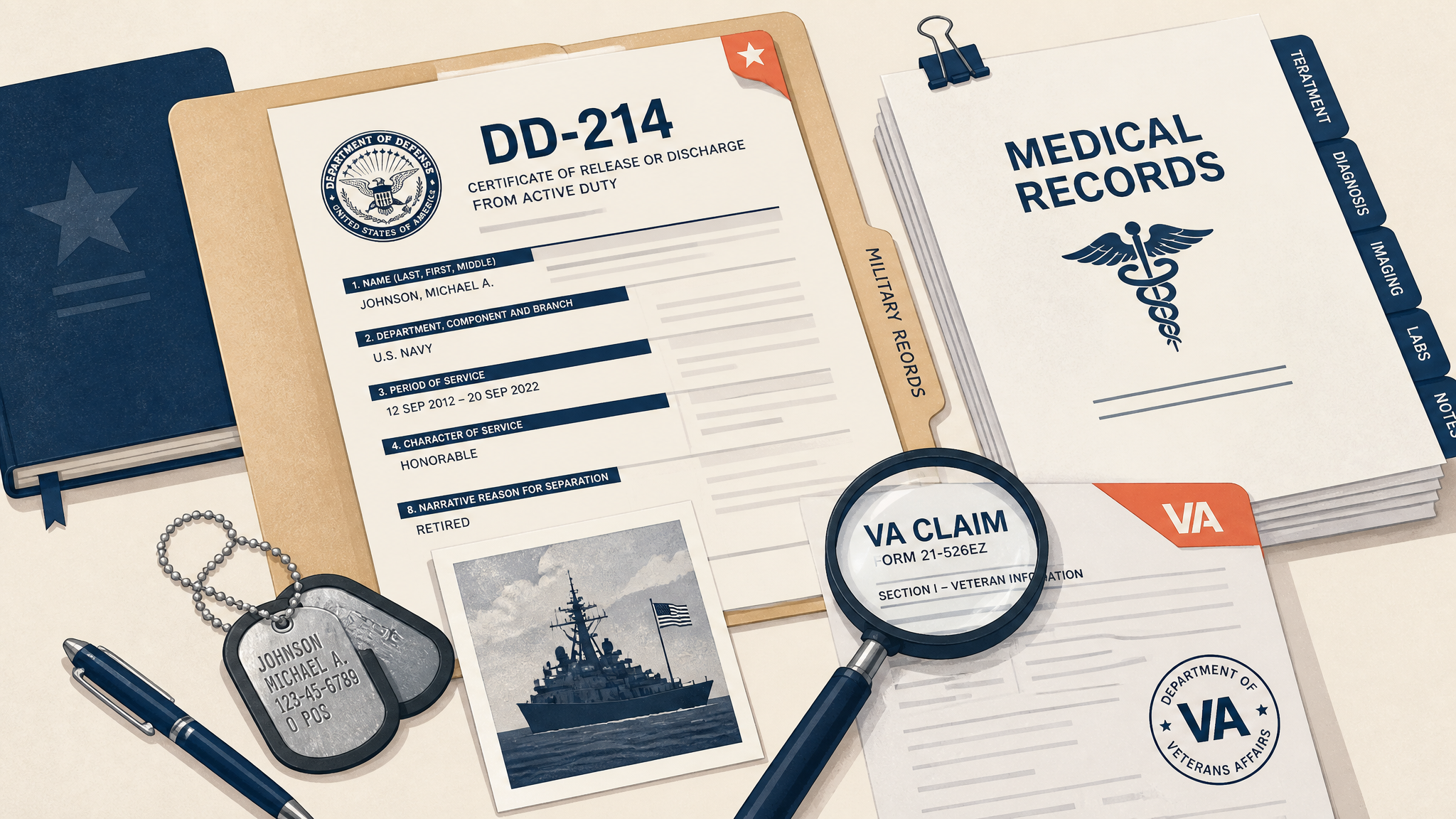
FIG. 01 - Gather your paperwork
Gather
Collect proof of service and income
You will need proof of the veteran’s wartime service and your own income and net-worth figures.
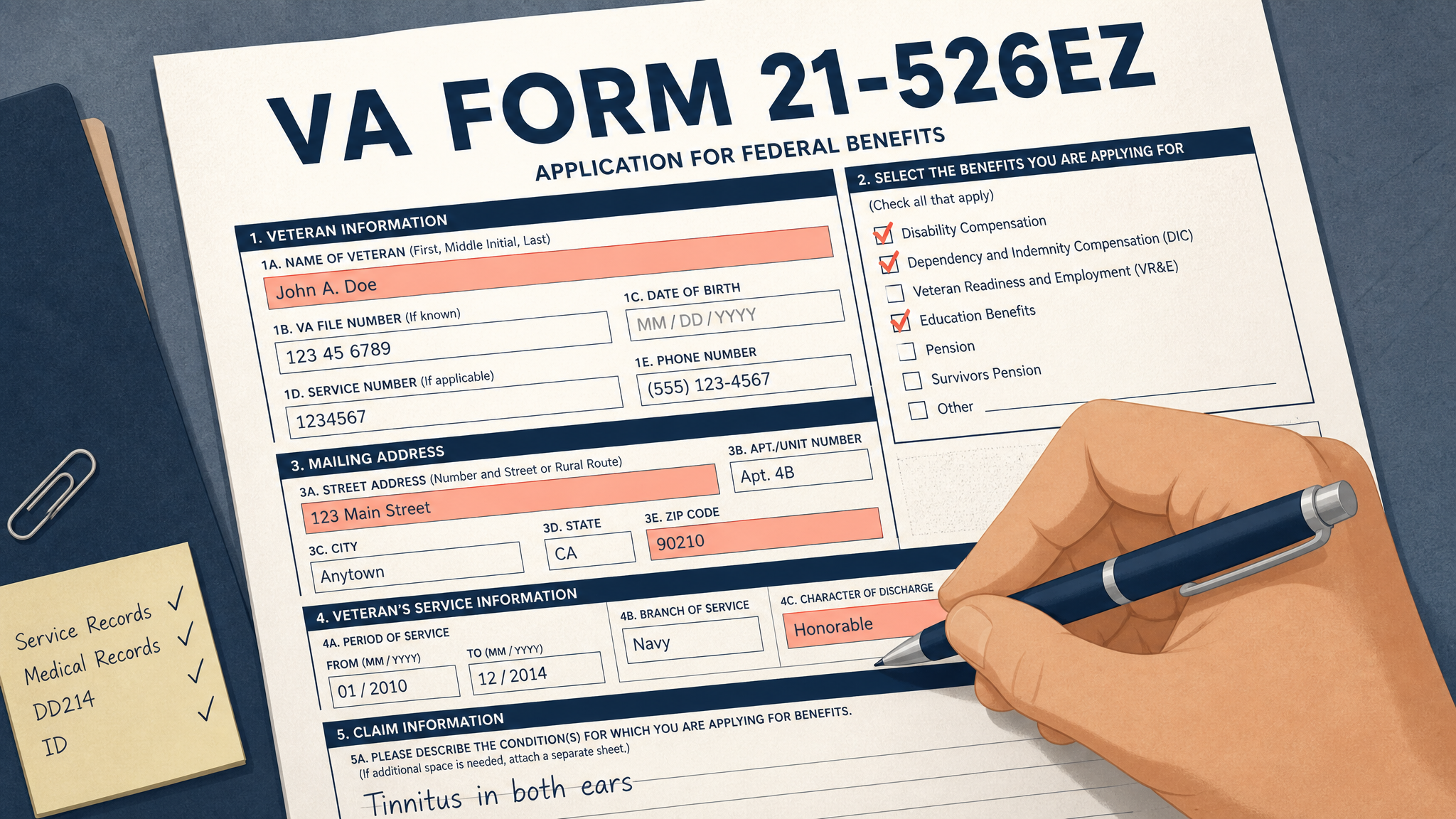
FIG. 02 - Fill out the form
File the form
Submit VA Form 21P-534EZ
This one form can start your survivors pension - file online at va.gov, by mail, or with free accredited help.
FIG. 03 - File the claim
If you need care
Add Aid & Attendance
Include a physician’s statement (VA Form 21-2680) to raise your monthly amount if you need daily help.
Who to call & where to go
These are free, official VA lines. Have your Social Security number handy when you call.
VA Benefits Hotline
Compensation, pension, and general claim questions.
MyVA411 - Main VA Line
Not sure who to call? Start here. One number for anything VA - they route you to the right office.
Rather have us handle it?
No phone tag, no hold music. Call our office and a real, VA-accredited person walks you through it - start to finish.
702-992-4883Not sure where to start?
File VA Form 21P-534EZ with proof of the veteran's wartime service and your income and net worth. If you need daily help, add a physician's statement on VA Form 21-2680 to claim Aid & Attendance at the same time.
More support for survivors & family
These often go hand in hand - tap any card to learn more.
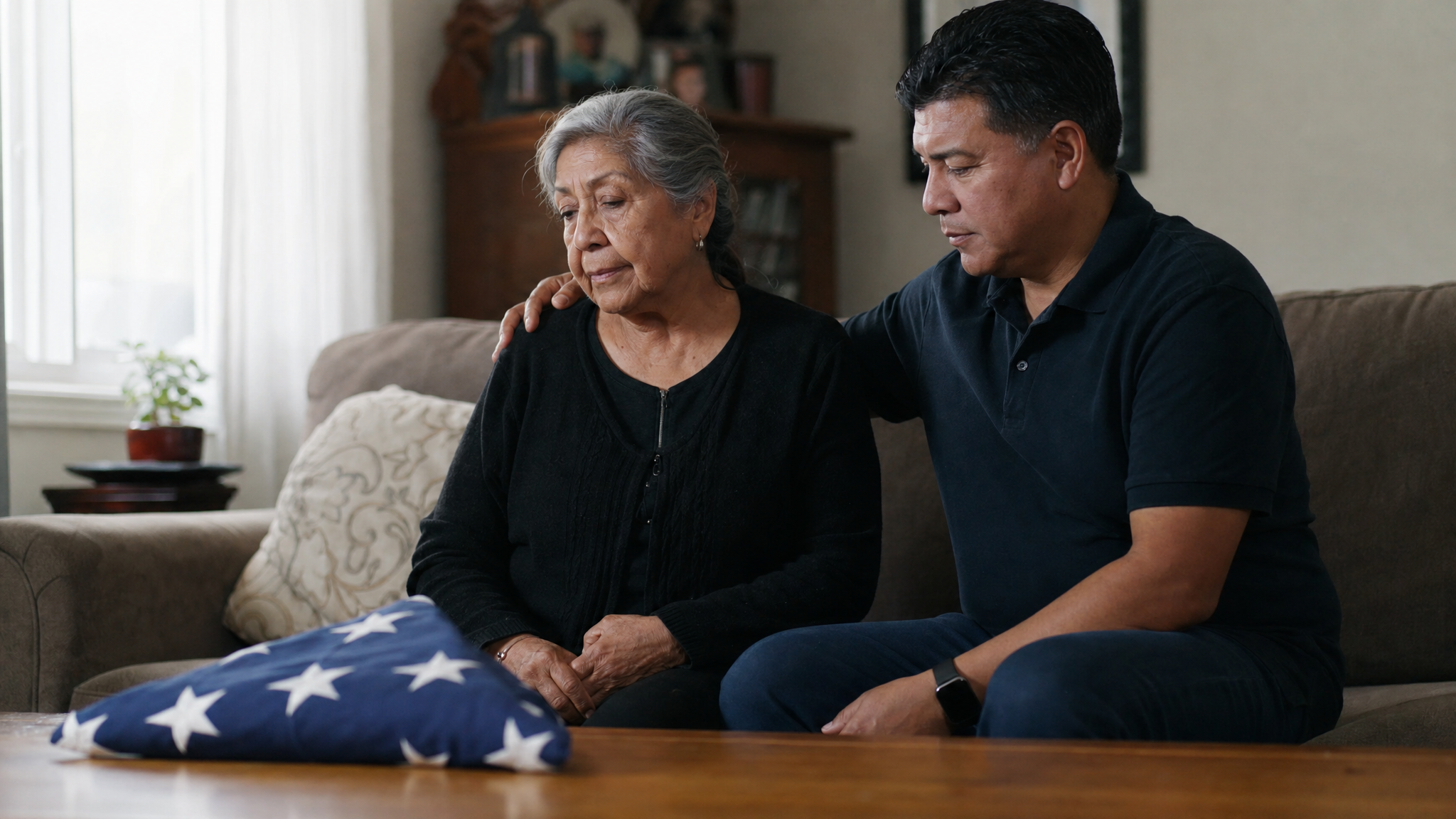






Free information — get a free benefit review
Tell us how to reach you and an accredited team member will help you understand this benefit and claim everything you have earned. No cost, no obligation.
Ready to hire us? Register with us
For veterans who’ve decided they want us on their claim — registering is free too, and it does not make you our client or obligate you to anything. Here is exactly how it works:
- You register. This simply starts the conversation — you are not our client yet, and you owe us nothing.
- You sign and return VA Form 21-22a. It appoints us as your accredited representative and gives us access to your VA file.
- Once we have your signed 21-22a and access to your case, we verify everything is in order.
It involves the registration form and signing VA Form 21-22a — by law we can’t accept your claim, work on it, or contact the VA for you until that power of attorney is signed. You decide whether to move forward.
Answers, in plain language
Common questions about Survivors Pension
What is Survivors Pension?
A tax-free monthly benefit for eligible surviving spouses and unmarried dependent children of deceased wartime veterans with limited income. If you lost the spouse who served during a wartime period and you are getting by on less than you used to, the VA may owe you a monthly, tax-free check. Survivors Pension fills the gap between your income and a guaranteed minimum for an unmarried surviving spouse or dependent child - and the money you spend on your own care can raise the amount.
Who qualifies for Survivors Pension?
This benefit is generally for: Surviving spouse, Surviving child. Based on yearly countable income and net worth limits set by the VA Requires the veteran to have served during a recognized wartime period
How much does Survivors Pension pay?
The VA sets a Maximum Annual Pension Rate (MAPR) and pays the gap between your countable income and that rate, divided into twelve monthly payments. 2026 MAPRs: surviving spouse $11,699, or $15,311 with a dependent child; permanently housebound $14,298, or $17,902 with a child; needs regular Aid & Attendance $18,697, or $22,304 with a child. Each additional dependent child adds $2,984. That means a surviving spouse with $8,000 of countable income and no dependents would receive about $3,699 a year, or roughly $308 a month - and the same spouse who qualifies for Aid & Attendance would receive about $10,697 a year.
How do I apply for Survivors Pension?
File VA Form 21P-534EZ with proof of the veteran's wartime service and your income and net worth. If you need daily help, add a physician's statement on VA Form 21-2680 to claim Aid & Attendance at the same time.
What does it cost to get help with Survivors Pension, and are you VA-accredited?
Most surviving spouses who tell us they "make too much" for pension have never actually run the math with medical expenses deducted. A spouse paying $3,500 a month for assisted living can be over the income limit on paper and still qualify. The deduction is the whole game, and the VA is not going to compute it for you. It is free to talk with us, and no one may charge you to file a first-time VA claim. The Aging Veteran is led by Albert L. Thombs Jr., a VA-accredited claims agent (accreditation #45147) and disabled veteran; any appeal work is handled on a no-fee-unless-you-win basis. We are an independent accredited practice and are not affiliated with, or endorsed by, the U.S. Department of Veterans Affairs.