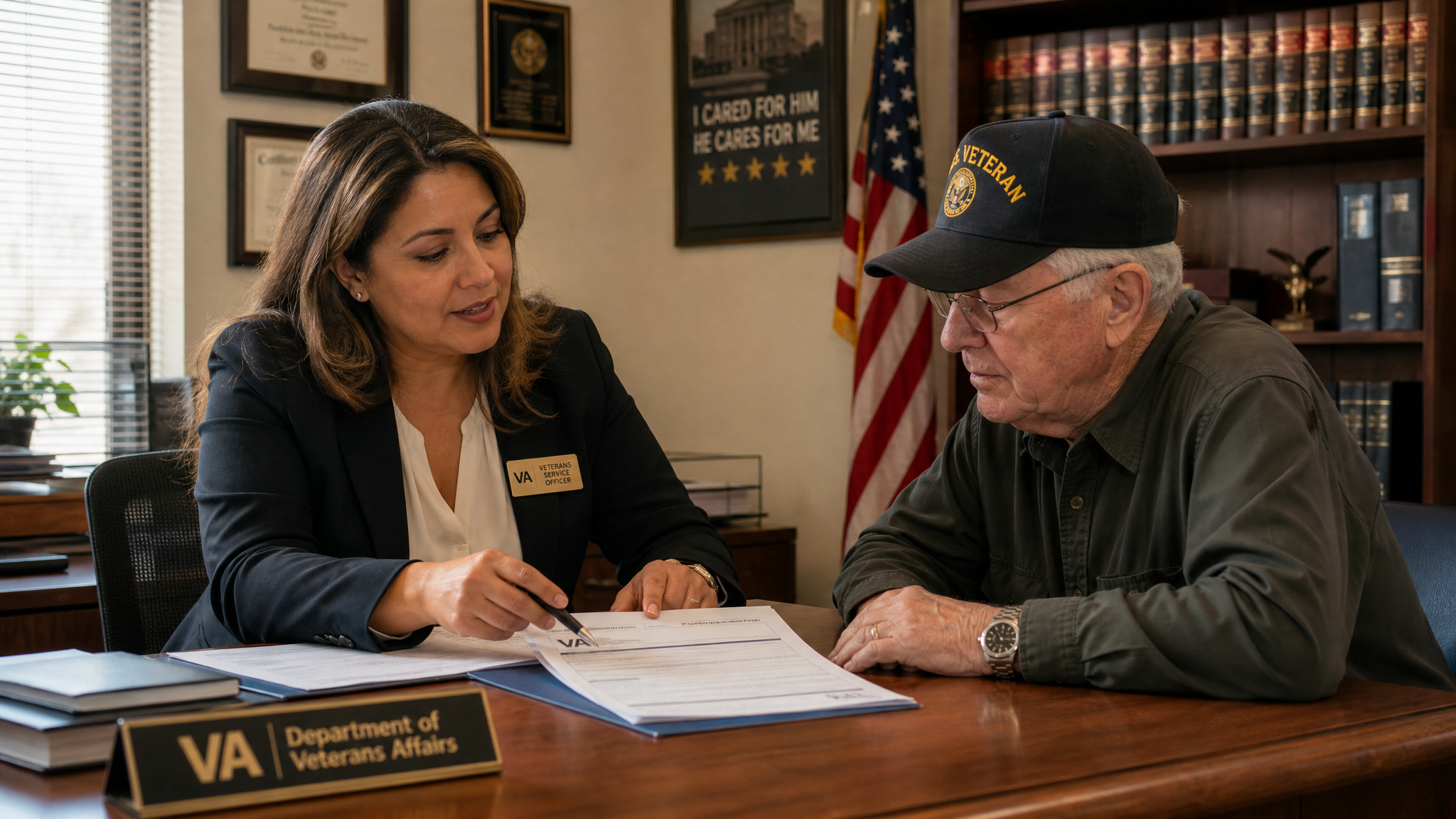
If you are 45 or older and think you waited too long, you did not. VA disability compensation has no age limit and no deadline on a first claim.
If you have been telling yourself you are too old, you waited too long, or nobody ever told you so the chance must be gone, you are not alone. Many veterans do not look at disability compensation until their 50s, 60s, 70s, or later.
No age limit. No first-claim deadline. If a condition is connected to service, or service made it worse, you may still be entitled to tax-free monthly compensation now.
What disability compensation can do for you now
Tax-free monthly payments may be available for illnesses or injuries connected to military service, including conditions that service aggravated. This can include physical conditions and mental-health conditions such as PTSD.
The amount depends on the VA's final decision and your individual situation. As published on our site for 2026 rates effective Dec. 1, 2025, payments may be about $180.42 a month at 10% and about $356.66 a month at 20%.
At 30% and up, the VA may add more for dependents. For example, compensation could be roughly $617 a month at 30% with a spouse, rising to about $4,158 a month at 100% with a spouse, depending on the rating and family situation.
Those rates also rise with the Social Security cost-of-living adjustment. For 2026, that increase is 2.8%.
You did not age out of this benefit
You do not age out of VA disability compensation. There is no age cutoff for filing, and there is no deadline on a first claim.
The VA does not award this benefit based on whether you are young enough. It looks at whether the condition is connected to service and what evidence supports that connection.
That matters because many older veterans quietly talk themselves out of filing. They think, "I'm too old," "I waited too long," or "If nobody told me back then, I must have missed my chance." Those beliefs stop valid claims, and they are often wrong.
Being aware of what you may be entitled to today helps protect your health, your family, and your benefits. It is also easier to work on a claim while you can still gather records and attend exams.
What kinds of conditions may qualify
Service connection is the key question. The condition does not have to be something you claimed decades ago, and it does not have to be a brand-new diagnosis.
- Conditions directly tied to service
- Conditions that military service made worse
- Physical injuries and illnesses
- Mental-health conditions, including PTSD
- Presumptive conditions, such as certain illnesses tied to Agent Orange or burn-pit exposure, which can make claims easier
When a condition is presumptive, the VA may not require the same level of proof about the connection to service. That is different from the rating question, which is about how severe the condition is and how much compensation the VA may award.
If toxic exposure is part of your story, Albert built a whole separate site just for this at https://veterantoxicexposure.com.
The step many veterans miss: protect your date first
File an Intent to File first. That can help lock in your effective date and possible back pay while you gather evidence.
This is one of the most important moves for a veteran who has waited years. You do not need to have every record in hand before taking that first protective step.
Then file your claim on VA Form 21-526EZ online or with help. You can find more detail on our full page about this benefit at /benefits/disability-compensation.
What makes a claim stronger
Strong medical evidence linking the condition to service can make a real difference. This is where older veterans often have an advantage if they take time to organize the story clearly.
- Current medical records showing the condition
- Service records or other records that help show what happened in service
- Evidence showing service caused the condition or made it worse
- A clear timeline of symptoms, treatment, and how the condition affects daily life
You do not have to make the claim sound dramatic. You do need to make it understandable, supported, and consistent.
Organizing your records matters. Many claims are not denied because the veteran is too old. They are denied because the file does not clearly connect the dots.
If the VA says no, you still have options
A denial is not the end. If the VA denies the claim, there are three review paths.
- Supplemental Claim if you have new evidence
- Higher-Level Review
- Board Appeal
Each path fits a different kind of problem. Some denials need better evidence. Some involve an error in how the VA reviewed what was already there.
The important thing is not to assume one denial means you were never entitled. Veterans who were overlooked, underdeveloped, or misunderstood do win on review. If that is your situation, you may also want deeper help from Albert's sister site, The VA Disability Advocate, at https://newvadisabilityadvocate.abacusai.app.
You can start for free, and help is there when you want it
You can file an initial claim yourself for free. That is an important protection in the law, and no one can charge you an upfront fee for an initial claim if fees come up.
If you choose accredited representation, the law prohibits any upfront fee for an initial claim. General information like this can help you understand the process, but it is not legal, medical, or financial advice, and The Aging Veteran is not the VA or part of the federal government.
If you are finally ready to look at what you earned, free help is available when you want it. Albert L. Thombs Jr. is a VA-accredited claims agent with accreditation #45147, and you can reach his team at 702-992-4883.
It is not too late. If service caused it, or service made it worse, you may still have a claim worth filing for your health, your family, and your future.
A quick, honest note
This article is general information, not legal advice, and every rate or example is an estimate. Your own claim depends on your records and the facts the VA finds. Albert L. Thombs Jr. is a VA-accredited claims agent (accreditation #45147). If you would like a real person to look at your situation, you are always welcome to reach out - there is no cost to ask.