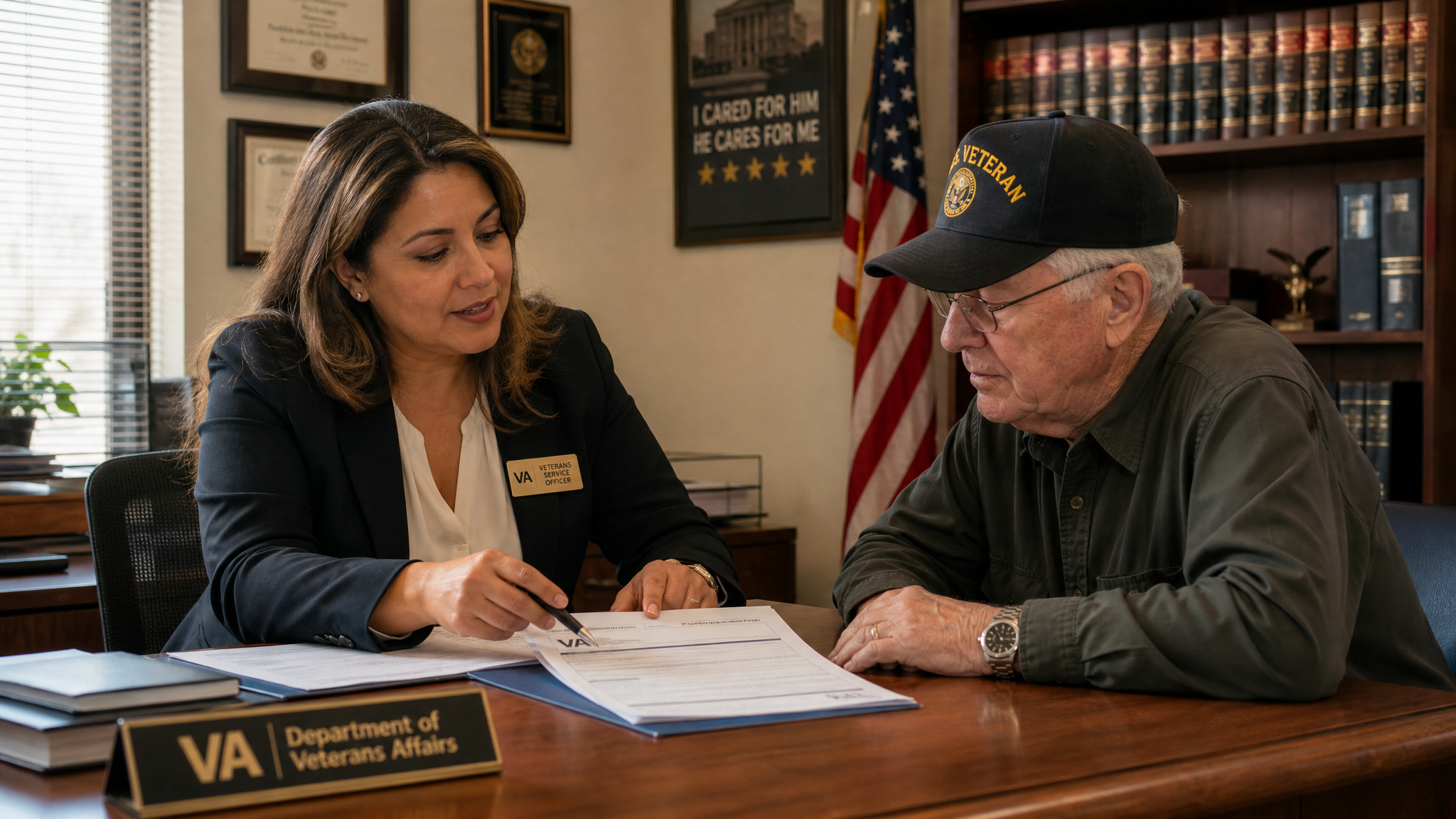
If you are enrolled in VA health care, you may already qualify for free exams, hearing aids, eyeglasses, and other devices. Age does not cancel what you earned.
You are not crazy for feeling like nobody ever told you this stuff. A lot of veterans hit their 50s, 60s, or 70s thinking they missed the boat, when the truth is a whole lot simpler, and a whole lot less insulting.
You did not age out. There is no age limit on filing a first VA claim, and there is no rule that says hearing help stops mattering because you got older. If your hearing problem connects to service, you are still in the game. Period.
What the VA may give you right now
Enrolled veterans can get free exams. If you are enrolled in VA health care, you can receive a free hearing test and a free eye exam.
And this is where a lot of veterans get misled. The exam is open to enrolled veterans, but the actual devices, hearing aids, eyeglasses, and certain other equipment, follow a separate rule.
- Hearing aids at no cost if you meet an eligibility category
- Eyeglasses and contact lenses under that same device rule
- Prosthetics and home medical equipment such as wheelchairs, walkers, scooters, canes, hospital beds, and similar items when medically appropriate
- Batteries, repairs, and replacements included for covered hearing devices
- Cochlear implants and assistive listening devices when prescribed by VA audiology
This matters now because hearing loss does not just make the television louder and the grandkids mumble. It affects safety, sleep, relationships, isolation, and your ability to manage your own care.
The rule that trips veterans up
The exam is not the hardware. The VA furnishes hearing aids and eyeglasses under 38 CFR 17.149, and you have to fit one of that regulation's eligibility categories.
Here is the hard truth with the fluff removed: age-related hearing loss alone is not enough. Same story for plain age-related vision loss by itself. That is not the VA being ageist, and it is not a reason to quit. It just means you need to understand the actual door in.
For hearing aids, the widest door is also the smallest rating. A 0 percent hearing rating qualifies for VA hearing aids under that eligibility rule. Zero percent may pay no monthly cash by itself, depending on your situation and the VA's final decision, but it still unlocks the devices.
That is the part people miss. They hear, "It is only 0 percent" or "it is only 10 percent," and they talk themselves out of a claim that could protect their health for years.
Why filing still matters, even later in life
There is no deadline on a first claim. If you never filed for hearing loss or tinnitus, that does not mean you missed your chance. It means nobody explained the rules to you, or you got discouraged and set it aside like most veterans do.
Hearing loss and tinnitus are commonly claimed conditions in the VA system. That does not mean automatic approval. It means the VA sees them every day, and if you have the evidence, they can be service-connected like anything else.
Every claim still needs the basics:
- A current diagnosis
- An in-service event or exposure
- A nexus linking the two
- Chronicity, meaning a real history of the problem over time
No doctor's visit. No evidence. No successful claim. It is as simple as that.
If you file and win service connection for hearing loss, even at 0 percent, you may settle your hearing-aid eligibility permanently under the rule. That protects more than your ears. It protects your independence, and it gives your family one less mess to sort out later.
What a proper hearing exam actually looks like
Bad exams sink good claims. When the VA schedules a compensation exam for hearing loss, do not just show up and hope for the best. Hope is not evidence, and the examiner is not your advocate.
A VA hearing exam only counts if a state-licensed audiologist performs both the Maryland CNC speech discrimination test and puretone audiometry. And those tests must be done with your hearing aids out.
If one of those pieces is missing, you may be dealing with an inadequate exam. The exam is theater until it is on paper. Read the result, not the room.
Tinnitus is its own issue. Tinnitus is capped at 10 percent, whether the ringing is in one ear or both. But what tinnitus causes, poor sleep, headaches, anxiety, depression, may lead to other claims or secondary issues depending on the facts and the evidence.
What to do next, in plain English
Start with enrollment and audiology. If you are not enrolled in VA health care, enroll. If you are enrolled, ask for an audiology appointment. Many VA medical centers let you schedule audiology directly without going through primary care first.
If you never filed for hearing loss or tinnitus, file the claim too on VA Form 21-526EZ. And before you do anything else, consider filing an Intent to File, VA Form 21-0966, to protect your effective date. Every day you wait may be back pay you do not get, depending on your situation and the VA's final decision.
- Enroll in VA health care if needed.
- Ask for a hearing test and keep the records.
- File for hearing loss and tinnitus if you have not already.
- Write your own statement about noise exposure and how the problem affects daily life.
- At the compensation exam, confirm state-licensed audiologist and Maryland CNC.
- If prescribed hearing aids, reorder supplies through the VA system as needed.
Once you are covered for hearing aids, the upkeep matters too. Supplies are free for as long as you need them, including batteries, wax guards, domes, cleaning supplies, and repairs through the VA Denver Logistics Center. Reorders can be made at 877-677-8710, and each shipment is about a 6-month supply.
If you want the full breakdown on this benefit, including the device rules and what may be covered, see our complete page here: /benefits/hearing-aids-devices.
What happens if you keep putting this off
Waiting usually makes the record weaker. Memories fade. Buddies disappear. Old records get harder to track down. And the longer you go without treatment, the easier it is for the VA to act like the problem is not that serious.
I will say the quiet part out loud. A lot of veterans tell themselves, "I'll deal with it when I really need care." That is backwards. Filing while you can still gather records, attend exams, and explain your history clearly is an advantage.
And think about your family. Too many veterans leave a spouse with no idea what benefits were in place, what equipment was covered, or what should have been claimed years earlier. Your claim affects your family too.
You are still in the fight
No VA benefit expires because you got older. Not one. The VA may make you feel too old, too late, or too far gone. That feeling is real. The rule is not.
This article is general educational information, not legal, medical, or financial advice. The Aging Veteran is not the U.S. Department of Veterans Affairs and is not part of the federal government.
When you are ready, free help is available from Albert L. Thombs Jr., a VA-accredited claims agent, accreditation #45147, at 702-992-4883. No pressure, no sales ambush, and no need to tell your life story to five different strangers. Just plain-English help, privately, when you want it.
A quick, honest note
This article is general information, not legal advice, and every rate or example is an estimate. Your own claim depends on your records and the facts the VA finds. Albert L. Thombs Jr. is a VA-accredited claims agent (accreditation #45147). If you would like a real person to look at your situation, you are always welcome to reach out - there is no cost to ask.