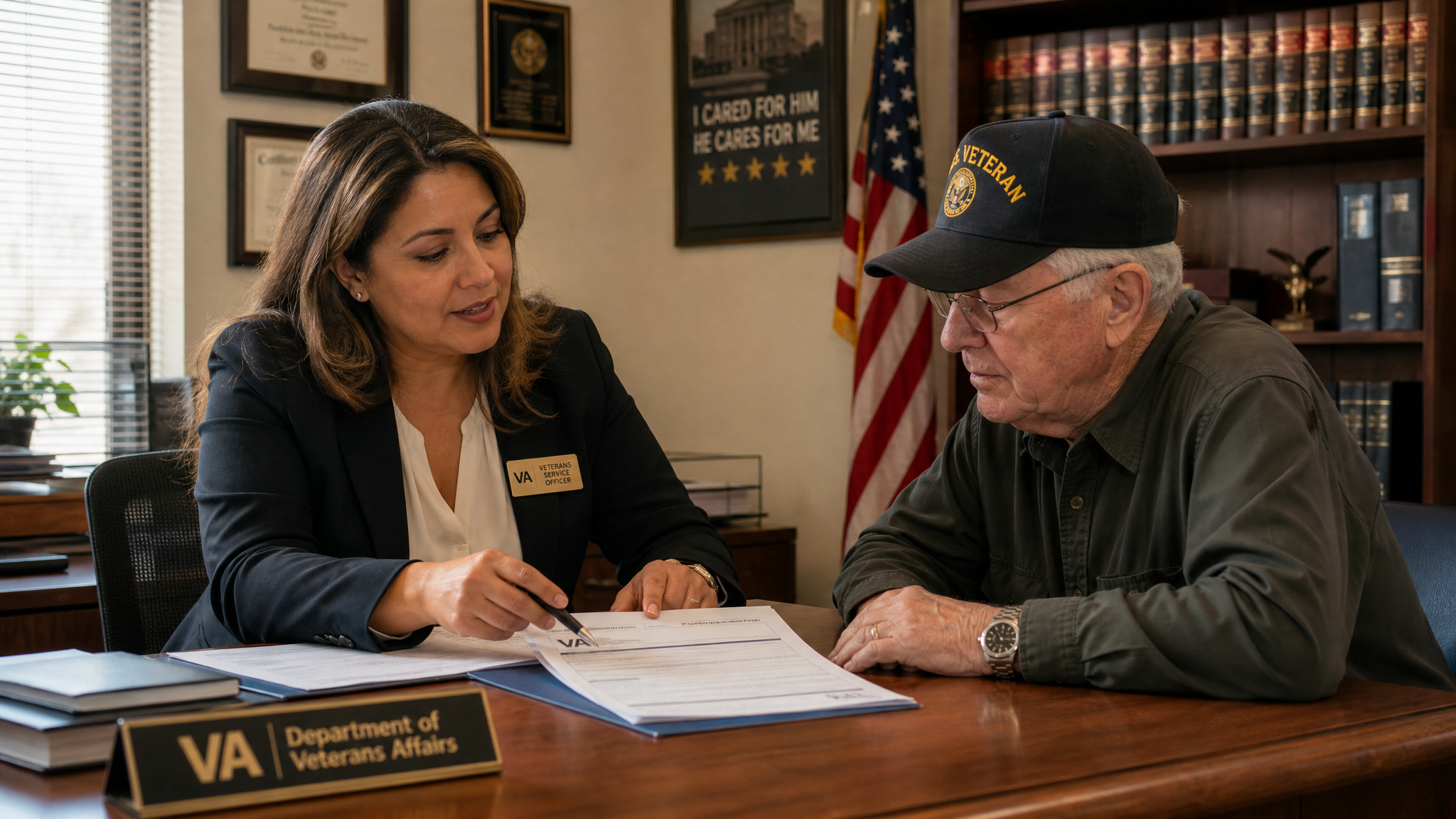
Too old to file? No. The doctor visit is where your VA evidence starts, and without it, even a real condition can be denied.
You are not too old. You did not miss your chance. If you are finally looking at VA benefits in your 50s, 60s, 70s, or beyond, this is where a lot of claims are won or lost, not in the form, but in the exam room.
And here is the hard truth. The doctor visit is claim evidence. If you have been telling yourself, "I'll file when I get around to it," but you have not actually talked to a doctor about the condition, you are trying to build a house without a foundation.
Why this matters more than the form
No diagnosis, no real claim. Before you ever file VA Form 21-526EZ, the VA is looking for the basics, a current diagnosis, an in-service event, a nexus linking the two, and a history showing the problem has continued over time.
On this issue, the first two medical pieces matter most at the start. Filing without a current diagnosis or documented treatment history results in denial roughly 80% of the time. That is one of the biggest reasons veterans lose claims they should have built better.
A lot of older veterans think, "My service records already show it." Maybe. But a single old record is not enough. The VA wants to see that the condition is chronic, meaning it is still with you and documented over time.
That is why there is no age limit on filing, but there is still a right way to do it. There is no VA benefit you age out of, not one. The question is not your age. The question is whether the evidence shows the condition is connected to service and still affecting you now.
What to say to your doctor, plainly and out loud
Your doctor cannot read your mind. If you walk in and just say, "My knee hurts," the record may only say knee pain. That does not tell the VA when it started, how long it has lasted, or why it may be connected to your service.
You need to say the part veterans often leave out. If your knee pain started after jumping out of helicopters in 1969, say that. If your back has bothered you since loading gear, falling, marching, or years of wear and tear in uniform, say that too.
Keep it simple and honest:
- What hurts or limits you now
- When it started
- What happened in service that you believe caused it
- How often it flares up
- How it affects sleep, walking, lifting, driving, or daily life
Military records do not speak, you do. If you do not connect the dots out loud, the chart may never connect them on paper. And the exam is theater until it is on paper.
How to build the treatment history the VA wants
Chronic conditions need ongoing documentation. The VA is not looking for one visit where you finally mention a problem after years of silence. It wants to see a pattern of care showing the condition is real, ongoing, and still affecting you.
You should be seeing your doctor regularly throughout the claims process, not just once before filing. Consistent notes help show the condition did not magically appear last week because you heard there might be benefits attached.
If you have not seen a doctor in over two years, schedule an appointment before you file. That is not fear talk. That is evidence talk.
If you are not enrolled in VA health care, you can call the VA Health Benefits Hotline at 877-222-8387. You can also see a private doctor. VA health care is not required to build a claim.
Bring this to every appointment
A symptom diary is one of your best tools. It can be a cheap notebook or a note on your phone. What matters is that it tracks what the condition actually does to you over time.
Write down:
- When symptoms happen
- How bad they are
- How long flare-ups last
- What makes them worse
- What you cannot do on the bad days
That diary helps you talk clearly at medical visits and later at a Compensation and Pension, or C&P, exam. It also keeps you from doing what veterans do all the time, minimizing the problem because you are used to living with it.
Bring your facts, not your pride. Toughing it out may have helped you survive the military. It does not help you build a record.
What to ask your doctor for
You are there to create usable evidence. That means you are not just showing up for pain pills or a quick complaint. You are trying to make sure the medical record actually reflects the condition, its history, and its impact.
At the visit, ask about:
- A clear current diagnosis
- Treatment recommendations and follow-up visits
- Referrals to specialists if needed
- Whether the record reflects when and how the problem began
- A medical opinion connecting the condition to service, if the condition is not presumptive
If your condition is not presumptive, a medical opinion may be important. A nexus may be needed to connect the current diagnosis back to service. That is especially true when many years have passed.
This is also why one-condition-at-a-time works. Build one solid condition with real evidence. Then move to the next. Throwing weak claims at the wall is not a strategy.
What happens if you skip this step
Real condition, denied claim. I have seen veterans lose claims they should have won because they never told the doctor the full story, never kept going back, or assumed the VA would figure it out from old records.
That is not how this system works. Service connection lives in 38 CFR Part 3, and the evidence has to support it. The VA may have a Duty to Assist under 38 U.S.C. 5103A and 38 CFR 3.159, but that does not erase your responsibility to show up, get treated, and tell the truth in detail.
If the evidence for and against your claim gets to a tie, 38 CFR 3.102, the Benefit of the Doubt rule, can help. But first you have to build enough evidence to get there. No doctor's visit. No evidence. No successful claim. It is as simple as that.
How to get started without overthinking it
Fix the medical record first. If you have not been to a doctor about the condition in years, start there, not with the paperwork.
- Schedule an appointment
- Tell the doctor what the condition is, when it started, and what happened in service
- Bring a symptom diary
- Follow through with treatment and follow-up visits
- Make sure you have a current diagnosis and documented history before filing
Then, when you are ready, you can dig deeper on this topic at /benefits/talk-to-your-doctor. This article is general educational information only. We are not the VA, and The Aging Veteran is not part of the federal government.
One more thing, for the veteran who thinks he waited too long. There is no deadline on a first claim, and there is no age where the VA says you are too old. Do not talk yourself out of care or compensation you may have been owed for years and never told about. Protect your health, protect your family, and protect the benefits you earned.
Your claim is still your responsibility. Use your free care if you have it. Write the statement. Keep the diary. Go back to the doctor. If you want free, no-pressure help when you are ready, Albert L. Thombs Jr., VA-accredited claims agent #45147, and his team are here to help at 702-992-4883. No hard sell, no nonsense, just plain-English guidance from someone who knows this system and does not pretend it is friendlier than it is.
A quick, honest note
This article is general information, not legal advice, and every rate or example is an estimate. Your own claim depends on your records and the facts the VA finds. Albert L. Thombs Jr. is a VA-accredited claims agent (accreditation #45147). If you would like a real person to look at your situation, you are always welcome to reach out - there is no cost to ask.