
Caregivers
Comprehensive Assistance for Family Caregivers (PCAFC)
The VA program that pays a monthly, tax-free stipend directly to the family caregiver of a seriously disabled veteran - plus training, counseling, respite, travel pay, and health coverage for the caregiver herself.
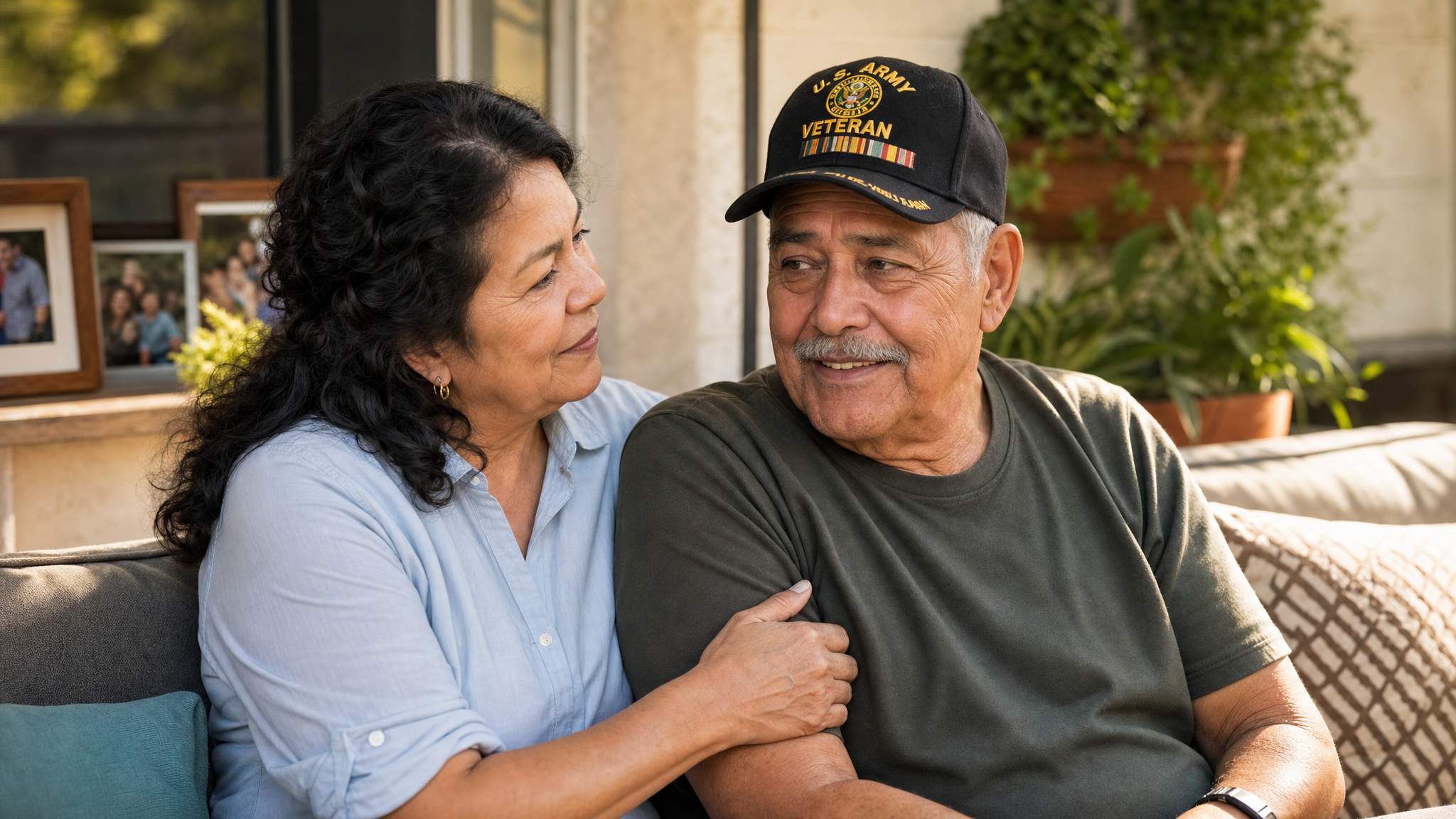
There’s a free calculator on this page - estimate the monthly caregiver stipend. No sign-up, no cost.
Who this is for
Somebody in your family is already doing this work - the driving, the pills, the getting him up at two in the morning. There is a VA program that pays that person a monthly stipend, covers her own health care, and gets her a break. It opened to Vietnam and Korea era families in 2022, and most of them still have not heard of it.
In plain language
What Comprehensive Assistance for Family Caregivers (PCAFC) covers
- A monthly stipend paid to the primary family caregiver, not to the veteran, and not taxed
- CHAMPVA health coverage for a primary caregiver who has no other health insurance
- At least 30 days a year of respite care so you can rest
- Caregiver training, a named Caregiver Support Coordinator, and mental-health services
- Travel, lodging, and per diem when you travel with the veteran for his care
- Up to two secondary caregivers approved as backup for the days you cannot be there
VA Caregiver Support Program (PGCSS & PCAFC)Official video - U.S. Department of Veterans Affairs - theSITREP
5 things most veterans aren't aware of
These apply to nearly every VA claim - and they change how much you get and when.
Your filing date sets your back pay
Benefits are generally paid back to the day you file - not the day you are approved. Filing an intent to file today can protect months, even years, of retroactive pay.
One condition can trigger others (secondary claims)
A service-connected condition that causes another - like sleep apnea from PTSD, or a bad knee from a bad hip - can be rated on its own. Each secondary condition adds to your rating.
A medical nexus is what wins the claim
The VA needs a documented link between your condition and your service. A clear nexus opinion is often the difference between an approval and a denial.
Accredited help is free to file an initial claim
By law, an accredited agent cannot charge a fee to prepare and file your original claim. If someone asks for money up front to file, that is a red flag.
A denial is not the end of the road
You have three appeal lanes - Higher-Level Review, a Supplemental Claim with new evidence, and the Board of Veterans Appeals. Many denials are overturned on review.
70%+
Single or combined rating the veteran must hold to qualify
6 months
Continuous in-person care he must need - not a temporary rough patch
62.5% / 100%
The two stipend levels, as a share of the local GS-4, Step 1 monthly rate
The full picture
Everything you need to know
Nothing hidden behind a click, and nothing you have to go looking for on another website. Here is the whole story in plain language - the facts and the figures first - so you can decide what fits your situation.
Key facts & current figures
- The veteran needs a single or combined service-connected rating of 70% or higher - one condition at 70, or several that add up to it.
- He must need in-person personal care for at least six continuous months - hands-on help with daily activities, or supervision and protection because of a cognitive or mental-health condition.
- The stipend is paid directly to the caregiver, every month, and it is not counted as taxable income.
- There is no single national amount. The VA uses the federal GS-4, Step 1 annual pay rate for the veteran's own locality, divided by 12 - then pays 62.5% of that at Level 1 and 100% at Level 2.
- Since October 1, 2022, PCAFC has been open to caregivers of veterans from every service era. If your family was told you were too old for it, that answer expired.
- Apply together on VA Form 10-10CG. One primary caregiver plus up to two secondary caregivers can be approved as backup.
General figures, current as of December 2025 and reviewed each year. Your exact amount depends on your situation - always confirm on va.gov.
What the veteran has to meet
- A single or combined service-connected rating of 70 percent or higher, from an injury or illness incurred or aggravated in the line of duty. Combined counts - it does not have to be one big condition.
- He must need in-person personal care services for at least six continuous months. A rough patch after surgery does not qualify; an ongoing decline does.
- He must be enrolled in VA health care and receiving ongoing care from a VA primary care team.
- He must be living at home, or be ready to go home once a caregiver is approved - this program exists to keep a veteran out of a facility.
What actually counts as "personal care"
- Hands-on help with activities of daily living - bathing, dressing, grooming, toileting, eating, or getting from the bed to the chair to the bathroom.
- Or supervision, protection, or instruction because of a cognitive condition, a traumatic brain injury, or a mental-health condition. He does not have to be physically helpless. Dementia and severe PTSD qualify on this ground, and families miss that constantly.
- The test is what he cannot safely do alone, not how many hours you happen to be in the house.
- Write it down before the assessment. Six weeks of notes on what you actually do each day will tell the story better than anything you say from memory in a stressful interview.
How the stipend is actually calculated
- Anyone who quotes you a flat national number is guessing. The VA starts with the federal GS-4, Step 1 annual pay rate set by the Office of Personnel Management (OPM) for the locality where the veteran lives.
- That annual rate is divided by 12 to get the full monthly rate for where you live, which is why the same care pays differently in a high-cost city than in a rural area - the locality adjustment is built into the GS-4 rate.
- A VA clinician then assigns a level. Level 1 pays 62.5% of that rate. Level 2 pays 100%. Level 2 is for a veteran who cannot be left to self-sustain in the community - continuous supervision, or hands-on help with three or more daily activities.
- The money is not taxable income, and it does not reduce the veteran's disability compensation or pension by a single dollar.
What comes with the stipend
- CHAMPVA health coverage for the caregiver if she has no other health insurance - real coverage in her own name, not the veteran's.
- At least 30 days of respite care a year so the caregiver can sleep, see her own doctor, or leave the house.
- Mental-health services and counseling for the caregiver, plus caregiver training and a named Caregiver Support Coordinator at the VA medical center.
- Travel, lodging, and per diem when you accompany the veteran to his care. Approved caregivers also get access to the VA's caregiver education programs at no cost.
Filing Form 10-10CG without tripping over it
- Both signatures are required. The veteran signs and the caregiver signs - one missing signature sends the whole thing back.
- File it online at va.gov, mail it to the 10-10CG Evidence Intake Center in Janesville, Wisconsin, or walk it into the caregiver support team at his VA medical center. Do not mail medical records with it - the VA pulls his records itself.
- Naming secondary caregivers on the same application costs you nothing and gives you legal backup for the weeks you get sick. Most families name nobody and regret it.
- After it is filed, expect a call, then an assessment - often a home visit. That assessment is the whole case. Have your notes, his medication list, and a plain description of a bad day ready.
Reassessment, and what to do if the answer is no
- PCAFC is reassessed, usually about once a year, or sooner if his condition changes. The level can go up. It can also come down, which is exactly why the first application has to describe the care honestly and completely.
- If the VA drops your level or discharges you from the program, ask for the decision and the reasoning in writing, then ask the Caregiver Support Program at the medical center how to request a review. A PCAFC decision is not automatically the end of it.
- If the veteran does not clear the 70% bar, file to raise his rating - and look hard at TDIU, secondary conditions, and anything the VA never rated. Many older veterans are underrated by 20 or 30 points.
- While you wait or appeal, General Caregiver Support Services and respite care are still open to you and have almost no requirements. Do not sit with nothing.
Estimate the monthly caregiver stipend
PCAFC stipend estimator
There is no flat national number - the VA builds the stipend from the GS-4, Step 1 annual pay rate for the veteran's own locality, divided by 12. Enter your locality's GS-4, Step 1 rate and pick the level of care to see a real, tax-free monthly estimate paid directly to the caregiver.
Your locality's GS-4, Step 1 annual rate
The VA builds the stipend from the federal GS-4, Step 1 annual pay rate for the OPM locality where the veteran lives, divided by 12. The number below is a rough national placeholder. Replace it with your locality's GS-4, Step 1 rate for a real estimate.
How much care does the veteran need?
A VA clinician assigns the level after an assessment. Pick the one closest to your situation to see the difference it makes.
Level 2 - estimated monthly stipend
$3,333/mo
About $40,000 a year, paid tax-free directly to the caregiver
$40,000 / 12 months x 100%
An estimate, not a promise. The VA uses the exact GS-4, Step 1 rate for the veteran's locality and a VA clinician assigns the level after an assessment. Confirm the current amount on va.gov.
This calculator is free. No sign-up, no catch.
Most people in this business hide tools like this behind a paywall or a sign-up form. We don’t. Use it as much as you need. And if you want a real accredited agent to look at your actual claim, we’re one call away — it’s free to talk, and free to file your claim.
Albert L. Thombs Jr. — VA-accredited claims agent (#45147), a disabled veteran with a team of advocates who do this every day.
The bigger picture for your family
100%
of the local GS-4, Step 1 monthly rate is what a Level 2 primary caregiver is paid every month - the VA takes the GS-4, Step 1 annual rate for the veteran's locality and divides it by 12, and the money is not taxed and does not reduce his compensation.
Two ways to move forward — both free
Not sure if this applies to you?
Ask our free assistant a few plain questions and get an honest read on what you and your family may qualify for, at no cost. It takes just a few minutes, and there is no sign-up and no obligation of any kind. You will get a clear, plain-language picture of where you stand and what might be worth filing. And if you would rather talk to a real person, an accredited agent is only a message away.
Have a question? Get free information
Ask a question, learn what you may be owed, or find out where you stand. Confidential, free, and no obligation to go any further.
Ready to hire us? Register
Decided you want us to work your claim? Registering is free — we match you with an accredited advocate and get you started. We cannot begin until you sign VA Form 21-22a, and fees, if any, are always disclosed up front.
Do not miss this
If your family was told you were too old for this program, that answer expired in 2022
PCAFC started out closed to older veterans. On October 1, 2022 it opened to caregivers of veterans from every service era - Vietnam, Korea, and everyone in between. A great many families were told no years ago, filed it away, and never went back.
The other thing families get wrong: the veteran does not have to be physically helpless. Needing supervision, protection, or instruction because of dementia, a traumatic brain injury, or severe PTSD qualifies on its own. That is how a veteran who can still walk and dress himself is approved.
Combined counts
It is a single OR combined 70% rating. Several conditions that add up to 70 qualify exactly the same as one big one.
Name your backup
Up to two secondary caregivers can be approved alongside you. Most families name nobody, then have no cover the week they get sick.
A clear path forward
Your step-by-step action plan
No rush and no pressure - but a little order helps. Applying is always free.
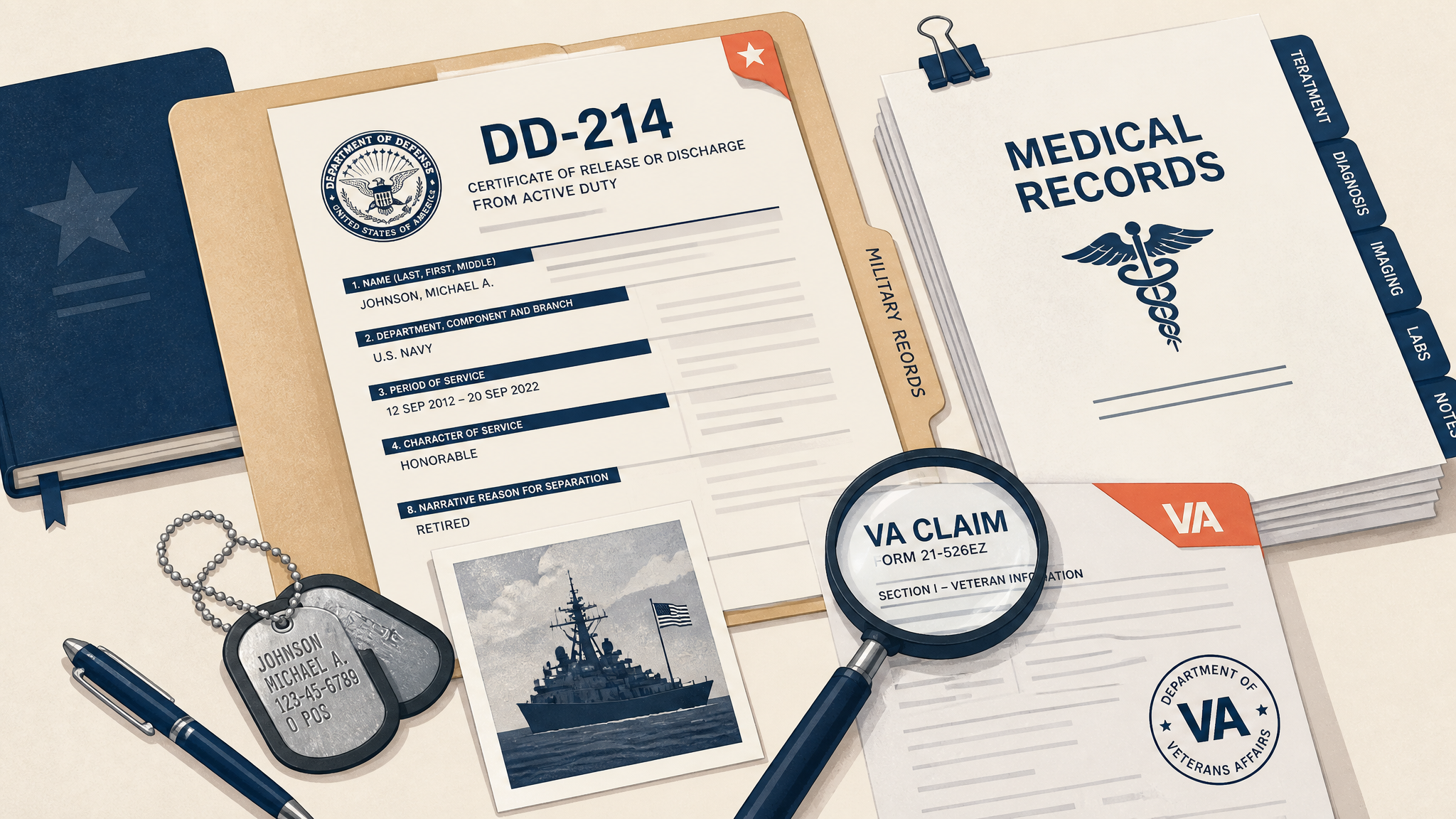
FIG. 01 - Gather your paperwork
First
Check the 70% number
Pull his rating decision and confirm the single or combined figure is 70% or higher. If he is short, look at TDIU, secondary conditions, and anything the VA never rated - underrating is common in older claims.
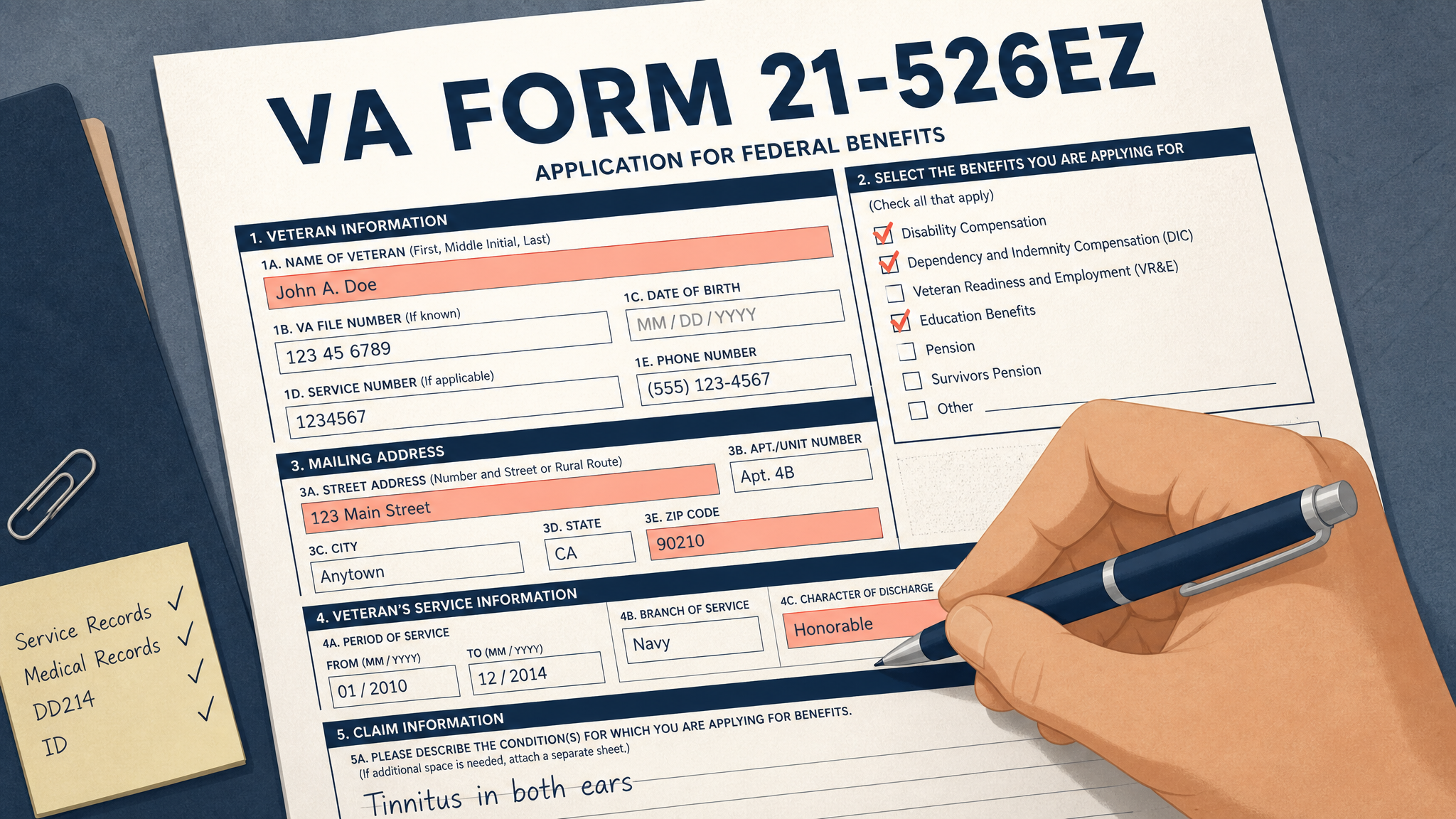
FIG. 02 - Fill out the form
Before you file
Write down what you actually do
Keep six weeks of plain notes: bathing, dressing, medications, night wakings, supervision. The assessment is the whole case, and memory under stress is a poor witness.
FIG. 03 - File the claim
File it
Submit VA Form 10-10CG together
The veteran and the caregiver both sign. File online at va.gov, mail it to the Evidence Intake Center, or hand it to the caregiver support team. Do not attach medical records. Name your secondary caregivers on the same form.
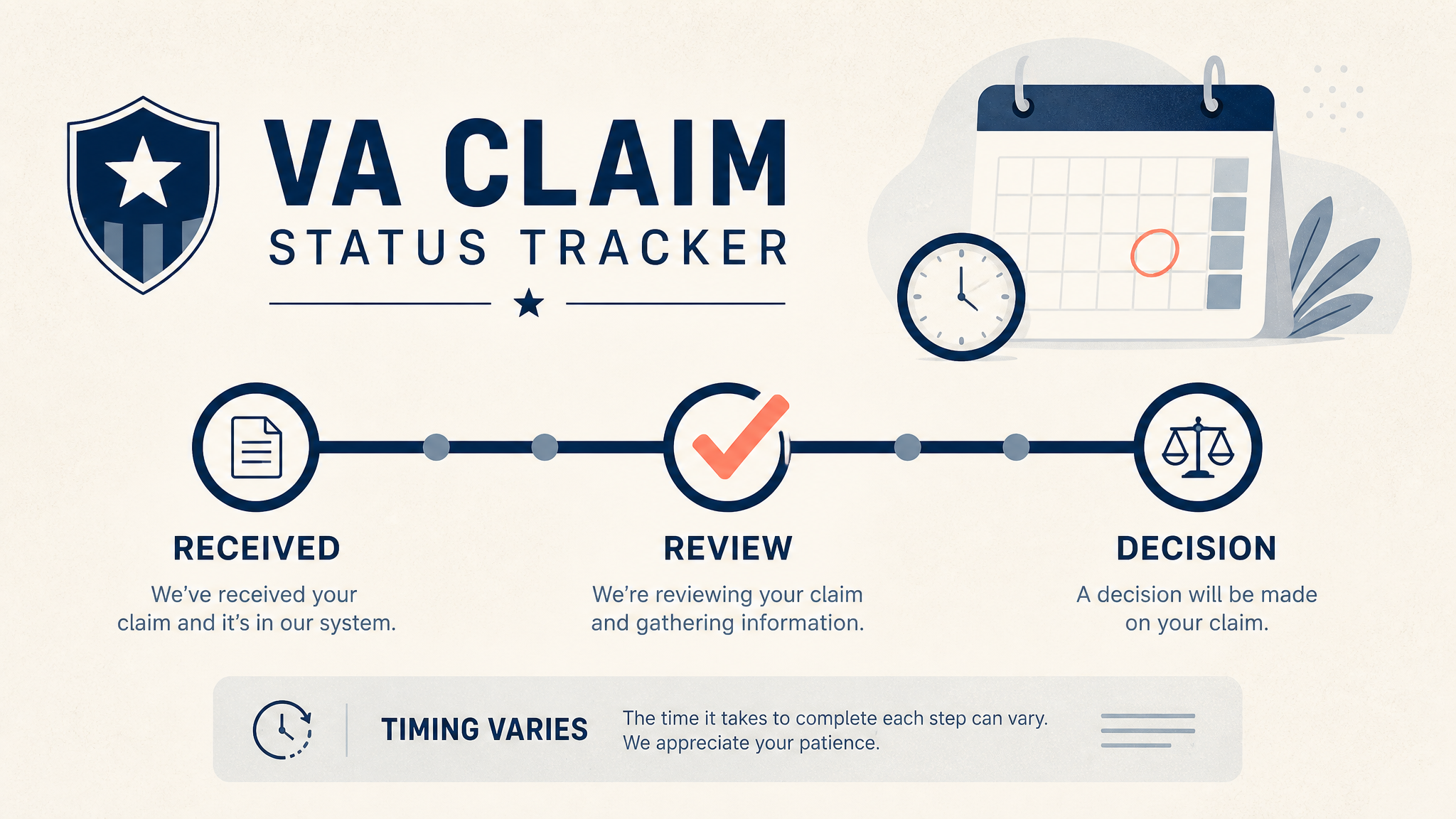
FIG. 04 - After you file
After
Prepare for the assessment
Expect a call and usually a home visit. Have your notes, his medication list, and an honest description of a bad day ready - the level they assign is what sets the stipend.
Who to call & where to go
These are free, official VA lines. Have your Social Security number handy when you call.
MyVA411 - Main VA Line
Not sure who to call? Start here. One number for anything VA - they route you to the right office.
Rather have us handle it?
No phone tag, no hold music. Call our office and a real, VA-accredited person walks you through it - start to finish.
702-992-4883Download the forms
Not sure where to start?
The veteran and the caregiver apply together on VA Form 10-10CG. File it online at va.gov, mail it to the Evidence Intake Center, or hand it to the caregiver support team at his VA medical center. Do not attach medical records. A VA team then contacts you, assesses the veteran's needs and the care you actually provide, and that assessment sets the level - which sets the stipend.
More support for caregivers
These often go hand in hand - tap any card to learn more.



Free information — get a free benefit review
Tell us how to reach you and an accredited team member will help you understand this benefit and claim everything you have earned. No cost, no obligation.
Ready to hire us? Register with us
For veterans who’ve decided they want us on their claim — registering is free too, and it does not make you our client or obligate you to anything. Here is exactly how it works:
- You register. This simply starts the conversation — you are not our client yet, and you owe us nothing.
- You sign and return VA Form 21-22a. It appoints us as your accredited representative and gives us access to your VA file.
- Once we have your signed 21-22a and access to your case, we verify everything is in order.
It involves the registration form and signing VA Form 21-22a — by law we can’t accept your claim, work on it, or contact the VA for you until that power of attorney is signed. You decide whether to move forward.
Answers, in plain language
Common questions about Comprehensive Assistance for Family Caregivers (PCAFC)
What is Comprehensive Assistance for Family Caregivers (PCAFC)?
The VA program that pays a monthly, tax-free stipend directly to the family caregiver of a seriously disabled veteran - plus training, counseling, respite, travel pay, and health coverage for the caregiver herself.
Who qualifies for Comprehensive Assistance for Family Caregivers (PCAFC)?
This benefit is generally for: Primary family caregiver. A monthly stipend paid to the primary family caregiver, not to the veteran, and not taxed CHAMPVA health coverage for a primary caregiver who has no other health insurance
How do I apply for Comprehensive Assistance for Family Caregivers (PCAFC)?
The veteran and the caregiver apply together on VA Form 10-10CG. File it online at va.gov, mail it to the Evidence Intake Center, or hand it to the caregiver support team at his VA medical center. Do not attach medical records. A VA team then contacts you, assesses the veteran's needs and the care you actually provide, and that assessment sets the level - which sets the stipend.
What does it cost to get help with Comprehensive Assistance for Family Caregivers (PCAFC), and are you VA-accredited?
This is a federal VA program, and it is strict. The Aging Veteran helps you understand the rules and prepare the application at no cost - there is never a fee for an initial claim. It is free to talk with us, and no one may charge you to file a first-time VA claim. The Aging Veteran is led by Albert L. Thombs Jr., a VA-accredited claims agent (accreditation #45147) and disabled veteran; any appeal work is handled on a no-fee-unless-you-win basis. We are an independent accredited practice and are not affiliated with, or endorsed by, the U.S. Department of Veterans Affairs.